Energy-Efficient Vinyl Siding Materials List & Insulation Guide
Maximize your home's thermal envelope with our comprehensive energy-efficient vinyl siding materials list, featuring R-values, costs, and assembly specs.

The Thermal Reality of Standard Vinyl Siding
Standard hollow-back vinyl siding provides an R-value of approximately 0.61. In the context of modern building science and updated International Energy Conservation Code (IECC) mandates, this is essentially a thermal sieve. When wind washes behind the panels, it strips heat from the sheathing, rendering the wall assembly highly susceptible to thermal bridging at the wood studs. To transform vinyl from a mere weather shield into a high-performance thermal barrier, contractors and homeowners must rethink the entire exterior envelope. This requires a specialized vinyl siding materials list that integrates continuous insulation (ci), advanced weather-resistive barriers (WRB), and laminated insulated panels.
According to the U.S. Department of Energy, adding continuous insulation and upgrading to insulated siding can reduce exterior wall heat loss by up to 20%, significantly lowering HVAC loads in extreme climate zones. Below is the exact material specification list required to build an energy-efficient vinyl cladding system in 2026.
The Core Vinyl Siding Materials List for Thermal Performance
1. Insulated Vinyl Siding Panels
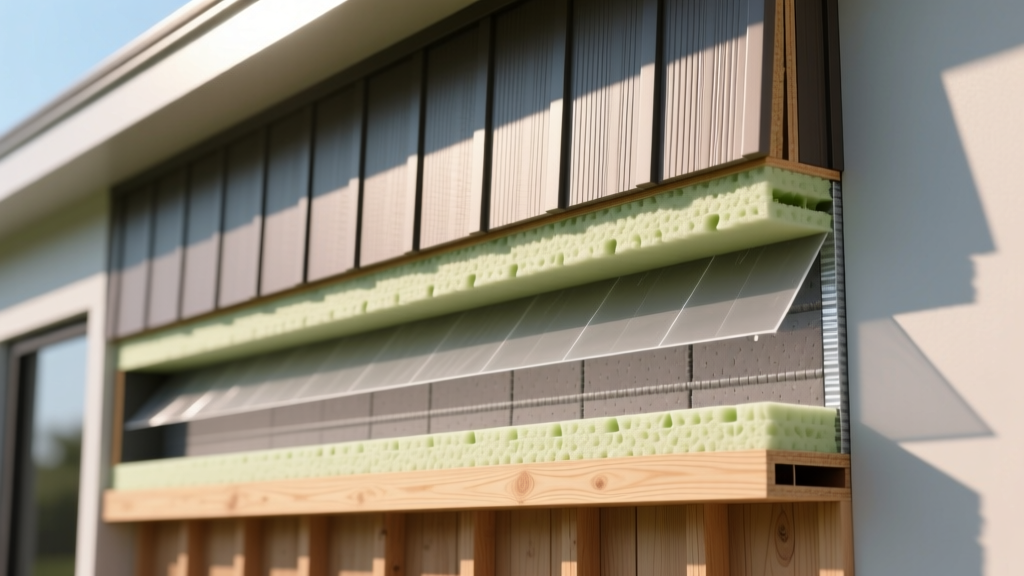
Unlike standard vinyl, insulated siding features a contoured Expanded Polystyrene (EPS) foam backing permanently laminated to the back of the panel. This foam locks the panel to the wall, eliminating the wind-washing gap and adding measurable R-value.
- Alside Prodigy: Features a 1.5-inch thick EPS backing, delivering an industry-leading R-value of 3.3. Includes a built-in 3/4-inch nailing hem for secure fastening over thick continuous insulation.
- CertainTeed CedarBoards: Offers an R-value ranging from 2.0 to 3.0 depending on the profile. Excellent for replicating wood clapboard while providing a rigid, impact-resistant thermal break.
- Mastic Quest: Delivers an R-value of 3.3 with a premium thickness that resists thermal expansion and contraction warping.
2. Continuous Insulation (ci) Boards
To meet modern energy codes in Climate Zones 4 and higher, rigid continuous insulation must be installed over the sheathing to break the thermal bridge of the wood framing.
- Extruded Polystyrene (XPS): Typically rated at R-5.0 per inch. Brands like Owens Corning FOAMULAR 250 provide high compressive strength (25 PSI), which is critical for supporting the mechanical load of the siding and resisting impact.
- Polyisocyanurate (Polyiso): Rated at R-6.0 to R-6.5 per inch. While offering the highest R-value per inch, polyiso must be carefully detailed, as its foil facers can act as an exterior vapor retarder, potentially trapping moisture inside the wall cavity in cold climates.
3. Advanced Weather-Resistive Barriers (WRB)
The WRB manages bulk water and allows water vapor to escape. When installing over continuous insulation, the WRB must be highly breathable.
- DuPont Tyvek HomeWrap: The industry standard with a perm rating of 58, allowing excellent outward drying.
- Henry Blueskin VP100: A self-adhered, fluid-applied membrane that seals around fastener penetrations, providing superior air-sealing compared to mechanically fastened housewraps.
4. Furring Strips & Rainscreen Components
While insulated vinyl has a built-in contour that allows some drainage, adding a dedicated rainscreen gap is the ultimate defense against moisture.
- Cor-A-Vent SturdiStrips: Engineered plastic furring strips that create a 3/8-inch ventilation cavity, promoting capillary break and convective drying.
- 1x3 Pressure-Treated Wood Furring: A cost-effective alternative, installed vertically directly over the studs to allow horizontal drainage channels.
5. Specialized Fasteners
Standard 1.5-inch nails will not penetrate through insulated siding, continuous insulation, and sheathing into the studs.
- Hot-Dipped Galvanized or Aluminum Roofing Nails: Minimum 5/16-inch head diameter and 1/8-inch shank. Length must be calculated as: Siding Thickness (0.5'') + ci Thickness (1.0'') + Sheathing (0.5'') + Stud Penetration (0.75'') = Minimum 2.75-inch nail length.
2026 Material Cost & R-Value Assembly Matrix
The following table outlines the material costs and thermal contributions for a high-performance vinyl wall assembly. Labor costs are excluded, as they vary wildly by regional market and existing wall conditions.
| Material Component | Product Example | R-Value Contribution | Est. Material Cost (per sq. ft.) |
|---|---|---|---|
| Insulated Vinyl Panel | Alside Prodigy | R-3.3 | $3.80 - $5.20 |
| Continuous Insulation | 1'' XPS Foam Board | R-5.0 | $1.20 - $1.60 |
| WRB Membrane | Tyvek HomeWrap | N/A (Air/Moisture) | $0.45 - $0.65 |
| Rainscreen Furring | Cor-A-Vent Strips | N/A (Ventilation) | $0.80 - $1.10 |
| Fasteners & Trim | 3'' Galv. Nails, J-Channels | N/A | $0.75 - $1.00 |
| Total Assembly | Complete System | R-8.3 (Exterior Only) | $7.00 - $9.55 |
For context, the Vinyl Siding Institute notes that while insulated siding increases upfront material costs by 20-30% compared to hollow-back vinyl, the reduction in HVAC energy consumption and the elimination of future exterior painting yields a strong lifecycle ROI.
Critical Installation Edge Cases & Failure Modes
Even the best materials on your vinyl siding materials list will fail if the physics of the wall assembly are ignored. Watch for these specific failure modes:
Vinyl expands and contracts significantly with temperature swings (up to 5/8 inch per 12-foot panel). Fasteners must be driven leaving a 1/32-inch gap between the nail head and the nailing hem. If driven flush or tight, the insulated panels will buckle, warp, and tear when temperatures drop, compromising the thermal seal.
If you use foil-faced Polyiso continuous insulation in a cold climate (Zone 5+), the exterior foil acts as a Class I vapor retarder. During winter, interior moisture drives outward, hits the cold foil, and condenses inside the wall cavity. Always use unfaced XPS or specialized permeable polyiso (like Huber ZIP-R) to allow outward drying, or consult the EPA ENERGY STAR insulation guidelines for climate-specific vapor retarder placement.
Decision Framework: Upgrading Your Existing Siding
Use this framework to determine which materials from the list above are necessary for your specific project:
- Assess the Existing Cavity: If your wall cavities already contain dense-pack cellulose or closed-cell spray foam (R-13 to R-21), you may skip the rigid XPS continuous insulation to save costs, relying solely on the R-3.3 of the insulated vinyl panels to break the stud thermal bridge.
- Evaluate the Sheathing: If removing old siding reveals degraded OSB or plywood, you must install a fluid-applied WRB (like Henry Blueskin) rather than a traditional housewrap, as it will seal the gaps and micro-cracks in the old sheathing.
- Calculate the Fastener Length: Never guess on nail size. Measure the exact depth of your continuous insulation and nailing hem. A fastener that misses the structural stud and only bites into the sheathing will result in siding blow-offs during high-wind events.
By treating the exterior cladding as a unified, multi-layered thermal system rather than just a cosmetic finish, you can leverage this vinyl siding materials list to achieve a draft-free, highly insulated building envelope that performs reliably for decades.
Written by
Sarah WhitfieldSarah Whitfield is a chartered quantity surveyor (MRICS) and construction cost analyst with 15 years of experience in material pricing, procurement strategy, and project budgeting. She earned her degree in Construction Management from the University of Reading (UK) and has worked on projects ranging from $2M custom homes to $180M mixed-use developments across North America and Europe. Sarah currently leads cost estimating for BuildMat Insight, maintaining a proprietary database of 4,000+ material price points updated quarterly. She is a frequent contributor to RSMeans cost data panels and has presented at the International Cost Engineering Council (ICEC) congress. Based in Denver, CO, Sarah is an avid trail runner and volunteer mentor for Women in Construction.
More from Sarah Whitfield
View all
Wood & Lumber
What Are the Different Types of Wood? A Builder's Guide
Compare structural softwoods, finish hardwoods, and engineered lumber. Analyze Janka ratings, MOE values, and 2026 pricing for construction.
Aug 4, 2026

Walls & Panels
Steel Framing vs Wood Framing: Corrosion and Moisture Defense
Compare steel framing vs wood framing for moisture resistance. Learn about galvanized coatings, condensation risks, and corrosion protection strategies.
Jul 21, 2026

Stone & Masonry
How to Cut Stone Veneer: Wet Saw vs Grinder Comparison
Compare the best tools for cutting stone veneer. We review wet saws, angle grinders, and chop saws to help you achieve clean, chip-free cuts.
Jul 21, 2026