Weather Resistance & the Cost to Paint Commercial Building Exterior
Analyze how climate zones, UV exposure, and moisture dictate surface prep and the true cost to paint commercial building exterior in 2026.

The Hidden Variable in Commercial Painting: Weather Exposure
When facility managers and property owners budget for exterior maintenance, the baseline metric is typically a flat price per square foot. However, the true cost to paint commercial building exterior facades is rarely determined by square footage alone. The single most significant variable driving both initial expenditure and long-term lifecycle costs is local weather exposure. Ultraviolet (UV) degradation, thermal cycling, salt spray, and freeze-thaw dynamics dictate the intensity of surface preparation required and the specific chemical formulation of the coating system.
Ignoring climatic variables during the specification phase leads to premature coating failure, often within 24 to 36 months. According to the Whole Building Design Guide (WBDG), improper surface preparation and material selection for specific environmental exposures account for over 75% of commercial coating failures. This guide breaks down how weather resistance requirements fundamentally alter project pricing, material selection, and preparation protocols.
Climate Zones and Their Impact on Surface Preparation Costs
Surface preparation is the most labor-intensive phase of any commercial painting project. In 2026, labor rates for certified commercial painters average between $65 and $95 per hour, making prep work the primary cost driver. Harsh weather environments require aggressive preparation standards that drastically increase the baseline cost to paint commercial building exterior surfaces.
| Climate Zone | Primary Weather Threat | Required Prep Standard | Cost Multiplier |
|---|---|---|---|
| Coastal / Marine | Chloride (salt) intrusion, high humidity | SSPC-SP3 (Power Tool) + Chloride extraction | +35% to +45% |
| High UV / Desert | Chalking, thermal expansion, UV degradation | High-pressure wash (3000 PSI) + chalk removal | +15% to +20% |
| Freeze-Thaw / Northern | Efflorescence, masonry spalling, ice dams | Acid etching, crack routing, silane sealing | +30% to +40% |
| Industrial / Urban | Acid rain, airborne pollutants, soot | SSPC-SP1 (Solvent Cleaning) + alkaline wash | +20% to +25% |
In coastal zones, simply power washing is insufficient. Salt deposits left in the pores of concrete masonry units (CMU) or metal cladding will cause osmotic blistering once the new coating is applied. Contractors must use specialized chloride-removal agents and test the surface using Bresle patch methods (per ISO 8502-6) before priming, adding significant time and material costs to the project.
Coating Chemistry: Matching the Product to the Climate
The materials themselves represent 20% to 30% of the total project cost. Selecting a coating based purely on initial price rather than weather-resistant chemistry is a false economy. Below is an analysis of the primary commercial coating systems and their weather-resistant properties.
100% Acrylic Elastomerics (Best for Freeze-Thaw & Masonry)
Products like Tnemec Series 156 Enviro-Crete or Sherwin-Williams Sher-Cryl offer high elongation properties (up to 300% at 70°F). This allows the coating to bridge hairline cracks in stucco and CMU that expand and contract during freeze-thaw cycles. 2026 Installed Cost: $2.80 to $4.50 per square foot. While highly resistant to moisture intrusion, standard acrylics will chalk and degrade rapidly in high-UV desert environments.
Aliphatic Polyurethanes (Best for Industrial & High-Traffic)
Polyurethanes provide exceptional resistance to chemical splash, acid rain, and physical abrasion. They are typically used as a topcoat over epoxy primers on structural steel and metal cladding. They retain color and gloss far better than epoxies when exposed to UV light. 2026 Installed Cost: $4.00 to $6.50 per square foot.
PVDF Fluoropolymers (Best for Extreme UV & Coastal)
Polyvinylidene fluoride (PVDF) coatings, such as those utilizing Kynar 500 resins, represent the pinnacle of weather resistance. The carbon-fluorine bond is virtually impervious to UV degradation, salt spray, and chemical attack. These are typically factory-baked onto metal panels but field-applied PVDF systems (like PPG Coraflon) are available for commercial retrofits. 2026 Installed Cost: $7.50 to $11.00 per square foot. The high initial cost to paint commercial building exterior with PVDF is offset by a 20- to 30-year lifecycle without repainting.
"Specifying a coating system without referencing the local ASHRAE climate zone and UV index is malpractice. A premium polyurethane will fail in a marine environment if the underlying zinc-rich primer was not applied to the correct mil thickness." — Association for Materials Protection and Performance (AMPP) Guidelines
Calculating the True Cost to Paint Commercial Building Exterior
To build an accurate budget, facility managers must move beyond square-foot estimates and use a component-based calculation model. The true cost is the sum of access, preparation, materials, and environmental compliance.
- Access and Containment (15-25%): Boom lifts, swing stages, and scaffolding. In high-wind coastal areas, scaffolding must be heavily tied and wrapped, increasing rental and setup costs by up to 30%.
- Surface Preparation (35-50%): As dictated by the climate zone matrix above. Includes power washing, abrasive blasting, chemical treatments, and masking.
- Primer and Topcoat Materials (15-20%): Varies wildly by chemistry (Acrylic vs. PVDF).
- Application Labor (15-25%): Airless spraying, back-rolling, and cutting in. High-humidity environments require strict monitoring of the dew point; painting cannot occur if the surface temperature is within 5°F of the dew point, which can cause project delays and increased labor holding costs.
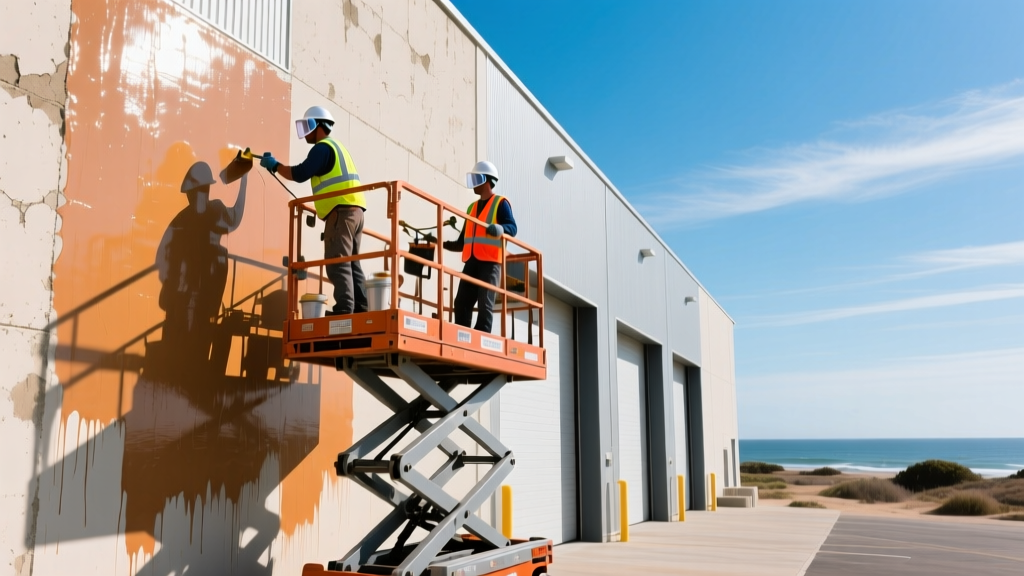
Real-World Failure Modes: When Cheap Paint Meets Harsh Weather
⚠️ Critical Warning: Osmotic Blistering in Marine Environments
Applying a standard acrylic masonry paint over CMU blocks in a coastal environment without a breathable silane/siloxane water repellent primer is a catastrophic error. Salt trapped inside the masonry draws ambient moisture through the coating via osmosis. Within one summer season, the facade will develop thousands of fluid-filled blisters. Remediation requires complete mechanical removal of the coating (often via dry-ice blasting to avoid damaging the masonry), pushing the remediation cost to $8.00 - $12.00 per square foot—triple the cost of doing it correctly the first time.
Another common failure is thermal delamination on dark-colored metal cladding in desert climates. Dark pigments absorb heat, causing metal panels to reach surface temperatures exceeding 160°F (71°C). If the coating system lacks sufficient thermal shock resistance, the rapid cooling during desert nights causes the metal to contract faster than the paint film, resulting in micro-cracking and eventual delamination. Always specify coatings tested to ASTM D6944 for thermal shock resistance in high-diurnal temperature zones.
Expert Specification Framework for 2026
To optimize the cost to paint commercial building exterior assets while ensuring maximum weather resistance, follow this specification framework:
- Conduct a Climate-Specific Substrate Audit: Use a moisture meter to check for trapped water in EIFS (Exterior Insulation and Finish Systems) and stucco. Do not coat over substrates with moisture content above 12%.
- Mandate Adhesion Testing: Require the contractor to perform ASTM D4541 (Pull-off adhesion) tests on mock-up areas before full-scale application begins. This verifies that the specified primer is chemically bonding to the weathered substrate.
- Specify Dry Film Thickness (DFT), Not Wet Film: Weather resistance is directly tied to DFT. A coating applied too thin will lack the physical mass to block UV and moisture. Require third-party inspection using magnetic or ultrasonic DFT gauges (per SSPC-PA 2) to ensure the manufacturer's exact mil requirements are met.
- Factor in VOC Regulations: In 2026, strict Volatile Organic Compound (VOC) limits in states like California (SCAQMD Rule 1113) and the Northeast (Ozone Transport Commission) mean that high-performance solvent-based polyurethanes may require expensive air-scrubbing containment or force a switch to advanced waterborne alternatives, impacting both material and compliance costs.
By aligning coating chemistry and preparation protocols with the specific weather threats of the building's geographic location, property owners can transform exterior painting from a recurring, high-maintenance expense into a long-term, weather-resistant asset protection strategy.
Written by
Sarah WhitfieldSarah Whitfield is a chartered quantity surveyor (MRICS) and construction cost analyst with 15 years of experience in material pricing, procurement strategy, and project budgeting. She earned her degree in Construction Management from the University of Reading (UK) and has worked on projects ranging from $2M custom homes to $180M mixed-use developments across North America and Europe. Sarah currently leads cost estimating for BuildMat Insight, maintaining a proprietary database of 4,000+ material price points updated quarterly. She is a frequent contributor to RSMeans cost data panels and has presented at the International Cost Engineering Council (ICEC) congress. Based in Denver, CO, Sarah is an avid trail runner and volunteer mentor for Women in Construction.
More from Sarah Whitfield
View all
Wood & Lumber
What Are the Different Types of Wood? A Builder's Guide
Compare structural softwoods, finish hardwoods, and engineered lumber. Analyze Janka ratings, MOE values, and 2026 pricing for construction.
Aug 4, 2026

Walls & Panels
Steel Framing vs Wood Framing: Corrosion and Moisture Defense
Compare steel framing vs wood framing for moisture resistance. Learn about galvanized coatings, condensation risks, and corrosion protection strategies.
Jul 21, 2026

Stone & Masonry
How to Cut Stone Veneer: Wet Saw vs Grinder Comparison
Compare the best tools for cutting stone veneer. We review wet saws, angle grinders, and chop saws to help you achieve clean, chip-free cuts.
Jul 21, 2026