How Performance Specs Drive Your 2026 Siding Replacement Cost
Discover how ASTM ratings, wind resistance, and fire specs impact your 2026 siding replacement cost. Compare material tiers and hidden upgrade fees.
The Hidden Cost of Performance: Beyond Base Material Pricing
When homeowners research siding replacement cost, they typically focus on the base price per square foot of the material. However, in 2026, the true financial variable is the performance specification tier you select. Upgrading from standard builder-grade materials to high-performance, code-exceeding assemblies can increase your total project budget by 25% to 60%. Understanding how ASTM standards, wind load ratings, and fire classifications dictate pricing is essential for accurately forecasting your siding replacement cost and ensuring your investment aligns with your regional climate risks.
Performance Tiers and Their Impact on Siding Replacement Cost
Manufacturers engineer siding products to meet specific baseline building codes, but premium tiers are tested against extreme environmental stressors. These rigorous testing protocols require thicker substrates, advanced chemical treatments, and proprietary interlocking mechanisms, all of which scale the manufacturing and installation costs.
Vinyl Siding: ASTM D3679 and Wind Load Ratings
Standard vinyl siding is manufactured to meet ASTM D3679, typically featuring a panel thickness of 0.040 inches and a wind load rating of 90 to 110 mph. In 2026, standard hollow-back vinyl installed costs between $6.50 and $9.00 per square foot.
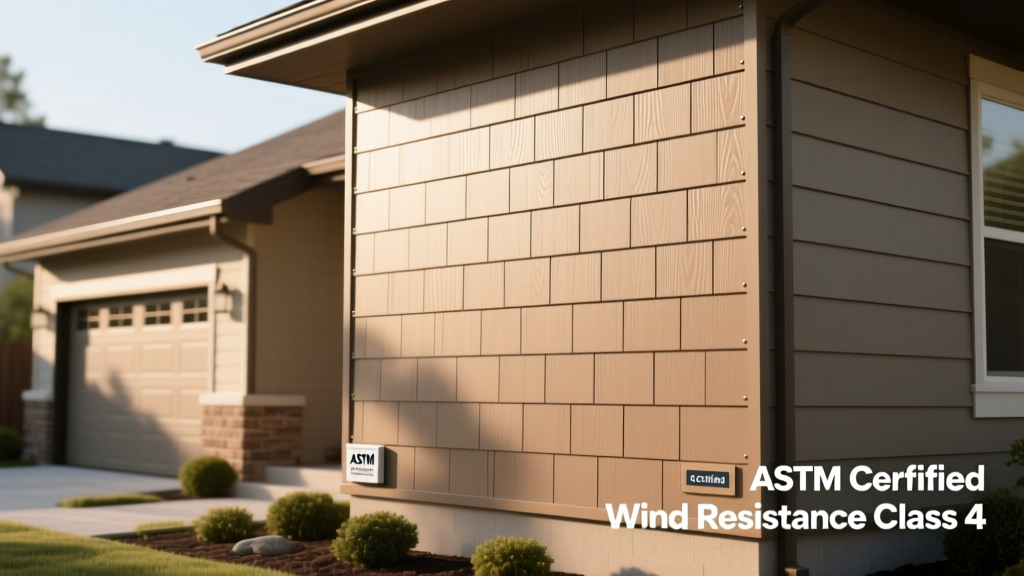
For coastal regions or tornado-prone corridors, homeowners must look at high-wind rated vinyl. These panels boast a thickness of 0.044 to 0.055 inches, reinforced double-hem nail flanges, and interlocking designs tested to withstand 150+ mph winds. Many of these premium lines carry a Miami-Dade County NOA, which is the gold standard for impact and wind resistance. The material cost for high-wind vinyl jumps to $9.50 to $13.00 per square foot, fundamentally altering the baseline siding replacement cost.
Fiber Cement: Fire Ratings and Hail Impact Resistance
Fiber cement siding, governed by ASTM C1186, is inherently non-combustible and carries an ASTM E84 Class A fire rating. Standard lap siding (such as traditional 5/16-inch thick profiles) installs for $10.00 to $14.00 per square foot. However, in Wildland-Urban Interface (WUI) zones, local fire marshals often require a complete assembly rating, not just a material rating.
Achieving a 1-hour or 2-hour fire-resistance rating requires pairing the fiber cement with specific fire-rated sheathing, mineral wool cavity insulation, and specialized fire-blocking flashing at all penetrations. Furthermore, upgrading to thicker architectural panels (up to 7/16 inch) to achieve a UL 2218 Class 4 hail impact rating adds significant weight. This weight requires heavier structural fastening and increases labor time, pushing the fully installed cost to $15.00 to $21.00 per square foot.
2026 Cost Matrix: Standard vs. High-Performance Upgrades
The table below illustrates the financial delta between standard code-minimum siding and high-performance upgrades across the most common exterior materials in 2026.
| Material Type | Standard Spec Cost (Sq. Ft.) | High-Perf Cost (Sq. Ft.) | Key Specification Upgrade |
|---|---|---|---|
| Vinyl | $6.50 - $9.00 | $9.50 - $13.00 | 0.055' thickness, 150+ mph wind rating |
| Fiber Cement | $10.00 - $14.00 | $15.00 - $21.00 | UL 2218 Class 4 impact, 1-hour fire assembly |
| Steel / Metal | $11.00 - $15.00 | $17.00 - $24.00 | 24-gauge to 16-gauge, hidden fastener clips |
| Engineered Wood | $8.00 - $12.00 | $13.00 - $17.00 | Fungal/moisture resistance, extended substrate warranty |
Insulation and Energy Specs: The R-Value Premium
The thermal performance of your exterior cladding is a major driver of your siding replacement cost. Standard hollow-back siding offers virtually zero insulating value (R-0.1 to R-0.2). According to the U.S. Department of Energy's Building America Solution Center, adding continuous exterior insulation is critical for modern building envelope efficiency.
Insulated vinyl siding features a custom-contoured Expanded Polystyrene (EPS) foam backing permanently laminated to the panel. This upgrades the siding's R-value to between R-2.0 and R-5.0, depending on the profile depth. While the material cost increases by $2.50 to $4.50 per square foot, the hidden savings emerge in labor and ancillary materials: insulated siding panels are wider and longer, require fewer cuts, and often eliminate the need for a separate fan-fold underlayment.
Decision Framework: When to Pay for Higher Energy Specs
- Climate Zones 5 and Higher (Northern US): The premium for insulated siding is easily justified. The EPS backing prevents thermal bridging through the wall studs, reducing winter heat loss and preventing interior condensation.
- Climate Zones 1-3 (Southern US): Focus your budget on radiant barriers and high-reflectivity pigments rather than thick EPS insulation. Light-colored, solar-reflective fiber cement or metal siding will yield a better ROI by reducing cooling loads.
- Historic Renovations: If you cannot add exterior rigid foam due to historic district trim-line restrictions, insulated siding provides a code-compliant way to boost R-value without altering the roofline or window casings.
Labor and Installation Variables Tied to Performance
High-performance siding demands high-performance installation. The Insurance Institute for Business & Home Safety (IBHS) FORTIFIED Home standard dictates that material ratings are void if the fastening schedule does not match the engineered specifications. This directly inflates the labor portion of your siding replacement cost.
Standard siding is often installed with smooth-shank electro-galvanized nails. High-wind and heavy-material specs (like fiber cement or thick metal) require hot-dipped galvanized or stainless steel ring-shank nails. Ring-shank nails increase withdrawal resistance by up to 300%, but they cost three times more per pound and require pneumatic coil nailers calibrated to precise depths to avoid fracturing the siding face.
Furthermore, high-performance assemblies require advanced weather-resistive barriers (WRB). Upgrading from standard #15 felt paper to a drainable housewrap (like Tyvek DrainWrap or HydroGap) adds $0.75 to $1.25 per square foot in materials and requires meticulous tape-sealing at all seams and penetrations, adding 10% to 15% to the overall labor timeline.
Wildfire Zones and the Cost of Fire-Resistant Assemblies
For homes in California, Colorado, and other wildfire-prone states, the National Fire Protection Association (NFPA) Firewise guidelines and local WUI codes mandate strict exterior material standards. Standard vinyl siding will melt and expose the combustible sheathing underneath, failing WUI inspections.
To meet WUI codes, homeowners must install non-combustible siding (fiber cement, stucco, or steel) extending all the way to the ground, with a 6-inch non-combustible clearance at the base. The siding replacement cost in these zones must also factor in the replacement of combustible wood trim, fascia, and soffits with composite or metal alternatives, as well as the installation of 1/8-inch metal mesh over all soffit vents to prevent ember intrusion. This holistic approach to fire-rated cladding can increase the total exterior envelope replacement cost by 40% compared to a standard cosmetic siding swap.
Frequently Asked Questions on Performance-Based Pricing
Does homeowners insurance cover the premium for high-wind rated siding?
Standard insurance policies will only pay the 'Actual Cash Value' or 'Replacement Cost' for standard builder-grade materials. However, if you upgrade to IBHS FORTIFIED-rated high-wind siding, many insurers in coastal states offer premium discounts of 10% to 30% on your annual windstorm policy. Some states also offer 'code upgrade' or 'ordinance and law' coverage riders that will pay the difference between standard and high-performance materials if your home is destroyed by a named storm.
Are thicker vinyl panels always better for impact resistance?
Not necessarily. While a 0.055-inch panel is more rigid and resists wind-load bowing better than a 0.040-inch panel, extreme thickness without adequate impact modifiers can make the vinyl brittle in freezing temperatures. High-performance vinyl relies on a precise blend of titanium dioxide (for UV resistance) and acrylic impact modifiers. Always verify the ASTM D4226 impact test results rather than relying solely on the physical thickness of the panel.
How do I verify the performance specs of my contractor's materials?
Require your contractor to provide the manufacturer's specific Product Approval Data Sheet or Miami-Dade NOA document before signing the contract. Verify that the fastening schedule, WRB brand, and flashing details listed in the contract exactly match the specifications outlined in the manufacturer's installation manual. Deviating from these specs to save on the siding replacement cost will void the material warranty and compromise the structural rating.