Vinyl Siding Materials Cost Breakdown: 2026 Price Guide
Explore the complete 2026 cost breakdown for vinyl siding materials. Compare prices for insulated, standard, and premium profiles per square foot.

The True Cost of Vinyl Siding Materials in 2026
Pricing for polyvinyl chloride (PVC) extrusion has stabilized entering 2026 following the supply chain fluctuations of the early 2020s. However, the cost of vinyl siding materials is no longer a single metric. The gap between builder-grade hollow-back panels and architectural-grade insulated profiles has widened significantly. When budgeting for an exterior envelope replacement, contractors and homeowners must look beyond the base per-square price of the siding panels and account for the complete material ecosystem, including structural accessories, weather barriers, and profile-specific waste factors.
2026 Quick Material Cost Baseline (Per Square Foot)
- Builder-Grade Hollow-Back (0.040"): $2.50 – $3.75
- Mid-Grade Standard Lap (0.044"): $3.80 – $5.20
- Premium Insulated Vinyl (0.046"+): $5.50 – $8.90
- Architectural Shakes & Board/Batten: $6.50 – $11.00
- Complete Accessory & Trim Package: Add 18% – 25% to base panel cost
Note: These figures represent materials only, excluding labor, scaffolding, and old siding tear-off/disposal fees.
Material Tiers, Thickness, and Pricing Matrix
The primary driver of vinyl siding material cost is panel thickness, measured in mils (thousandths of an inch). The Vinyl Siding Institute (VSI) and ASTM International standard D3679 dictate that rigid PVC siding must meet a minimum thickness of 0.035 inches. However, material performance, impact resistance, and rigidity scale exponentially with thickness.
| Grade Tier | Thickness | 2026 Price / Sq. Ft. | Wind Load Rating | Common Brand Lines |
|---|---|---|---|---|
| Economy / Builder | 0.040" - 0.042" | $2.50 - $3.75 | Up to 110 mph | Alside Mezzotint, generic box-store |
| Mid-Grade Residential | 0.044" - 0.046" | $3.80 - $5.20 | Up to 160 mph | Mastic Quest, CertainTeed Mainstreet |
| Premium / Heavy Duty | 0.048" - 0.055" | $5.50 - $8.90 | Up to 200+ mph | CertainTeed Landmark, Crane Market Square |
Panels in the 0.046" to 0.055" range feature deeper shadow lines, more rigid nailing hems, and advanced UV-inhibitor capstocks that resist fading and warping. For homes in coastal or high-wind zones (HVHZ), building codes often mandate the premium tier to pass structural wind-load testing.
Profile Variations and Their Price Premiums
The shape and orientation of the siding profile heavily influence manufacturing complexity and, consequently, material costs.
Standard Lap vs. Dutch Lap
Traditional horizontal clapboard (standard lap) is the most cost-effective profile to extrude and package. Dutch lap, which features a concave curve at the top of the panel to create a deeper shadow line, typically carries a 10% to 15% price premium over standard lap in the exact same thickness and brand tier.
Vertical Board and Batten
Vertical vinyl siding requires a wider extrusion die and more complex interlocking mechanisms to prevent water intrusion along vertical seams. Board and batten profiles cost between $6.00 and $9.50 per square foot for materials. Furthermore, vertical installations require horizontal furring strips behind the panels to ensure proper drainage and a flat nailing surface, adding roughly $0.85 per square foot in lumber or composite strapping materials.
Architectural Shakes and Scallops
Injection-molded polymer shakes (often made from polypropylene rather than standard PVC) are used for accents on gables and dormers. Because they are molded individually rather than continuously extruded, material costs jump to $9.00 – $14.00 per square foot. Brands like CertainTeed (Cedar Impressions) and Mid-America dominate this high-margin segment.
The Hidden Material Costs Contractors Don't Quote
A common budgeting error is calculating the wall square footage and multiplying it by the panel price. The "accessories" line item frequently accounts for 20% or more of the total material invoice. Here is the exact breakdown of the hidden vinyl siding materials required for a weather-tight installation:
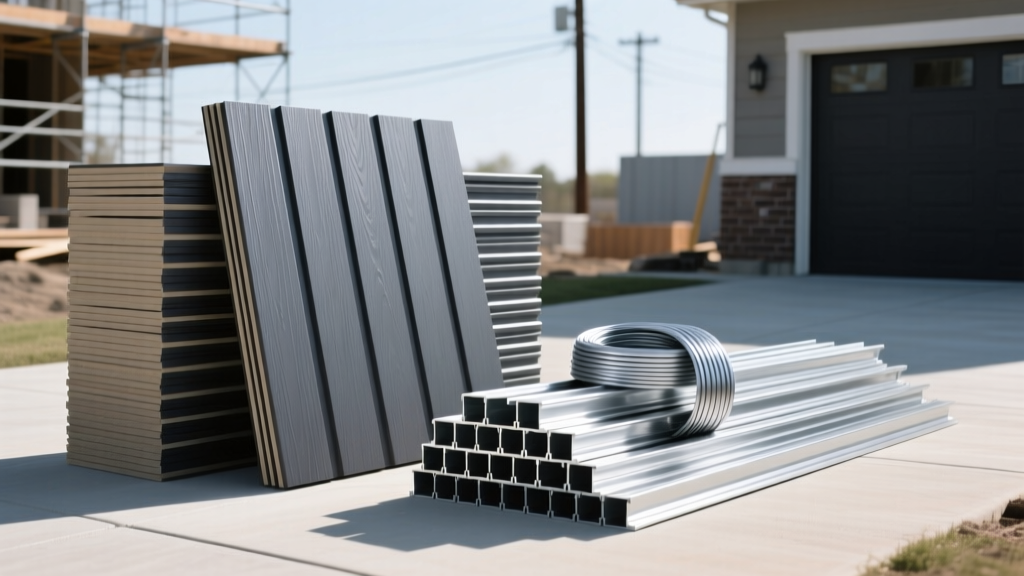
- Aluminum Trim Coil (0.019" or 0.024" thick): Used to wrap fascia, soffits, and custom window casings. A 50-foot roll costs $55 to $75 in 2026. A standard 2,500 sq. ft. home requires 8 to 12 rolls.
- J-Channel and Utility Trim: Essential for terminating panels around windows, doors, and rooflines. Standard 3/4" J-channel costs $1.10 to $1.60 per linear foot. Wide 1-inch J-channel, required for insulated siding, costs up to $2.25 per linear foot.
- Starter Strips: The foundational track that locks the bottom course of siding. Priced at $1.25 per linear foot. Failing to use a continuous, level starter strip guarantees bottom-course buckling.
- House Wrap (Weather-Resistive Barrier): Vinyl siding is a cladding system, not a waterproof barrier. A high-quality breathable membrane like DuPont Tyvek HomeWrap adds $0.60 to $0.85 per square foot to the material budget. Do not skip this layer; building codes (IRC Section R703.2) mandate a WRB behind all exterior wall coverings.
Insulated vs. Uninsulated Vinyl: ROI and Material Realities
Insulated vinyl siding features a contoured EPS (expanded polystyrene) foam backing permanently laminated to the PVC panel. It costs $2.50 to $4.00 more per square foot than uninsulated equivalents. However, the material benefits extend beyond thermal resistance.
"The primary value of insulated siding is not its R-value—which typically maxes out at R-3.0—but its structural reinforcement. The foam backing fills the void behind the PVC, drastically reducing impact cracking from hail or debris and eliminating the 'hollow' sound of standard vinyl. It also forces the installer to maintain a true plane, hiding minor wall imperfections."
— Adapted from building science analysis on exterior cladding thermodynamics and structural rigidity (Building Science Corporation, BSI-067).
If your existing sheathing is uneven, or if you are located in a region with severe temperature swings, the premium for insulated materials (like Alside Prodigy or Mastic Structure) pays dividends in reduced callbacks for panel warping and fastener back-out.
Calculating Your Exact Material Order (With Waste Factors)
Vinyl siding materials are sold in "squares" (one square = 100 square feet of wall coverage). To calculate your exact material order, you must apply a waste factor based on your home's architectural complexity.
1. Calculate total gross wall area (Length × Height for all walls).
2. Subtract the area of large openings (garage doors, massive picture windows).
3. Divide the net area by 100 to get base squares.
4. Multiply by the appropriate waste factor:
• Simple Box / Ranch: × 1.10 (10% waste)
• Moderate Complexity (Gables, standard windows): × 1.15 (15% waste)
• High Complexity (Steep dormers, turrets, board & batten): × 1.20+ (20%+ waste)
Because PVC expands and contracts significantly with temperature changes (up to 5/8 of an inch per 12-foot panel between winter and summer), off-cuts from panels cannot always be reused on the opposite side of the house. Always order an extra 5% of material beyond your calculated waste factor to keep in reserve for future storm damage repairs, as dye-lot color matching for vinyl is impossible after the initial manufacturing run.
Sourcing and Supply Chain Considerations
When procuring vinyl siding materials in 2026, verify that the product carries VSI (Vinyl Siding Institute) certification. According to Remodeling Magazine's Cost vs. Value data, exterior replacements remain one of the highest ROI projects for residential real estate, but this ROI assumes the use of certified, warrantied materials. VSI-certified products are independently tested to ASTM D3679 for dimensional stability and ASTM D4216 for impact resistance. Purchasing non-certified, off-brand materials from liquidation brokers may save 15% upfront, but these panels are highly susceptible to UV degradation, chalking, and brittle failure within 5 to 7 years, voiding any long-term cost benefit.
Written by
David NakamuraDavid Nakamura is a licensed architect (AIA) and construction technology writer focused on sustainable building methods, mass timber engineering, and high-performance building envelopes. He holds a Master of Architecture from the University of Washington and is a certified Passive House Consultant (CPHC). David spent eight years at the Seattle firm Mithun, where he led the design of three LEED Platinum projects, before founding his own practice specializing in net-zero residential design. He serves on the editorial advisory board of GreenBuilder Magazine and has authored peer-reviewed papers on cross-laminated timber (CLT) connections for the Journal of Structural Engineering. In his spare time, David teaches woodworking at Pratt Fine Arts Center and kayaks the Puget Sound.
More from David Nakamura
View all
Construction Cost
Labor Cost to Build a Deck Per Sq Ft: 2026 Installation Guide
Discover the exact labor cost to build a deck per sq ft in 2026. This installation guide breaks down contractor rates, complexity factors, and hidden fees.
Aug 4, 2026

Construction Cost
How Much Does It Cost to Build a 3 Bedroom House? Financing Guide
Learn exactly how much it costs to build a 3 bedroom house and explore 2026 financing options, construction loan types, and budget frameworks for your build.
Aug 4, 2026

Construction Cost
Cost to Build a Tennis Court: 2026 Guide
How much does it cost to build a tennis court in 2026? Breakdowns for asphalt, concrete, and synthetic surfaces plus fencing and lighting.
Jul 30, 2026