CertainTeed Impact and Moisture Resistant Gypsum Board: 2026 Guide
Compare CertainTeed impact and moisture resistant gypsum board options for 2026. Specs, costs, and installation tips for high-traffic wet areas.

The Dual-Threat Challenge in Commercial Construction
Specifying wall assemblies for commercial restrooms, school corridors, and hospital hallways requires balancing two hostile environments: high humidity and severe physical abuse. When architects and contractors search for a CertainTeed impact and moisture resistant gypsum board, they are often looking for a single panel that satisfies both ASTM C1396 (Standard Specification for Gypsum Board) for moisture and ASTM C1629 (Standard Classification for Abuse-Resistant Nondecorated Interior Gypsum Panel Products) for impact. However, navigating CertainTeed’s 2026 product ecosystem requires understanding a critical distinction: paper-faced moisture boards and glass-mat impact boards serve fundamentally different structural roles. This comprehensive guide breaks down the exact specifications, installation protocols, and material costs required to achieve dual-threat wall performance.
CertainTeed Product Matrix: Moisture vs. Impact Capabilities
CertainTeed does not manufacture a single paper-faced gypsum board that maxes out both moisture and impact resistance. Instead, they offer specialized product lines that address these threats individually or through advanced glass-mat technology. Below is the definitive specification matrix for 2026.
| Product Line | Core / Face Material | Moisture/Mold Rating (ASTM D3273) | Impact Rating (ASTM C1629) | Ideal Application |
|---|---|---|---|---|
| M2Tech (Standard/Type X) | Standard Core / Purple Moisture-Resistant Paper | Score 10 (Highest) | Level 1 (Standard) | Commercial restrooms, locker rooms (low cart traffic) |
| Abuse-Resistant (Type X) | High-Density Core / Standard Paper | Not Rated | Level 2 (Moderate Abuse) | Dry corridors, elevator shafts, stairwells |
| GlasRoc H | Moisture-Resistant Core / Fiberglass Glass Mat | Score 10 (Highest) | Level 2 to 3 (High Abuse) | High-traffic wet zones, commercial kitchens, pool enclosures |
The Specification Trap: Paper-Faced vs. Glass Mat
Critical Warning for Specifiers
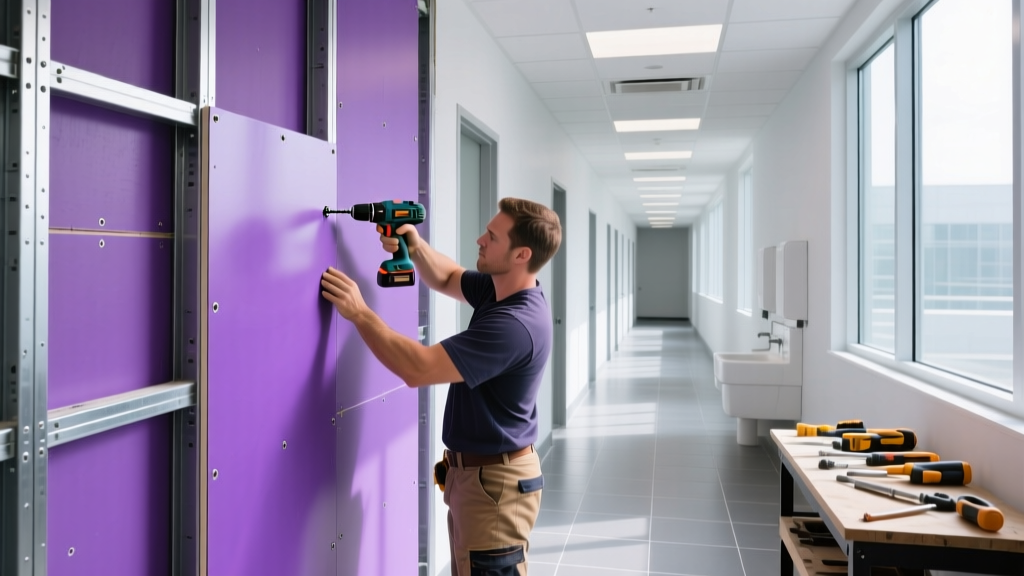
A common and costly error in commercial construction is specifying CertainTeed M2Tech for high-impact corridors under the assumption that its thick face paper resists physical punctures. While M2Tech excels at preventing mold growth and moisture absorption, its paper face will tear under the shear force of gurneys, housekeeping carts, or heavy luggage. If the zone requires both high impact and high moisture resistance, you must specify CertainTeed GlasRoc H (glass mat) or pair M2Tech with rigid PVC wall protection systems.
Deep Dive: GlasRoc H for High-Impact Wet Zones
When the project demands a true CertainTeed impact and moisture resistant gypsum board without relying on secondary wall guards, GlasRoc H is the required specification. Unlike paper-faced boards, GlasRoc H utilizes a patented embedded fiberglass mat that is impervious to water and highly resistant to surface indentation.
Key Technical Specifications
- Thickness: Available in 1/2 in. (12.7 mm) and 5/8 in. (15.9 mm).
- Weight: Approximately 2.1 lbs per square foot for 5/8 in. board (lighter than traditional high-density abuse-resistant boards).
- Fire Rating: Type X formulations are available, providing up to a 1-hour fire rating when installed in specific UL-designated assemblies.
- Water Absorption: Less than 3% by weight when tested per ASTM C473, vastly outperforming standard paper-faced moisture boards.
According to the Gypsum Association Technical Resources, glass-mat gypsum panels are the industry standard for areas subject to direct water exposure and high mechanical stress, eliminating the organic food source (paper) that mold requires to propagate.
Installation Protocols for High-Traffic Wet Zones
Achieving the rated impact resistance of GlasRoc H or M2Tech requires strict adherence to fastener schedules and joint treatment protocols. Failure to follow these steps voids the abuse-resistance warranty.
- Framing Preparation: Use minimum 20-gauge steel studs spaced at 16 inches on center (o.c.) for walls. For severe impact zones (e.g., hospital gurney corridors), reduce framing spacing to 12 inches o.c. to minimize panel deflection upon impact.
- Fastener Selection: Use corrosion-resistant, hot-dipped galvanized or ceramic-coated drywall screws. For 5/8 in. board, use 1-5/8 in. screws. Standard phosphate-coated screws will rust in high-humidity environments, bleeding through the finish.
- Fastener Spacing (ASTM C1629 Compliance): To achieve Level 2 or 3 abuse resistance, fasteners must be spaced at a maximum of 12 inches o.c. on walls and 8 inches o.c. on ceilings. Do not rely on standard 16-inch or 24-inch spacing.
- Joint Treatment: Paper tape is strictly prohibited on glass-mat boards. You must use alkali-resistant fiberglass mesh tape (such as FibaTape) embedded in a setting-type joint compound (e.g., CertainTeed ProForm Setting Compound). Standard all-purpose joint compound lacks the tensile strength to resist cracking under impact deflection.
For comprehensive material optimization strategies and lifecycle durability, the Whole Building Design Guide (WBDG) recommends specifying glass-mat panels in all below-grade or high-humidity commercial corridors to reduce long-term maintenance costs.
2026 Cost Breakdown: Material and Labor Estimates
Budgeting for dual-threat wall assemblies requires accounting for both the premium material costs and the specialized labor required for glass-mat or high-density boards. Below are the estimated 2026 commercial market rates (per square foot) for the CertainTeed Gypsum Product Portfolio.
| Material Specification | Material Cost (per sq. ft.) | Labor & Finishing Cost (per sq. ft.) | Total Installed Cost (per sq. ft.) |
|---|---|---|---|
| 5/8 in. M2Tech (Moisture Only) | $0.75 - $0.90 | $1.60 - $2.10 | $2.35 - $3.00 |
| 5/8 in. Abuse-Resistant (Impact Only) | $0.85 - $1.05 | $1.75 - $2.25 | $2.60 - $3.30 |
| 5/8 in. GlasRoc H (Moisture + Impact) | $1.35 - $1.65 | $2.00 - $2.60 | $3.35 - $4.25 |
| PVC Wall Guard Add-on (for M2Tech) | $4.50 - $7.00 (linear) | $2.00 - $3.50 (linear) | $6.50 - $10.50 (linear) |
Note: Labor costs assume union prevailing wages in major US metropolitan areas. Non-union or rural markets may see labor costs 15-20% lower.
Specification FAQ
Can I use CertainTeed M2Tech as a tile backer in commercial showers?
No. While M2Tech is highly resistant to ambient moisture and mold, it is not designed for continuous direct water exposure or the weight of heavy commercial tile. For commercial shower enclosures, specify a cementitious backer board or a specialized glass-mat tile backer board, followed by a liquid-applied waterproofing membrane.
Does GlasRoc H require special cutting tools?
Yes. Cutting fiberglass-mat gypsum boards generates fine glass particulates. Contractors must use sharp, carbide-tipped utility knives or specialized dust-extracting rotary tools. Standard drywall saws will fray the glass mat edges, requiring extensive sanding and joint compound to achieve a Level 4 or Level 5 finish. Always mandate N95 respirators and eye protection for the finishing crew.
How do I transition between GlasRoc H and standard drywall in adjacent rooms?
Use a standard butt joint, but treat the seam with alkali-resistant mesh tape and setting-type compound. The glass mat on the GlasRoc H side will reject moisture from standard pre-mixed joint compounds, so a chemical-setting compound (like a 45- or 90-minute setting mud) is mandatory for the first coat to ensure proper adhesion and prevent edge-blistering.
Written by
James ThorntonJames Thornton is a construction industry veteran with 25 years of hands-on experience in wood framing, lumber grading, and residential building codes. He started as a framing carpenter in rural Oregon, earned his ICC Residential Building Inspector certification, and eventually became a senior plan reviewer for the City of Portland Bureau of Development Services. James holds a B.S. in Wood Science & Technology from Oregon State University and is a certified lumber grader through the West Coast Lumber Inspection Bureau (WCLIB). He has inspected over 3,000 residential construction sites and authored the city's internal guide on advanced framing techniques (2x6 at 24" O.C.). James lives in Bend, OR, where he builds custom timber-frame cabins and competes in lumberjack sports.
More from James Thornton
View all
Insulation
Best Home Insulation Materials: Complete 2026 Guide
Compare top home insulation materials for 2026. Find R-values, installed costs per square foot, and best uses for fiberglass, spray foam, and mineral wool.
Aug 4, 2026

Sustainable Building
Certify Your Green Building Material for LEED and WELL
Step-by-step guide to certifying a green building material for LEED v5 and WELL v2. Master EPDs, HPDs, and VOC limits for 2026 project specifications.
Aug 4, 2026

Stone & Masonry
Veneer Stacked Stone Panels: Interior Design & Style Showcase
Discover how veneer stacked stone panels transform interiors. Explore modern design profiles, material pairings, and technical installation specs.
Aug 4, 2026