Pink Gypsum Board Selection Guide: Moisture and Fire Ratings
Master pink gypsum board selection for wet areas. Compare moisture-resistant specs, international color codes, installation, and 2026 costs.

The Color Code: Decoding Pink Gypsum Board
In the global building materials market, drywall color coding is the primary visual indicator of a board's specialized performance characteristics. While the North American market predominantly uses green for moisture resistance and purple for mold/moisture combinations, pink gypsum board is the standardized facing color for Moisture-Resistant (MR) plasterboard across international markets, including the Middle East, Asia, and parts of Europe. Manufactured by industry leaders like Saint-Gobain Gyproc and Knauf, pink-faced boards are engineered specifically to withstand high-humidity environments without structural degradation.
Selecting the correct pink MR board requires understanding its core chemical modifications, regional specification standards, and strict installation protocols. This guide provides a technical framework for architects, contractors, and procurement managers to specify and install pink gypsum board in 2026.
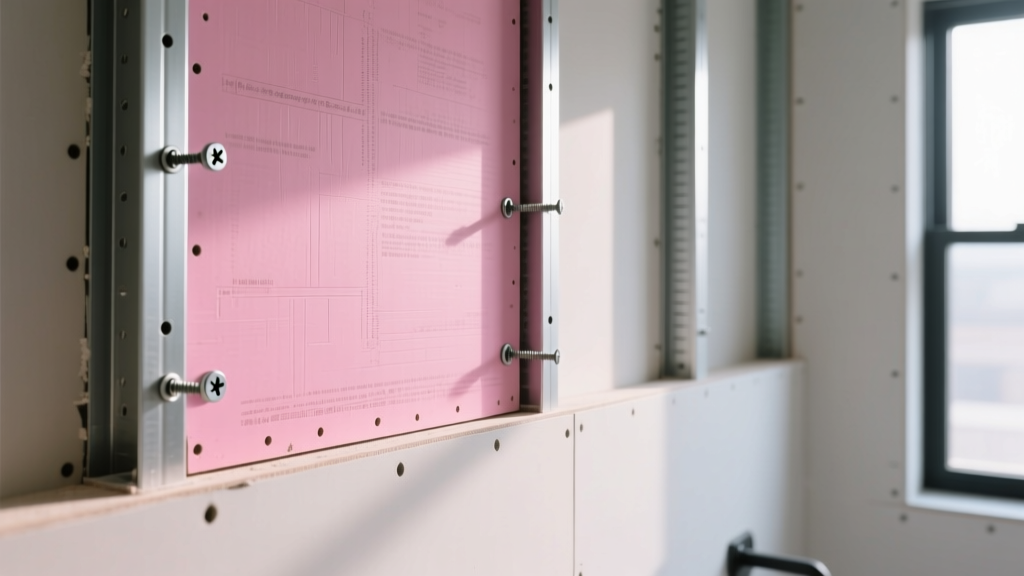
Core Material Composition and Manufacturing Specs
The moisture resistance of pink gypsum board is not merely a surface treatment; it is integrated into the core matrix and the facing paper. Understanding these material properties is critical for passing building inspections and ensuring long-term durability.
- Gypsum Core Modification: The calcined gypsum core is treated with a silicone-based emulsion or wax-resin additives during the manufacturing slurry phase. This creates a hydrophobic matrix that limits capillary water absorption.
- Specialized Facers: The pink facing paper and the brown backer paper are treated with sizing agents to prevent moisture wicking and delamination when exposed to high relative humidity (RH > 85%).
- Density Profile: MR boards typically feature a higher core density than standard white boards, ranging from 800 to 950 kg/m³, which provides additional screw-holding strength and impact resistance.
Governing Standards and Testing Thresholds
When reviewing product submittals, ensure the pink gypsum board complies with the relevant regional standards for moisture absorption:
| Standard | Classification | Max Water Absorption (Weight) | Surface Water Absorption |
|---|---|---|---|
| ASTM C1396 (US/Intl) | Water-Resistant (WR) | ≤ 5.0% (after 2-hour immersion) | ≤ 1.6g per 100cm² |
| EN 520 (Europe/Intl) | Type H1 / H2 / H3 | H1: ≤ 3% | H2: ≤ 5% | H3: ≤ 10% | Varies by Type |
For comprehensive testing methodologies and compliance documentation, refer to the technical bulletins published by the Gypsum Association.
Regional Color Variations: US vs. International Markets
One of the most common procurement errors occurs when international contractors order materials based on North American color conventions, or vice versa. Clarifying this matrix prevents catastrophic specification errors.
International Market (Middle East, Asia, UK/EU variants)
- Pink: Moisture-Resistant (MR) - Bathrooms, kitchens, laundries.
- White/Ivory: Standard Regular (RG) - Dry interior partitions.
- Red/Pink-Red: Fire-Rated (Type X / Fireline) - Shafts, stairwells.
North American Market (USG, CertainTeed, National Gypsum)
- Green: Moisture-Resistant (MR) - Standard wet-area backing.
- Purple: Mold & Moisture-Resistant - High-humidity, anti-microbial.
- Red: Fire-Rated (Type X) - 1-hour and 2-hour fire assemblies.
Application Framework: Where to Specify Pink MR Board
Pink gypsum board is mandated by most international building codes for specific interior zones. Use the following decision framework to determine if pink MR board is the correct specification for your project.
Zone 1: Intermittent High Humidity (Optimal Use Case)
Areas subject to daily steam and condensation but not direct, continuous water flow. This includes bathroom ceilings, walls outside the shower enclosure, indoor pool perimeters, and commercial kitchen dry-zones. Pink MR board prevents the core from softening and the paper from harboring mold spores in these environments.
Zone 2: Concealed Plumbing Chases
Walls enclosing supply lines and drain pipes are prone to minor condensation and slow leaks. Specifying pink MR board for the interior-facing side of plumbing chases provides a secondary defense against ambient moisture accumulation before a leak becomes visible.
Zone 3: Direct Water Impact (Prohibited Use Case)
Code Violation Warning: Do not use pink gypsum board as a tile backing board inside shower stalls or wet rooms. Continuous water exposure will eventually compromise the hydrophobic additives, leading to core collapse. Use fiber-cement or foam-core tile backer boards for direct-impact zones.
Installation Protocols and Fastener Schedules
Moisture-resistant boards require specific installation techniques to maintain their integrity. The Association of the Wall and Ceiling Industry (AWCI) outlines strict protocols for MR board framing and finishing.
- Framing Clearance: Maintain a minimum 10mm (3/8-inch) gap between the bottom edge of the pink board and the finished floor or shower pan. This prevents capillary action from drawing standing water into the gypsum core.
- Fastener Selection: Use only corrosion-resistant, hot-dipped galvanized or ceramic-coated drywall screws. Standard phosphate-coated black screws will rust in high-humidity environments, causing bleed-through stains on the finished pink paper.
- Screw Spacing: Maximum 200mm (8 inches) on center for wall studs, and 150mm (6 inches) on center for ceiling joists. Drive screws just below the paper surface without breaking the facing paper.
- Joint Treatment: This is the most frequent point of failure. Standard joint compound is water-soluble. You must use a moisture-resistant setting-type compound (e.g., Durabond) and alkali-resistant fiberglass mesh tape for all seams and corners.
2026 Cost Estimates and Procurement Data
Pricing for specialized drywall fluctuates based on raw material costs (specifically synthetic gypsum from flue-gas desulfurization) and regional shipping logistics. Below are the average 2026 procurement costs for standard 12.5mm (1/2-inch) pink MR boards.
| Region / Market | Standard Sheet Size | Average Unit Cost (2026) | Premium vs. Standard White Board |
|---|---|---|---|
| Middle East (UAE/Saudi) | 1200 x 2400 mm | $11.00 - $14.50 USD | +25% to 35% |
| Southeast Asia (Singapore/Malaysia) | 1200 x 2400 mm | $9.50 - $12.00 USD | +20% to 30% |
| India | 1200 x 2400 mm | $7.00 - $9.00 USD | +15% to 25% |
| North America (US Green/Purple Equiv.) | 4 ft x 8 ft (1220 x 2440 mm) | $15.00 - $19.00 USD | +40% to 60% |
Critical Failure Modes to Avoid
Even when the correct pink gypsum board is specified, poor site management or finishing errors can nullify its moisture-resistant properties. Watch for these specific failure modes during QA/QC inspections:
1. Paper Delamination from Standard Mud
The Error: Tapers use standard pre-mixed all-purpose joint compound (which retains water for long drying times) on pink MR board seams.
The Result: The prolonged moisture exposure softens the treated facing paper, causing it to bubble and delaminate from the core.
The Fix: Mandate setting-type compounds (chemical cure) that generate heat and dry rapidly without soaking the paper.
2. Vapor Barrier Trapping
The Error: Installing a polyethylene vapor barrier behind the pink MR board in an air-conditioned commercial bathroom.
The Result: Moisture from the room penetrates the board, hits the cold vapor barrier, condenses, and becomes trapped inside the wall cavity, leading to hidden mold growth on the back paper.
The Fix: In HVAC-cooled climates, rely on the MR board's surface resistance and high-quality primer/paint systems rather than internal poly-vapor barriers, unless specifically mandated by local hygrothermal building codes.
Frequently Asked Questions
Can I paint directly over pink gypsum board without a primer?
No. The specialized sizing agents on the pink paper will cause uneven paint absorption and flashing. You must apply a high-quality, alkali-resistant PVA drywall sealer or an oil-based primer before applying topcoats. For wet areas, specify an epoxy or specialized moisture-cured urethane paint system.
Does pink gypsum board provide any fire resistance?
Standard pink MR board provides the same baseline fire resistance as standard white board (typically 20-30 minutes for a single layer). If your project requires both moisture and fire resistance (e.g., a commercial kitchen fire wall), you must specify a specialized Fire-Moisture Resistant (FMR) board, which often features a pink facing with red edge-tape or a dual-layer system combining pink MR and red Type X boards.
Written by
Elena RodriguezElena Rodriguez is a civil engineer and technical writer specializing in concrete technology, masonry systems, and ASTM/ACI compliance. She earned her B.S. in Civil Engineering from Texas A&M University and spent a decade at a materials testing laboratory, performing over 2,000 concrete compressive strength tests and masonry prism evaluations. Elena is an ACI-certified Field Testing Technician (Grade I) and a member of ASTM Committee C12 on Natural Building Stone. She currently consults on forensic engineering cases involving concrete failures and moisture intrusion. Based in San Antonio, TX, Elena is a proud member of the Society of Women Engineers (SWE) and coaches her daughter's FIRST Robotics team.
More from Elena Rodriguez
View all
Walls & Panels
Cost Analysis: Light Gauge Steel Framing Advantages and Disadvantages
Evaluate light gauge steel framing advantages and disadvantages through a strict cost analysis lens, comparing material, labor, and lifecycle expenses.
Aug 4, 2026

Walls & Panels
Gypsum Board Types: Exact Specifications, Thickness & Dimensions
Compare standard, Type X, and moisture-resistant gypsum board types. Get exact specifications, thicknesses, dimensions, and ASTM standards for your project.
Aug 4, 2026

Fire Resistance
Best Fire-Resistant Outdoor Decking Materials: 2026 Buyer Guide
Discover the best fire-resistant outdoor decking materials for 2026. Compare Class A PVC, aluminum, and hardwood options for WUI compliance and safety.
Aug 4, 2026