Difference Between Drywall and Gypsum Board: A Complete Guide
Discover the technical and semantic difference between drywall and gypsum board, plus a 2026 product guide for Type X, glass mat, and standard panels.

The Short Answer: Are Drywall and Gypsum Board the Same?
In everyday construction parlance, the terms are used interchangeably, but technically, they refer to two distinct concepts. Gypsum board is the specific manufactured building material—a panel consisting of a noncombustible calcium sulfate dihydrate core encased in paper or glass-mat facers. Drywall, conversely, refers to the entire building system and the method of construction. It is a colloquial North American term that emerged in the mid-20th century to distinguish this panel-and-joint-compound system from traditional "wet" lath-and-plaster methods.
Semantic vs. Technical: Breaking Down the Terminology
To specify materials accurately on architectural drawings or procurement orders, understanding the semantic boundaries is critical. The Gypsum Association strictly uses "gypsum board" in its technical literature to encompass the full spectrum of panel types, whereas contractors use "drywall" to describe interior partition finishing.
Regional and Brand Variants
- Sheetrock: A registered trademark of the United States Gypsum Company (USG). Often used generically in the U.S., similar to Kleenex, but technically refers only to USG's specific product line.
- Plasterboard: The standard terminology in the United Kingdom, Australia, and New Zealand. It refers to the exact same gypsum-core panel.
- Wallboard: A generic catch-all term used in building codes to describe any rigid panel material used to surface interior walls, which can technically include cement board or fiberboard, though it usually implies gypsum.
Core Manufacturing and Composition Standards
Regardless of the terminology used on the job site, the manufacturing process is governed by strict chemical and physical standards. The core is primarily composed of gypsum (calcium sulfate dihydrate). During manufacturing, the raw gypsum is calcined to remove roughly 75% of its chemically combined water, creating stucco (calcium sulfate hemihydrate).
When mixed with water, foaming agents, and specific additives, the slurry rehydrates and crystallizes between two continuous sheets of facing material. According to ASTM C1396 (the standard specification for gypsum board), the resulting panel must meet rigorous criteria for surface water absorption, core hardness, and flexural strength. The chemically combined water within the core is what gives gypsum board its inherent fire-resistive properties; when exposed to fire, the water calcines and releases as steam, actively retarding heat transmission.
Comprehensive Product Guide: Types of Gypsum Board in 2026
Selecting the correct panel requires moving beyond the generic "drywall" label. Modern manufacturing has bifurcated the market into highly specialized panels. Below is a technical matrix of the primary gypsum board categories available for specification in 2026.
| Product Type | ASTM Standard | Core Additives & Facers | Typical Thickness | 2026 Material Cost (per sq ft) | Primary Use Case |
|---|---|---|---|---|---|
| Standard (Regular) | C1396 | Stucco core, 100% recycled paper facing | 1/4", 3/8", 1/2" | $0.45 - $0.60 | Standard interior walls and ceilings in low-moisture areas. |
| Type X (Fire-Rated) | C1396 | Fiberglass reinforcement, paper facing | 1/2", 5/8" | $0.65 - $0.85 | Garages, furnace rooms, multi-family separation walls (1-hour rating). |
| Type C (Enhanced Fire) | C1396 | Fiberglass + Vermiculite, paper facing | 1/2", 5/8" | $0.80 - $1.05 | Shaft walls, stairwells, and 2-hour rated assemblies. |
| Moisture-Resistant (Green Board) | C1396 | Silicone-treated core, green paper facing | 1/2", 5/8" | $0.70 - $0.90 | Behind tiles in residential bathrooms (non-wet areas). |
| Glass-Mat (e.g., DensGlass) | C1177 / C1658 | Silicone-treated core, fiberglass mat facers | 1/2", 5/8" | $1.15 - $1.45 | Exterior sheathing, commercial tile backer, high-humidity shafts. |
Application Decision Framework: Which Board to Specify?
Architects and lead contractors should utilize the following decision logic to prevent costly tear-outs and code violations. Relying on standard drywall in specialized environments is a primary cause of mold litigation and fire-code failures.
1. Evaluating Fire and Life Safety Requirements
If the building code mandates a fire-resistance-rated assembly (e.g., separating a residential garage from the living space, or enclosing an elevator shaft), standard gypsum board is strictly prohibited. You must specify Type X or Type C. The critical difference lies in the core shrinkage under extreme heat. Standard cores shrink and crack, exposing the paper to flames. Type X utilizes fiberglass strands to hold the calcined core together. Type C adds vermiculite, which expands when heated, compensating for the shrinkage of the gypsum and maintaining the integrity of the barrier for up to four hours in specialized multi-layer assemblies.
2. Managing Moisture and Mold Vectors
The industry has largely moved away from traditional "green board" (moisture-resistant paper-faced gypsum) for high-risk commercial applications. While green board is acceptable for residential bathroom walls outside the direct shower spray zone, commercial projects and wet-area tile backers now mandate glass-mat gypsum board. Because glass-mat panels eliminate the organic paper facing entirely, they score a 10 out of 10 on the ASTM D3273 mold resistance test, effectively removing the food source that black mold requires to propagate.
3. Optimizing for Ceiling Framing and Weight
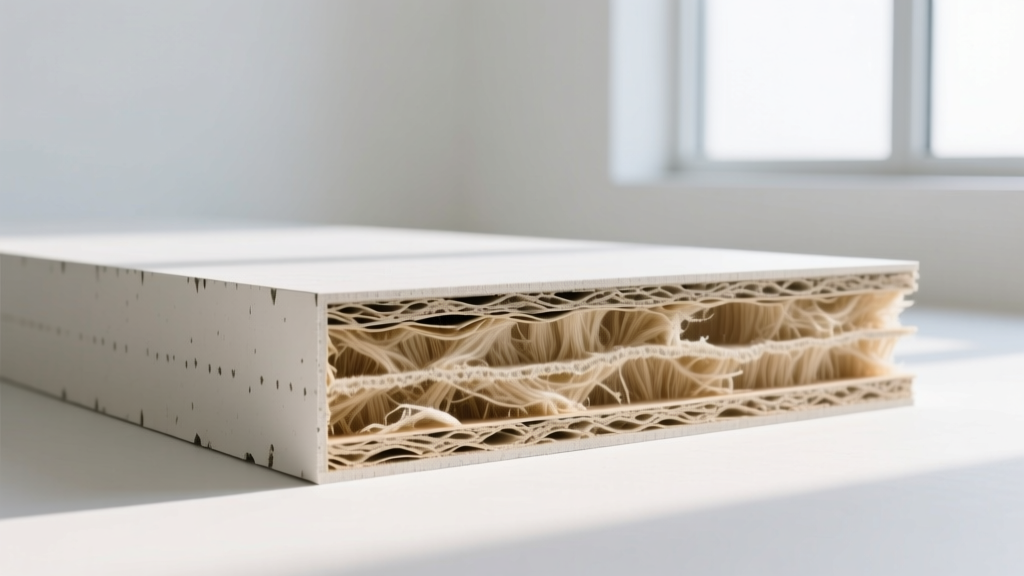
For ceiling applications framed at 24 inches on-center (O.C.), standard 1/2-inch gypsum board will sag over time due to gravity and ambient humidity. You must either step up to 5/8-inch board or utilize specialized Ultra-Light 1/2-inch ceiling board. Ultra-light formulations replace a portion of the gypsum core with microscopic hollow glass spheres and expanded polystyrene, reducing panel weight by up to 25% while maintaining the flexural rigidity required for 24-inch O.C. framing.
Fastener and Installation Specifications
The best gypsum board will fail if the fastener schedule is incorrect. The drywall system relies on specific mechanical connections to transfer shear and wind loads to the framing.
- Screw Selection: Use Type S (fine-thread) screws for light-gauge steel framing (20-gauge and thinner) and Type W (coarse-thread) screws for wood framing. Using wood screws on steel will strip the metal; using steel screws on wood will result in poor withdrawal resistance.
- Penetration Depth: Fasteners must penetrate wood framing by a minimum of 5/8 inch and steel framing by a minimum of 3/8 inch. For 1/2-inch gypsum board, use 1-1/4 inch screws. For 5/8-inch board, use 1-5/8 inch screws.
- The "Dimple" Rule: The screw head must break the paper face and create a shallow dimple without tearing the paper. If the paper is torn, the screw loses its holding power, and the joint compound will eventually crack over the fastener head.
- Spacing Schedule: For standard 1/2-inch wall applications on 16-inch O.C. wood framing, space screws at 16 inches in the field and 8 inches on the edges. For ceilings, reduce field spacing to 12 inches to combat gravitational sag.
Frequently Asked Questions
Can I use standard drywall behind a shower surround?
No. While some local residential codes historically allowed moisture-resistant green board behind acrylic tub surrounds, modern best practices and commercial codes require a cementitious backer board or a specialized glass-mat gypsum panel (like USG Fiberock or Georgia-Pacific DensShield) with a continuous liquid-applied waterproofing membrane. Standard paper-faced drywall will wick moisture through capillary action and fail structurally.
Why is 5/8-inch drywall often called "fire code" board?
This is a slight misnomer. The thickness itself does not provide the fire rating; the core composition does. However, 5/8-inch Type X gypsum board is the standard baseline for achieving a 1-hour fire-resistance rating on a standard wood-stud wall assembly. The additional 1/8-inch of thickness provides more calcined water to absorb heat, delaying the temperature rise on the unexposed side of the wall.
Is there a difference in soundproofing between drywall and gypsum board?
Since they are the same material, the terminology doesn't change the acoustics. However, if sound transmission class (STC) is a priority, you should specify sound-dampening gypsum board. These specialized panels feature a viscoelastic polymer layer sandwiched between two thin gypsum cores, which dissipates acoustic energy as low-grade heat, drastically reducing sound transfer compared to standard panels of the same thickness.
Written by
Priya KapoorPriya Kapoor is a real estate market analyst and construction economics researcher with expertise in housing affordability, development feasibility, and infrastructure investment. She holds a Master of Regional Planning from Cornell University and previously worked as a senior analyst at CBRE's Investment Properties group, where she modeled returns for $4B in mixed-use development pipelines. Priya now runs an independent research practice advising developers, municipalities, and REITs on construction cost forecasting and market timing. She publishes the quarterly "BuildMat Market Pulse" report tracking material price indices across 12 commodity categories. Based in Austin, TX, Priya serves on the board of Habitat for Humanity Austin and is a marathon runner.
More from Priya Kapoor
View all
Construction Cost
Cost to Build a 1600 Sq Ft Home in 2026: Full Breakdown
Accurate 2026 cost to build a 1600 sq ft home—material, labor, and regional pricing breakdowns included. Plan your budget with real-time estimates.
Aug 11, 2026

Wood & Lumber
Name the Types of Wood for Pressure Treatment and Preservation
Learn how to name the types of wood best suited for pressure treatment. Compare species treatability, chemical retention levels, and 2026 preservation costs.
Aug 4, 2026

Stone & Masonry
Stone Veneer Suppliers Lindenhurst: 2026 Cost Analysis
Analyze 2026 stone veneer costs in Lindenhurst, NY. Compare local supplier pricing, delivery fees, and Suffolk County installation labor rates.
Aug 4, 2026