Does Gypsum Board Contain Asbestos? Safe Selection Guide
Discover if gypsum board contains asbestos. This selection guide covers historical risks, testing protocols, and how to buy safe drywall.

The Short Answer: Modern vs. Legacy Drywall
If you are purchasing new gypsum board for a 2026 construction or renovation project, the answer is unequivocally no: modern, domestically manufactured gypsum board does not contain asbestos. The mineral was never a necessary ingredient in the gypsum core itself, but it was historically added to paper backings, joint compounds, and textured coatings for fire resistance and tensile strength.
However, if you are selecting materials for a renovation, managing a commercial retrofit, or salvaging architectural elements in a building constructed before 1990, the risk of asbestos-containing materials (ACM) in legacy drywall systems is a critical safety and legal liability. This selection guide provides the exact frameworks, testing protocols, and purchasing criteria required to navigate asbestos risks in gypsum board systems.
Timeline of Asbestos in Gypsum Manufacturing
Understanding the manufacturing era of the existing drywall is your first diagnostic tool. The U.S. Environmental Protection Agency (EPA) notes that while bans were proposed in the 1970s, complete phase-outs of asbestos in building materials took decades due to legal challenges and supply chain lags.
| Era | Risk Level | Primary ACM Locations in Drywall Systems |
|---|---|---|
| 1930 – 1975 | High | Joint compounds, textured paints, paper backing, some gypsum cores. |
| 1976 – 1985 | Moderate | Legacy joint compound stock, imported paper facings, specialty fire-rated boards. |
| 1986 – 1995 | Low | Rare, but possible in surplus inventory or unregulated imported joint compounds. |
| 1996 – Present | None | Zero asbestos. Modern boards use fiberglass mesh and synthetic polymers. |
How to Identify Asbestos-Containing Gypsum Board
Visual inspection is insufficient for definitive identification. While some legacy boards exhibit distinct physical traits, the only legally and scientifically valid method for selection and remediation planning is laboratory analysis.
Visual and Physical Clues (Presumptive Indicators)
- Board Dimensions: Pre-1970s gypsum board was frequently manufactured in smaller panels, such as 2x4 feet or 4x8 feet with square edges, rather than the modern tapered-edge 4x12 or 4x16 sheets.
- Paper Backing Color: Older boards often feature a gray, brown, or black backing paper, whereas modern standard boards use ivory or white face paper and brown backing.
- Joint Compound Texture: If the seams between boards have a distinct, sandy, or unusually hard texture that resists standard scoring, it may indicate chrysotile reinforcement.
- Manufacturer Stamps: Finding a stamp from historical brands like Gold Bond (National Gypsum) or early USG Sheetrock on the back of the panel indicates the era, but does not confirm the presence of asbestos.
The Definitive Testing Protocol
To comply with NIOSH and OSHA safety guidelines, you must utilize Polarized Light Microscopy (PLM) testing. Here is the exact workflow for renovation selection:
- Sample Collection: Wet the area with amended water (water mixed with a few drops of dish soap) to suppress dust. Use a coring tool to extract a 1-inch diameter sample that includes the paper facing, the gypsum core, the joint compound, and the paint layer.
- Sealing: Place the sample in a clean, sealable plastic bag (Ziploc) and wipe the exterior with a damp cloth.
- Laboratory Submission: Send to an NVLAP-accredited laboratory. Specify that you require PLM testing for chrysotile, amosite, and crocidolite.
- Cost and Turnaround: Standard PLM testing costs between $35 and $60 per sample in 2026, with results typically returned within 24 to 48 hours.
Contractors often test only the gypsum core and receive a 'negative' result, assuming the entire wall is safe. Historically, the highest concentration of asbestos (up to 5-10% by volume) was found in the drywall joint compound ('mud') and tape, not the gypsum core itself. Always submit a composite sample that includes the seam compound.
Selection Guide: Buying Safe Gypsum Board in 2026
When specifying new gypsum board for commercial or residential projects, you must verify that the products meet modern safety, environmental, and performance standards. The selection criteria below ensure you are procuring materials entirely free of legacy contaminants while maximizing indoor air quality.
Modern Certification Matrix
Require your suppliers to provide documentation for the following certifications when bidding on drywall contracts:
| Certification / Standard | What It Verifies | Why It Matters for Selection |
|---|---|---|
| ASTM C1396 | Standard Specification for Gypsum Board | Ensures structural integrity, moisture resistance, and material composition meets current baseline safety. |
| UL GREENGUARD Gold | Low VOC and chemical emissions | Guarantees the board and its paper facings do not off-gas harmful chemicals; required for LEED v4.1 credits. |
| ASTM E119 / UL Fire Ratings | Fire-resistance endurance (Type X / Type C) | Confirms fire ratings are achieved via modern glass-fiber reinforcement, not legacy asbestos fibers. |
| EPD (Environmental Product Decl.) | Life-cycle environmental impact | Transparent supply chain tracking, ensuring no contaminated recycled materials enter the gypsum core. |
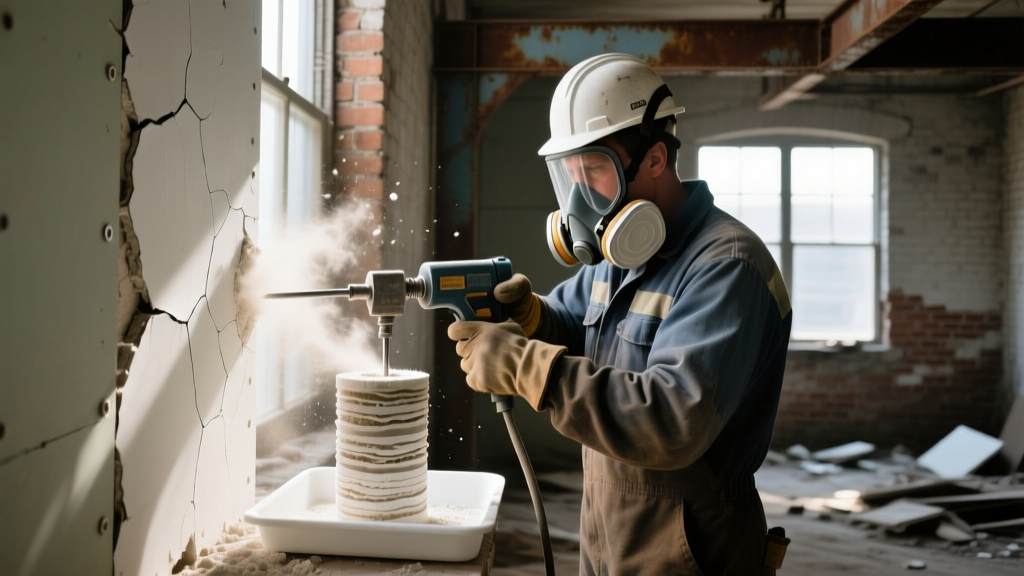
Remediation and Handling Protocols for Legacy Boards
If your selection process involves demolishing existing walls and testing confirms the presence of ACM in the drywall or joint compound, you must transition from a standard renovation to an abatement protocol governed by the EPA's National Emission Standards for Hazardous Air Pollutants (NESHAP).
Required Abatement Steps
- Containment: Seal the work area using 6-mil polyethylene sheeting. Establish negative air pressure using HEPA-filtered air scrubbers (minimum 4 air changes per hour).
- Wet Methods: Continuously mist the gypsum board with amended water during removal to prevent fiber aerosolization.
- Intact Removal: Do not snap or break the boards. Carefully cut around the perimeter using a utility knife and remove the panels whole.
- Waste Disposal: Double-bag all ACM drywall in 6-mil leak-tight plastic bags. Label them with OSHA-compliant asbestos warning tags and transport to a licensed hazardous waste landfill.
Frequently Asked Questions
Does modern 'Chinese Drywall' contain asbestos?
No. The highly publicized 'Chinese Drywall' issue (primarily affecting homes built between 2001 and 2009) involved defective imported gypsum board that off-gassed volatile sulfur compounds, causing copper corrosion and respiratory irritation. It did not contain asbestos. Modern imports in 2026 are strictly regulated and tested for both sulfur emissions and ACM.
Is asbestos found in the drywall tape?
Yes, historically. While modern drywall tape is made from paper or fiberglass mesh, pre-1980 drywall tape was frequently manufactured with asbestos fibers to increase tensile strength and prevent tearing when wet joint compound was applied. Always include tape in your composite laboratory samples.
Can I paint over asbestos-containing drywall instead of removing it?
Yes, encapsulation is a recognized and legally compliant management strategy. If the drywall is in excellent condition, undamaged, and will not be subjected to friction or impact, sealing it with a high-quality, elastomeric masonry or drywall primer effectively locks the fibers in place. However, you must disclose the presence of encapsulated ACM to future buyers or commercial tenants.
Written by
Priya KapoorPriya Kapoor is a real estate market analyst and construction economics researcher with expertise in housing affordability, development feasibility, and infrastructure investment. She holds a Master of Regional Planning from Cornell University and previously worked as a senior analyst at CBRE's Investment Properties group, where she modeled returns for $4B in mixed-use development pipelines. Priya now runs an independent research practice advising developers, municipalities, and REITs on construction cost forecasting and market timing. She publishes the quarterly "BuildMat Market Pulse" report tracking material price indices across 12 commodity categories. Based in Austin, TX, Priya serves on the board of Habitat for Humanity Austin and is a marathon runner.
More from Priya Kapoor
View all
Construction Cost
Cost to Build a 1600 Sq Ft Home in 2026: Full Breakdown
Accurate 2026 cost to build a 1600 sq ft home—material, labor, and regional pricing breakdowns included. Plan your budget with real-time estimates.
Aug 11, 2026

Wood & Lumber
Name the Types of Wood for Pressure Treatment and Preservation
Learn how to name the types of wood best suited for pressure treatment. Compare species treatability, chemical retention levels, and 2026 preservation costs.
Aug 4, 2026

Stone & Masonry
Stone Veneer Suppliers Lindenhurst: 2026 Cost Analysis
Analyze 2026 stone veneer costs in Lindenhurst, NY. Compare local supplier pricing, delivery fees, and Suffolk County installation labor rates.
Aug 4, 2026