Gypsum Board Ceiling Cost Guide: 2026 Material & Labor Rates
Detailed 2026 cost analysis for gypsum board ceilings. Explore material prices, labor rates, framing costs, and hidden expenses for your project.

The True Cost of a Gypsum Board Ceiling in 2026
Calculating the budget for a gypsum board ceiling requires moving beyond simple square-footage multipliers. In 2026, supply chain stabilization has normalized material costs, but regional labor shortages and updated building codes have shifted the financial weight toward installation and finishing. A standard residential ceiling installation ranges from $2.85 to $4.50 per square foot fully installed, while commercial or high-performance acoustic ceilings can exceed $7.00 per square foot. Understanding the granular breakdown of materials, framing substrates, and finish levels is critical for preventing budget overruns.
2026 Quick Cost Snapshot (Per Square Foot)
- Standard 1/2-inch Ceiling Board: $0.45 - $0.60 (Materials only)
- Specialty Acoustic/Fire-Rated: $0.85 - $1.65 (Materials only)
- Framing & Furring: $0.80 - $1.40
- Hanging & Level 4 Finishing: $1.10 - $1.80
- Total Installed Average: $2.85 - $4.50
Material Costs: Standard vs. Specialty Ceiling Boards
Not all gypsum boards are engineered for overhead applications. Standard wall boards are prone to sagging when installed on ceiling joists spaced 24 inches on center (OC). According to The Gypsum Association, ceiling-specific panels utilize specialized core formulations and fiberglass mesh reinforcement to resist gravitational deflection over time.
| Board Type & Brand Example | Thickness / Specs | 2026 Cost / Sq. Ft. | Primary Application |
|---|---|---|---|
| USG Sheetrock Ultralight Ceiling | 1/2" (Sag-Resistant) | $0.48 - $0.55 | Standard residential, 24" OC framing |
| CertainTeed ToughRock Firecode X | 5/8" (Type X, 1-hr rating) | $0.75 - $0.90 | Garages, multi-family, egress paths |
| CertainTeed SilentFX | 5/8" (Acoustic damping) | $1.35 - $1.65 | Home theaters, bedrooms, studios |
| USG Sheetrock Mold Tough | 1/2" (Moisture/Mold) | $0.65 - $0.80 | Bathrooms, indoor pools, basements |
For a comprehensive look at specific product specifications and availability, contractors frequently reference the USG Sheetrock Product Line to verify ASTM C1396 compliance for sag-resistant ceiling applications.
Framing and Substrate Preparation
The substrate dictates both the material yield and the labor hours required for hanging. While wood joists are standard in residential construction, commercial projects and high-end residential builds often utilize metal furring channels or resilient channels.
Resilient Channels for Acoustic Isolation
If sound transmission between floors is a concern, installing resilient channels (RC) perpendicular to the joists before hanging the gypsum board is mandatory. RC decouples the board from the structural framing, breaking the path of impact noise.
- Material Cost: $0.35 to $0.50 per linear foot for 25-gauge galvanized steel RC.
- Labor Addition: Adds approximately $0.40 per square foot to the overall hanging phase.
- Installation Rule: Channels must be spaced exactly 16 inches OC for 1/2-inch ceiling board, or 24 inches OC for 5/8-inch board. Screws must only penetrate the channel flange, never the underlying joist, or the acoustic decoupling is voided.
Labor Rates and the Impact of Finish Levels
Labor accounts for 50% to 65% of the total gypsum board ceiling cost. The Gypsum Association defines six distinct levels of finish (Level 0 through Level 5). Selecting the wrong finish level results in either wasted capital or visible joint imperfections under critical lighting conditions.
Level 3 Finish (Standard)
Cost: $0.80 - $1.10 / sq. ft.
Specs: Two coats of joint compound over tape. Suitable for ceilings receiving heavy texture (e.g., knockdown or popcorn) or in low-visibility utility areas.
Level 4 Finish (Premium)
Cost: $1.20 - $1.60 / sq. ft.
Specs: Three coats of compound, flat finish. Required for flat paints and standard lighting. The industry standard for 90% of modern residential living spaces.
The Level 5 Skim Coat Necessity
Level 5 involves applying a thin skim coat of joint compound over the entire ceiling surface. This is non-negotiable if the ceiling will be painted with gloss or semi-gloss paint, or if it is subjected to severe oblique lighting (such as large skylights or wall-washing LED fixtures). Expect to pay an additional $0.45 to $0.70 per square foot for a Level 5 upgrade. Skipping this step on a vaulted ceiling with a skylight will guarantee visible joint banding and fastener highlights.
Hidden Variables and Edge Cases
Budgets frequently fracture when estimators fail to account for site-specific variables that inflate labor times and equipment rental fees.
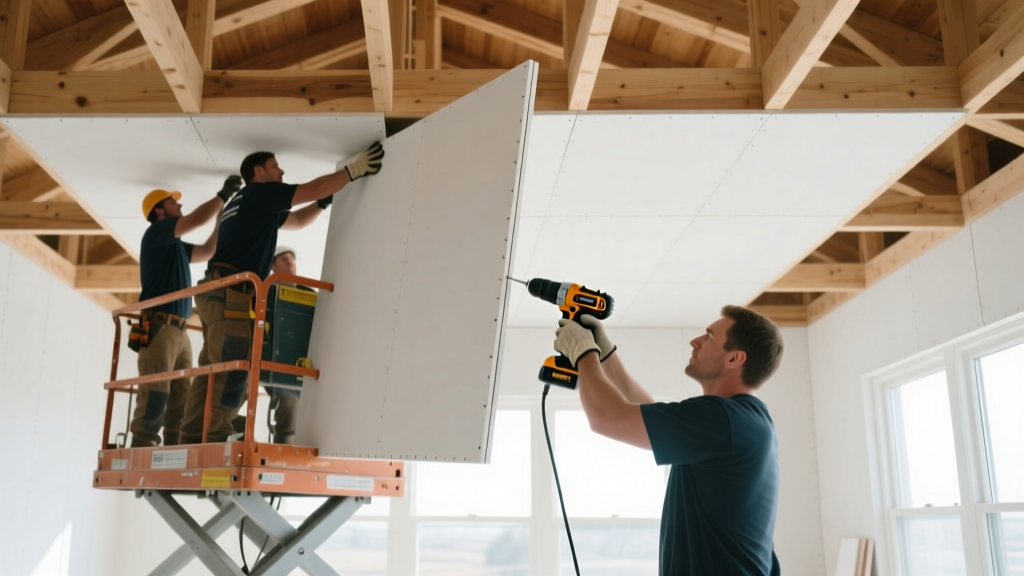
Estimator Warning: Ceilings exceeding 10 feet in height require specialized scaffolding or motorized drywall lifts. A standard manual drywall lift rents for $50-$75 per day, but motorized scissor lifts required for commercial heights (14ft+) cost upwards of $250 per day, drastically altering the labor equipment budget.
- Vaulted and Coffered Ceilings: Complex geometries increase cutting time, waste factor, and taping difficulty. Add a 25% to 40% labor premium for vaulted pitches or multi-tiered coffered designs.
- HVAC and Plumbing Rerouting: Dropping a ceiling to accommodate new ductwork requires framing out soffits. Soffit framing and drywall wrapping cost between $15 and $25 per linear foot.
- Debris Removal and Disposal: Tearing down an existing plaster or drywall ceiling generates massive weight. Disposal fees average $40 to $60 per ton at municipal landfills. For a 500 sq. ft. tear-out, budget $300 to $450 strictly for dumpster rental and tipping fees.
- Material Waste Factor: Standard flat ceilings require a 10% waste factor. Ceilings with multiple penetrations (recessed lighting, HVAC registers, ceiling fans) or irregular room shapes require a 15% to 20% waste factor.
Cost Optimization Strategies for 2026
To maximize budget efficiency without violating building codes or compromising structural integrity, implement the following technical strategies:
- Upgrade to Ultralight 1/2-inch over Standard 5/8-inch: Historically, contractors used 5/8-inch standard board to prevent sagging on 24-inch OC joists. Modern 1/2-inch sag-resistant ceiling boards (like USG Ultralight) weigh 25% less, reducing worker fatigue, speeding up installation by up to 15%, and eliminating the need for heavy-duty lifts, all while costing roughly the same per square foot as standard 5/8-inch panels.
- Optimize Board Orientation: Always hang ceiling boards perpendicular to the framing members. This spans the joints across multiple joists, increasing structural rigidity and reducing the linear footage of butt joints, which are notoriously difficult to finish invisibly.
- Batch Fastener Purchasing: For ceilings, coarse-thread screws (for wood) or fine-thread screws (for metal) must be used. Buying 5lb buckets of #6 or #8 coarse-thread drywall screws from wholesale suppliers rather than retail boxes reduces fastener costs by approximately 30%.
Frequently Asked Questions
Can I use standard 1/2-inch wall board on a ceiling?
Only if the ceiling joists are spaced 16 inches on center or less, and the area is not subject to high humidity. For 24-inch OC framing, standard wall board will sag between the joists over time due to gravity and ambient moisture absorption. Always use designated sag-resistant ceiling board or 5/8-inch panels for wider framing spacing.
How does the cost of a suspended acoustic grid ceiling compare to direct-applied gypsum?
Suspended mineral fiber or fiberglass acoustic tile ceilings generally cost between $4.00 and $8.00 per square foot installed. While the material cost for the grid and tiles is higher than raw gypsum board, the labor is significantly faster because it eliminates the taping, mudding, sanding, and painting phases. For commercial offices requiring frequent plenum access, suspended ceilings offer a lower lifecycle cost despite the higher initial investment.
What is the current cost to repair water damage on a gypsum ceiling?
Patching and repairing water-damaged ceiling drywall costs between $350 and $650 for a standard 4x8 foot section. This includes cutting out the compromised material, installing backing wood, screwing in a new patch, taping, mudding, sanding, and priming. If the water damage has compromised the structural integrity of the joists or requires mold remediation, costs will scale accordingly.
Written by
Priya KapoorPriya Kapoor is a real estate market analyst and construction economics researcher with expertise in housing affordability, development feasibility, and infrastructure investment. She holds a Master of Regional Planning from Cornell University and previously worked as a senior analyst at CBRE's Investment Properties group, where she modeled returns for $4B in mixed-use development pipelines. Priya now runs an independent research practice advising developers, municipalities, and REITs on construction cost forecasting and market timing. She publishes the quarterly "BuildMat Market Pulse" report tracking material price indices across 12 commodity categories. Based in Austin, TX, Priya serves on the board of Habitat for Humanity Austin and is a marathon runner.
More from Priya Kapoor
View all
Construction Cost
Cost to Build a 1600 Sq Ft Home in 2026: Full Breakdown
Accurate 2026 cost to build a 1600 sq ft home—material, labor, and regional pricing breakdowns included. Plan your budget with real-time estimates.
Aug 11, 2026

Wood & Lumber
Name the Types of Wood for Pressure Treatment and Preservation
Learn how to name the types of wood best suited for pressure treatment. Compare species treatability, chemical retention levels, and 2026 preservation costs.
Aug 4, 2026

Stone & Masonry
Stone Veneer Suppliers Lindenhurst: 2026 Cost Analysis
Analyze 2026 stone veneer costs in Lindenhurst, NY. Compare local supplier pricing, delivery fees, and Suffolk County installation labor rates.
Aug 4, 2026