1/2-Inch Gypsum Board Selection Guide: Types & Uses
Compare standard, fire-rated, and moisture-resistant 1/2-inch gypsum board. Learn which drywall type fits your 2026 construction or remodel project.

Understanding 1/2-Inch Gypsum Board Specifications
The 1/2-inch gypsum board is the undisputed industry standard for interior wall partitions in both residential and light commercial construction. Governed by ASTM C1396 (Standard Specification for Gypsum Board), this thickness provides the optimal balance between structural rigidity, sound attenuation, and weight management. While 5/8-inch panels are reserved for heavy-duty fire separations and 1/4-inch panels for curved surfaces, the 1/2-inch profile handles 85% of all interior drywall applications.
- Actual Thickness: 0.468 to 0.500 inches (11.9 mm to 12.7 mm)
- Standard Panel Weights: 2.2 lbs/sq ft (Standard Core) vs. 1.6 lbs/sq ft (UltraLight Core)
- Common Dimensions: 4 ft x 8 ft, 4 ft x 10 ft, 4 ft x 12 ft (Width tolerance: ±1/8 inch)
- Edge Profiles: Tapered edge (standard for taping), square edge (for veneer or specific trim)
When sourcing a 1/2-inch gypsum board, the primary decision matrix shifts from thickness to core composition and facing material. Selecting the incorrect variant for a specific environment leads to fastener pop, joint banding, mold proliferation, or failed fire inspections.
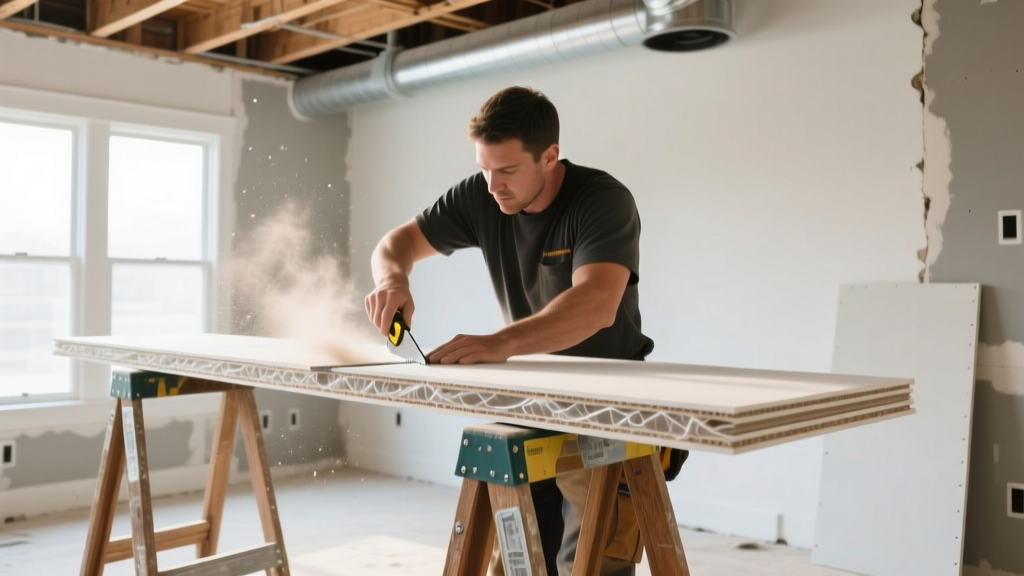
The 4 Primary Types of 1/2-Inch Drywall
1. Standard (Regular) Gypsum Board
Standard 1/2-inch drywall features a non-combustible gypsum core encased in manila or gray paper. It is strictly intended for interior, climate-controlled environments with low humidity. Modern manufacturing has largely shifted to "lightweight" standard boards, which incorporate expanded perlite or starch modifiers into the core. This reduces panel weight by up to 25% (dropping a 4x8 sheet from ~70 lbs to ~52 lbs) without sacrificing structural integrity, significantly reducing installer fatigue and joint-compound cracking over time.
2. Fire-Rated (Type X) Gypsum Board
Type X 1/2-inch gypsum board is engineered with glass fibers and other non-combustible additives mixed directly into the gypsum core. When exposed to extreme heat, the chemically bound water in the gypsum calcines (turns to steam), delaying heat transmission. A single layer of 1/2-inch Type X board applied to 2x4 wood studs spaced 16 inches on-center typically achieves a 1-hour fire-resistance rating (e.g., UL Design U419). It is mandated by the International Building Code (IBC) for attached garage separation walls, furnace rooms, and multi-family dwelling unit separations.
3. Moisture and Mold-Resistant (Green/Purple Board)
For high-humidity zones like bathrooms, kitchens, and laundry rooms, standard paper-faced boards will wick moisture and degrade. Moisture-resistant (MR) boards utilize a green or purple paper facing treated with water-repellent chemicals and a core modified with silicone or wax emulsions. For areas with direct water exposure (shower surrounds), builders must upgrade to glass-mat gypsum panels (paperless), which pass the stringent ASTM D3273 mold-resistance test, scoring a perfect 10.
4. Acoustic and Abuse-Resistant Board
Acoustic 1/2-inch panels feature a high-density, viscoelastic polymer-damped core designed to increase the Sound Transmission Class (STC) rating of a wall assembly. While standard 1/2-inch drywall on a wood stud wall yields an STC of roughly 33-35, specialized acoustic boards can push this to 40+ without requiring resilient channels or double-stud framing. Abuse-resistant variants incorporate heavy fiberglass mesh embedded behind the face paper to withstand impact in high-traffic corridors, schools, and hospitals.
Comparison Matrix: Which 1/2-Inch Board Do You Need?
| Board Type | Core / Facing | Primary Application | 2026 Avg. Cost (4x8) |
|---|---|---|---|
| Standard UltraLight | Gypsum / Manila Paper | Bedrooms, living rooms, hallways | $14.00 - $17.50 |
| Type X (Fire-Rated) | Glass-fiber Gypsum / Paper | Garage walls, furnace rooms, stairwells | $18.50 - $23.00 |
| Moisture-Resistant (MR) | Silicone-modified / Green Paper | Bathroom ceilings, kitchen backsplashes | $20.00 - $26.00 |
| Glass-Mat (Paperless) | Gypsum / Fiberglass Mat | Shower/tub surrounds, exterior soffits | $24.00 - $32.00 |
| Acoustic / High-Density | Polymer-damped / Heavy Paper | Home theaters, bedroom partitions, condos | $38.00 - $48.00 |
Top 2026 Product Recommendations
Based on current market availability and performance metrics, the following specific product lines represent the top tier for 1/2-inch applications:
- USG Sheetrock UltraLight Panels: The benchmark for standard walls. Weighs 13 lbs less per 4x8 sheet than standard panels, offering superior sag resistance on ceilings framed at 24 inches on-center.
- CertainTeed AirRenew Essential: A standard 1/2-inch board featuring patented technology that actively captures and converts indoor VOCs (volatile organic compounds) into safe, non-releasable compounds. Ideal for nurseries and healthcare facilities.
- Georgia-Pacific DensGlass: The premier paperless, fiberglass-mat gypsum panel. Required for exterior sheathing applications and interior tile backer boards where continuous moisture exposure is guaranteed.
- National Gypsum Gold Bond SoundBreak XP: A 1/2-inch acoustic board featuring a constrained-layer viscoelastic polymer core, eliminating the need for mass-loaded vinyl (MLV) in many residential soundproofing assemblies.
Installation Edge Cases & Framing Constraints
Proper selection means nothing if the framing and fastening protocols are ignored. The Gypsum Association strictly outlines framing limitations for 1/2-inch panels to prevent long-term deflection and fastener pop.
Standard 1/2-inch gypsum board will visibly sag between joists if installed on ceilings framed at 24 inches on-center (O.C.), especially in humid climates or when water-based texture is applied. For 24-inch O.C. ceiling framing, you MUST specify a 1/2-inch "Ceiling Board" (which has a reinforced core) or upgrade to 5/8-inch standard board.
Fastener Spacing Requirements
For wood framing, 1-1/4 inch Type S (coarse thread) drywall screws are mandatory. Fastener spacing must adhere to the following maximums:
- Ceiling Edges: 7 inches O.C.
- Ceiling Field: 12 inches O.C.
- Wall Edges: 8 inches O.C.
- Wall Field: 16 inches O.C.
"Fastener pop in 1/2-inch drywall is rarely a product defect; it is almost exclusively caused by lumber shrinkage post-installation or driving the screw head too deep, breaking the paper face. Set screw heads exactly 1/32-inch below the paper surface without tearing the fibers."
Building Code & ASTM Compliance Checklist
Before finalizing your material order, verify your local jurisdiction's adoption of the International Residential Code (IRC) or International Building Code (IBC). Key compliance triggers for 1/2-inch boards include:
- Garage Separations: IRC Section R302.6 mandates a minimum of 1/2-inch gypsum board applied to the garage side of walls and ceilings separating the garage from the residence. Type X is only required if the garage is directly beneath habitable space (requiring 5/8-inch Type X on the ceiling).
- Tile Backing: Standard water-resistant (green board) is no longer code-compliant for direct tile application in wet areas (shower stalls). You must use 1/2-inch glass-mat gypsum or cementitious backer units.
- Sound Transmission: Multi-family dwellings must meet an STC of 50 (or 45 if field-tested). Standard 1/2-inch drywall on single studs will fail this. Specify acoustic 1/2-inch board paired with mineral wool insulation.
Frequently Asked Questions
Can I use 1/2-inch Type X board everywhere for maximum safety?
While technically possible, Type X is heavier, more expensive, and harder to cut than standard board. The glass fibers dull utility blades rapidly and create more dust. Restrict Type X strictly to code-mandated fire separation assemblies to optimize labor and material budgets.
Does lightweight 1/2-inch drywall compromise soundproofing?
Yes, marginally. Sound attenuation relies heavily on mass. Because lightweight panels reduce core density by integrating air voids and perlite, they offer a slightly lower STC rating (roughly 1-2 points less) compared to traditional heavy-core 1/2-inch boards. If acoustic isolation is the primary goal, use standard weight or specialized high-density acoustic boards.
Written by
Elena RodriguezElena Rodriguez is a civil engineer and technical writer specializing in concrete technology, masonry systems, and ASTM/ACI compliance. She earned her B.S. in Civil Engineering from Texas A&M University and spent a decade at a materials testing laboratory, performing over 2,000 concrete compressive strength tests and masonry prism evaluations. Elena is an ACI-certified Field Testing Technician (Grade I) and a member of ASTM Committee C12 on Natural Building Stone. She currently consults on forensic engineering cases involving concrete failures and moisture intrusion. Based in San Antonio, TX, Elena is a proud member of the Society of Women Engineers (SWE) and coaches her daughter's FIRST Robotics team.
More from Elena Rodriguez
View all
Walls & Panels
Cost Analysis: Light Gauge Steel Framing Advantages and Disadvantages
Evaluate light gauge steel framing advantages and disadvantages through a strict cost analysis lens, comparing material, labor, and lifecycle expenses.
Aug 4, 2026

Walls & Panels
Gypsum Board Types: Exact Specifications, Thickness & Dimensions
Compare standard, Type X, and moisture-resistant gypsum board types. Get exact specifications, thicknesses, dimensions, and ASTM standards for your project.
Aug 4, 2026

Fire Resistance
Best Fire-Resistant Outdoor Decking Materials: 2026 Buyer Guide
Discover the best fire-resistant outdoor decking materials for 2026. Compare Class A PVC, aluminum, and hardwood options for WUI compliance and safety.
Aug 4, 2026