Gold Bond XP Fire-Shield Gypsum Board: Specs, Costs & Assembly Guide
Comprehensive guide to Gold Bond XP Fire-Shield gypsum board. Explore 5/8-inch specs, UL assembly rules, mold resistance, and current pricing data.

Specifying the correct gypsum board for transitional zones—where strict fire-resistance ratings intersect with high-humidity environments—requires balancing building code mandates with long-term durability. Gold Bond XP Fire-Shield gypsum board, manufactured by National Gypsum, is engineered specifically for this overlap. By integrating a Type X fire-resistant core with moisture- and mold-blocking additives, it eliminates the need for redundant multi-material wall assemblies in commercial shafts, stairwells, and corridor walls.
This comprehensive product guide details the material anatomy, technical specifications, UL assembly parameters, and real-world cost metrics required to specify and install this board correctly.
Material Anatomy: What Makes XP Fire-Shield Different?
Standard Type X gypsum board relies on glass fibers and vermiculite within the calcined gypsum core to retard heat transmission during a fire. However, standard Type X paper facings are highly susceptible to mold and moisture degradation. Conversely, standard moisture-resistant (green board) panels lack the core density and fibrous reinforcement required to achieve 1-hour or 2-hour fire ratings.
Gold Bond XP Fire-Shield bridges this gap through three distinct material modifications:
- Reinforced Type X Core: Formulated with uncalcined gypsum and specialized glass fibers that maintain structural integrity at temperatures exceeding 1,800°F (982°C), preventing premature board collapse during ASTM E119 fire tests.
- XP Core Additives: Silicone-based water repellents are integrated directly into the core matrix, reducing water absorption to less than 5% by weight when tested per ASTM C473.
- Mold-Resistant Facings: The green face paper and brown back paper are treated with antimicrobial agents that inhibit the growth of mold and mildew, achieving a maximum score of 10 on the ASTM D3273 test standard.
Technical Specifications & Compliance Matrix
When drafting specifications for commercial projects, ensure the following baseline parameters are met. The data below applies to the standard 5/8-inch interior panels.
| Property | Specification / Value | Governing Standard |
|---|---|---|
| Thickness | 5/8 in. (15.9 mm) | ASTM C1396 |
| Width / Length | 48 in. / 96 in., 120 in., 144 in. | ASTM C1396 |
| Weight | ~2.2 to 2.4 lbs/sq. ft. | Manufacturer Data |
| Fire Resistance | Type X (Up to 4 hours in specific multi-layer shaftliner assemblies) | ASTM E119 / UL 263 |
| Mold Resistance | Score 10 (Maximum) | ASTM D3273 |
| Water Absorption | ≤ 5% by weight | ASTM C473 |
| Surface Water Absorption | ≤ 1.0 gram | ASTM C473 |
Specification Decision Tree: When to Use XP Fire-Shield
Over-specifying premium boards inflates material costs, while under-specifying risks code violations and catastrophic moisture failures. Use this decision framework to determine if Gold Bond XP Fire-Shield is the correct choice for your specific zone:
Zone Analysis Matrix
- Scenario A: Commercial Kitchen Demising Walls. Requires a 2-hour fire separation rating AND exposure to high ambient humidity/grease-laden vapor. Decision: Specify XP Fire-Shield.
- Scenario B: Bathroom Walls Adjoining Elevator Shafts. The shaft side requires a 2-hour fire rating; the bathroom side experiences direct moisture. Decision: Specify XP Fire-Shield on the bathroom face, standard Fire-Shield on the shaft face.
- Scenario C: Standard Corridor Walls. Requires a 1-hour fire rating but remains in a climate-controlled, dry environment. Decision: Use standard Gold Bond Fire-Shield (Type X) to save costs.
- Scenario D: Exterior Soffits or Unconditioned Parking Garages. Requires fire rating and extreme weather/moisture resistance. Decision: Upgrade to Gold Bond XP Fire-Shield EXT (exterior sheathing variant) or a glass-mat gypsum panel.
Installation Parameters for UL-Designated Assemblies
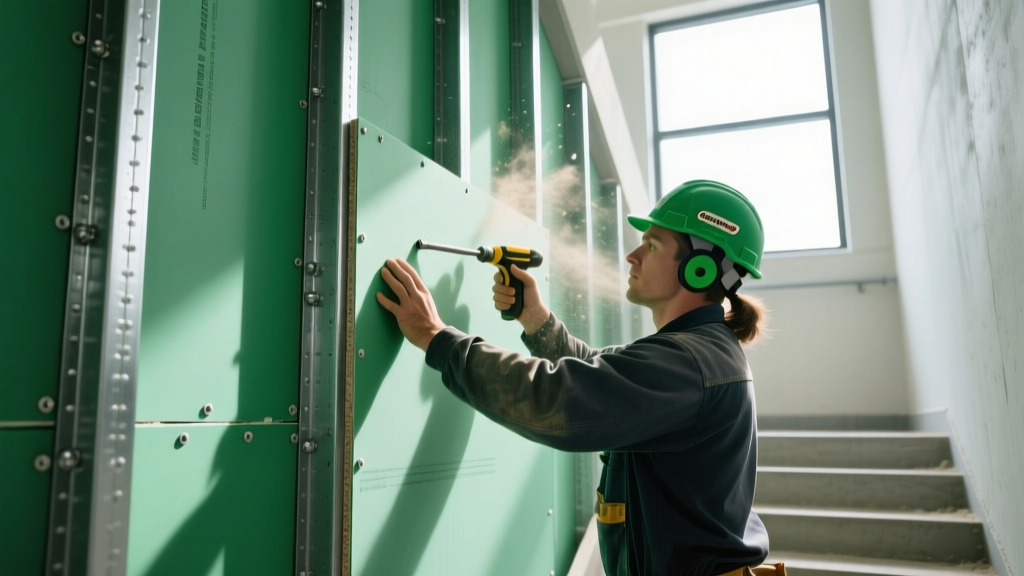
A fire-rated board only performs to its tested limits if the entire assembly—including framing, fasteners, and joint treatment—matches the Underwriters Laboratories (UL) or Warnock Hersey design. The Gypsum Association strictly mandates the following installation protocols for 5/8-inch Type X boards in rated assemblies:
Fastener Selection and Spacing
For steel stud framing (minimum 20-gauge), use 1-1/4 inch or 1-5/8 inch Type S-12 or Type S fine-thread drywall screws. While standard non-rated partitions allow 16-inch on-center (O.C.) spacing on walls, most 1-hour and 2-hour UL designs mandate a maximum 12-inch O.C. spacing on both walls and ceilings. Fasteners must be driven flush without breaking the paper facing; any blown-out screws must be abandoned and replaced 2 inches away.
Joint Treatment Requirements
In fire-rated assemblies, the joint compound acts as a thermal seal. The first coat (bedding coat) over the tape must be a setting-type compound (e.g., 45-minute or 90-minute chemical-setting joint compound). Standard all-purpose drying compounds shrink as water evaporates, potentially creating micro-fissures that allow superheated gases to penetrate the joint during a fire, compromising the assembly's integrity. Subsequent topping coats can utilize standard all-purpose compounds for a Level 4 or Level 5 finish.
Penetration and Cutout Sealing
Electrical boxes and HVAC penetrations are the most common failure points in rated moisture zones. Gaps between the gypsum board and the penetration must not exceed 1/8 inch. Any voids larger than this must be sealed with a UL-classified firestop sealant that is also rated for high-humidity environments, preventing both flame spread and vapor migration into the wall cavity.
Project Cost Breakdown: Material vs. Labor ROI
Gold Bond XP Fire-Shield commands a premium over standard Type X board. However, evaluating the ROI requires looking beyond the per-sheet cost to total installed assembly economics.
| Material Category | Approx. Cost per 4x8 Sheet | Cost per Sq. Ft. (Material Only) |
|---|---|---|
| Standard 5/8" Type X (Fire-Rated) | $16.00 - $19.00 | $0.50 - $0.59 |
| Standard 5/8" XP (Mold/Moisture) | $18.00 - $22.00 | $0.56 - $0.68 |
| 5/8" XP Fire-Shield (Dual Purpose) | $28.00 - $35.00 | $0.87 - $1.09 |
Note: Pricing reflects average national distributor rates for commercial volume purchases. Local market fluctuations and supply chain variables will affect final invoiced costs.
The Labor Offset: In zones requiring both fire and moisture protection, the alternative is often installing a cementitious backer board over a fire-rated Type X base layer, or applying specialized liquid-applied moisture membranes over standard Type X. XP Fire-Shield operates as a single-layer solution in many rated assemblies. The material premium of roughly $0.40 per square foot is routinely offset by eliminating the labor and material costs of secondary moisture barriers or double-layering, yielding a net savings of 8% to 12% on total wall assembly costs.
Critical Failure Modes in Fire-Rated Moisture Zones
Even when the correct product is specified, field execution errors can void the fire rating and invite mold growth. Inspect for these specific failure modes during construction:
⚠ Warning: Bottom Edge Wicking
Gypsum board, regardless of its moisture-resistant additives, should never rest directly on a concrete slab where hydrostatic pressure or pooling water may occur. Maintain a strict 1/2-inch to 5/8-inch gap at the floor line. In commercial bathrooms or kitchen zones, this gap must be sealed with a flexible, fire-rated silicone sealant to maintain the acoustic and fire barrier without creating a wicking path for standing water.
⚠ Warning: Improper Scoring and Snapping
When cutting XP Fire-Shield for pipe penetrations, contractors often use routers that obliterate the treated paper facing around the cut edge, exposing the raw gypsum core. In high-humidity shafts, this exposed core will absorb ambient moisture and degrade. All cut edges in wet zones must be sealed with a brush-on moisture barrier or a high-quality primer immediately after cutting and before the wall is closed in.
Final Specification Directives
Gold Bond XP Fire-Shield gypsum board is a highly specialized, code-compliant solution for complex commercial environments. To ensure optimal performance, architects and specifiers should explicitly reference ASTM C1396 for baseline material compliance and mandate the use of setting-type joint compounds for all primary fire-rated joints. By aligning material selection with precise UL assembly designs, project teams can deliver walls that satisfy the fire marshal's rating requirements and the facility manager's durability demands without resorting to costly, multi-layer workarounds.
Written by
Priya KapoorPriya Kapoor is a real estate market analyst and construction economics researcher with expertise in housing affordability, development feasibility, and infrastructure investment. She holds a Master of Regional Planning from Cornell University and previously worked as a senior analyst at CBRE's Investment Properties group, where she modeled returns for $4B in mixed-use development pipelines. Priya now runs an independent research practice advising developers, municipalities, and REITs on construction cost forecasting and market timing. She publishes the quarterly "BuildMat Market Pulse" report tracking material price indices across 12 commodity categories. Based in Austin, TX, Priya serves on the board of Habitat for Humanity Austin and is a marathon runner.
More from Priya Kapoor
View all
Construction Cost
Cost to Build a 1600 Sq Ft Home in 2026: Full Breakdown
Accurate 2026 cost to build a 1600 sq ft home—material, labor, and regional pricing breakdowns included. Plan your budget with real-time estimates.
Aug 11, 2026

Wood & Lumber
Name the Types of Wood for Pressure Treatment and Preservation
Learn how to name the types of wood best suited for pressure treatment. Compare species treatability, chemical retention levels, and 2026 preservation costs.
Aug 4, 2026

Stone & Masonry
Stone Veneer Suppliers Lindenhurst: 2026 Cost Analysis
Analyze 2026 stone veneer costs in Lindenhurst, NY. Compare local supplier pricing, delivery fees, and Suffolk County installation labor rates.
Aug 4, 2026