Fire Retardant Gypsum Board: 2026 Product & Spec Guide
Compare top fire retardant gypsum board options for 2026. Explore Type X specs, ASTM E119 ratings, pricing, and installation best practices.

The Reality of 'Fire Retardant' Gypsum Board
In the construction industry, the term 'fire retardant gypsum board' is frequently used by architects and DIY builders, but it is technically a misnomer. Gypsum board does not merely retard fire; it is inherently non-combustible and provides passive fire resistance. The core of the board consists of calcium sulfate dihydrate, which contains approximately 21% chemically combined water by weight. When exposed to fire, this water is released as steam through a process called calcination. This endothermic reaction holds the temperature of the unexposed side of the board near 212°F (100°C) until all the free water is driven off, effectively delaying heat transfer and structural failure.
Core Specifications and Industry Standards
To legally classify as Type X under ASTM International standard C1396, a 5/8-inch thick gypsum board must demonstrate a minimum one-hour fire-resistance rating when tested in a specific assembly under ASTM E119 (Standard Test Methods for Fire Tests of Building Construction and Materials). According to the Gypsum Association, the glass fibers integrated into Type X and Type C boards are the critical differentiator; they act as a structural mesh that holds the calcined gypsum core together when the paper facers burn away.
Type X vs. Type C: What is the Difference?
- Type X (5/8-inch): The baseline for commercial fire separations. Provides a 1-hour rating on standard wood or steel stud partitions. Contains standard glass fiber reinforcement.
- Type C (1/2-inch or 5/8-inch): An enhanced formulation with a higher density of glass fibers and often vermiculite or perlite additives. Type C can achieve a 1-hour rating at 1/2-inch thickness (saving weight and space) or a 2-hour rating at 5/8-inch thickness.
2026 Market Leaders: Product Comparison Matrix
When sourcing materials for 2026 commercial and multi-family residential projects, procurement teams must balance weight, core density, and UL design compatibility. Below is a comparison of the leading fire-rated gypsum boards available in the North American market.
| Brand & Product | Thickness / Type | Weight (per 4x12 sheet) | Max Fire Rating | Avg. 2026 Price |
|---|---|---|---|---|
| USG Sheetrock Firecode X | 5/8" Type X | ~95 lbs | 1 Hour (Standard) | $24.00 - $28.00 |
| CertainTeed Firestop | 5/8" Type X | ~92 lbs | 1 Hour (Standard) | $25.50 - $29.50 |
| GP ToughRock Fireguard 45 | 1/2" Type X | ~62 lbs | 45 Min / 1 Hr* | $19.00 - $23.00 |
| USG Firecode C | 5/8" Type C | ~100 lbs | 2 Hours | $32.00 - $38.00 |
*Note: 1-hour ratings with 1/2" Type X require specific UL assemblies, often involving double-layer applications or specialized steel stud gauges.
Installation Edge Cases and Critical Failure Modes
The fire resistance of a rated assembly is entirely dependent on strict adherence to tested installation parameters. As detailed in USG Corporation's technical fire resistance design guides, deviating from the tested UL or ULC design voids the fire rating and creates severe liability exposure. Below are the most common failure modes observed during municipal fire inspections.
Standard drywall installation allows screws at 16 inches on center (o.c.) for walls and 12 inches o.c. for ceilings. However, many 1-hour and 2-hour fire-rated assemblies mandate a maximum fastener spacing of 12 inches o.c. on walls and 8 inches o.c. on ceilings. Furthermore, screws must be bugle-head Type S (for steel) or Type W (for wood) and must dimple the paper without breaking it. Over-driven screws compromise the holding power required during calcination.
Joint Treatment and Penetration Sealing
Fire-rated partitions must be taped and finished to at least a Level 1 or Level 2 finish, but the compound used matters. While standard pre-mixed joint compound is acceptable for many rated assemblies, high-moisture or high-stress fire separations often require setting-type compounds (e.g., Durabond 45 or 90) to ensure the joints do not shrink and pull away from the tape under thermal stress.
Electrical and plumbing penetrations are the leading cause of failed fire inspections. Every penetration in a fire-rated gypsum board assembly must be sealed with an approved intumescent firestop sealant or putty pad. Standard acrylic caulk or expanding polyurethane foam will melt and allow toxic smoke and flames to bypass the wall cavity.
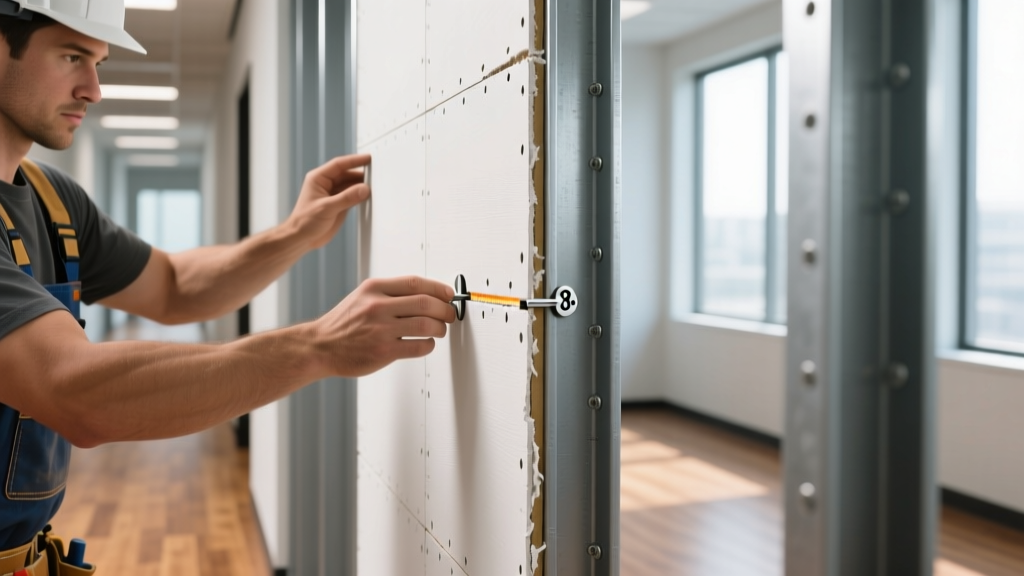
Decision Framework: Upgrading to Shaftliner Panels
When designing elevator shafts, stairwells, or mechanical chase enclosures, standard 5/8-inch Type X applied to both sides of a stud wall becomes impractical due to the labor required to frame and finish the inaccessible shaft side. In these scenarios, you must upgrade to specialized fire-rated gypsum products:
- 1-Inch Shaftliner Panels: These are rigid, self-supporting Type X panels that slide into the flanges of specialized H-studs or C-H studs. They allow contractors to build the fire-rated shaft wall from the corridor side without needing scaffolding inside the shaft.
- Abuse-Resistant Firecode: In hospital corridors or school stairwells where a 1-hour fire rating must be combined with impact resistance, specify 5/8-inch abuse-resistant Type X. These feature a denser core and heavy-duty fiberglass mesh facers to prevent punctures from gurneys and carts.
2026 Cost Variables for Fire-Rated Assemblies
Budgeting for fire-rated drywall requires looking beyond the sheet goods. The total installed cost per square foot for a 1-hour rated partition (single layer of 5/8" Type X on both sides of 3-5/8" 25-gauge steel studs) breaks down as follows:
- Material (Board & Studs): $1.80 - $2.40 per sq. ft.
- Labor (Hanging): $1.25 - $1.85 per sq. ft. (Heavier boards and tighter screw schedules increase labor time by roughly 15% compared to standard 1/2" board).
- Taping & Finishing (Level 4): $1.40 - $2.10 per sq. ft.
- Firestop Penetrations: $45.00 - $85.00 per penetration (including intumescent sealant and labor).
Frequently Asked Questions
Does fire-rated gypsum board also block sound?
While the increased mass and density of 5/8-inch Type X provide a marginal improvement in Sound Transmission Class (STC) over standard 1/2-inch board (typically raising STC by 2-3 points), it is not an acoustic product. For party walls requiring both fire and sound ratings, you must incorporate acoustic batt insulation, resilient channels, or specialized sound-damping gypsum boards in a multi-layer assembly.
Can I use fire-rated gypsum board in wet areas?
No. Standard Type X and Type C boards feature a standard paper facing that will degrade when exposed to continuous moisture. For fire-rated walls in commercial restrooms or shower surrounds, you must specify moisture-resistant fire-rated board (often featuring a green or purple glass-mat facing) or utilize a cement board system with a dedicated fire-rated backing layer.
How do I verify the fire rating of an existing wall?
Look for the manufacturer's stamp on the tapered edge of the board, which is often visible in the attic, plenum space, or inside electrical outlet boxes. The stamp will indicate the manufacturer, the mill location, and whether it is Type X or Type C. You can then cross-reference this with the UL Fire Resistance Directory to confirm the assembly's rating.
Written by
Priya KapoorPriya Kapoor is a real estate market analyst and construction economics researcher with expertise in housing affordability, development feasibility, and infrastructure investment. She holds a Master of Regional Planning from Cornell University and previously worked as a senior analyst at CBRE's Investment Properties group, where she modeled returns for $4B in mixed-use development pipelines. Priya now runs an independent research practice advising developers, municipalities, and REITs on construction cost forecasting and market timing. She publishes the quarterly "BuildMat Market Pulse" report tracking material price indices across 12 commodity categories. Based in Austin, TX, Priya serves on the board of Habitat for Humanity Austin and is a marathon runner.
More from Priya Kapoor
View all
Construction Cost
Cost to Build a 1600 Sq Ft Home in 2026: Full Breakdown
Accurate 2026 cost to build a 1600 sq ft home—material, labor, and regional pricing breakdowns included. Plan your budget with real-time estimates.
Aug 11, 2026

Wood & Lumber
Name the Types of Wood for Pressure Treatment and Preservation
Learn how to name the types of wood best suited for pressure treatment. Compare species treatability, chemical retention levels, and 2026 preservation costs.
Aug 4, 2026

Stone & Masonry
Stone Veneer Suppliers Lindenhurst: 2026 Cost Analysis
Analyze 2026 stone veneer costs in Lindenhurst, NY. Compare local supplier pricing, delivery fees, and Suffolk County installation labor rates.
Aug 4, 2026