Gypsum Board Anchor Code Compliance: Load Limits & IBC Rules
Master gypsum board anchor code compliance. Learn IBC load limits, ASCE 7 seismic rules, fire-rated assembly penetrations, and allowable stress matrices.

The Core IBC Requirements for Gypsum Board Anchors
Anchoring into gypsum board is frequently treated as a casual DIY task, but in commercial construction and multi-family residential projects, it is strictly governed by the International Building Code (IBC). Gypsum board is classified as a non-structural cladding material. Under IBC Section 1604, any load applied to a wall assembly must ultimately be transferred to the structural framing. When a gypsum board anchor is used to support nonstructural components—such as commercial shelving, medical equipment, or HVAC ductwork—the anchor must possess a verified allowable load capacity that accounts for dynamic forces, material degradation, and safety factors.
The fundamental rule of drywall anchorage in commercial spaces is the safety factor. The International Code Council (ICC) and manufacturer listings typically require a 4:1 or 5:1 safety factor for allowable stress design (ASD). This means an anchor that physically fails at 200 lbs of tensile pull-out force only has a code-allowable load of 40 to 50 lbs.
Anchor Classifications and Allowable Load Matrices
Selecting the correct hardware requires matching the anchor mechanism to the board thickness and core density. Standard 1/2-inch gypsum board has a significantly lower pull-out threshold than 5/8-inch Type X fire-rated board, which features a denser, fiberglass-reinforced core. Below is a comparative matrix of common anchor types and their code-allowable limits in standard wallboard.
| Anchor Type | Model / Example | Ultimate Tensile (1/2" Std) | Code Allowable (4:1 SF) | Seismic Approved? |
|---|---|---|---|---|
| Strap Toggle | Cobra SnapToggle | 250 lbs | 62 lbs | No (Bearing only) |
| Threaded Metal | Hilti HAS-E M6 | 150 lbs | 37 lbs | Conditional |
| Expansion (Plastic) | Generic Ribbed | 40 lbs | 10 lbs | No |
| Stud-Mounted | Simpson Strong-Drive | 800 lbs | 200 lbs | Yes |
Tensile vs. Shear Load Realities in 1/2" vs. 5/8" Type X
Inspectors frequently flag installations that confuse tensile (pull-out) strength with shear (downward) strength. A 1/4-inch steel toggle bolt may hold 100 lbs in sheer against the wall face, but the gypsum core will crush under the point load if the fastener head is not paired with a wide-bearing washer. When anchoring into 5/8-inch Type X board, the denser core increases screw-holding power by approximately 30% compared to standard 1/2-inch board, according to testing standards published in the Gypsum Association's technical resources. However, this density also means that forcing a standard plastic expansion anchor into Type X will often snap the anchor shaft before the fins can deploy.
Fire-Rated Assemblies: Penetrations and Anchor Restrictions
When installing anchors into a fire-rated partition (such as a 1-hour rated corridor wall governed by UL Design U419 or U465), the penetration created by the anchor becomes a critical code checkpoint. Under ASTM E119, any breach in the fire-resistive membrane must be properly firestopped.
Code Excerpt Principle: Small, solid steel fasteners (like standard drywall screws or narrow lag bolts) that do not create an open void are generally exempt from firestopping. However, hollow-toggle mechanisms, strap toggles, or oversized expansion sleeves that leave an annular gap between the anchor and the gypsum core must be sealed with an ASTM E814 tested through-penetration firestop system.
If you are using a 1/2-inch diameter strap toggle in a rated wall, the resulting hole must be packed and sealed with an intumescent firestop sealant, such as Hilti CP 606 or 3M Fire Barrier Sealant FD 150+, to maintain the assembly's hourly rating. Failure to seal these voids is one of the most common reasons commercial drywall fails final fire marshal inspections.
Seismic Bracing and Nonstructural Component Anchorage
In Seismic Design Categories C, D, E, and F, ASCE 7-22 Chapter 13 dictates how nonstructural components must be anchored. The code explicitly prohibits relying solely on gypsum board to resist seismic shear or tensile forces for heavy or hazardous components.
- HVAC Ductwork & Piping: Must bypass the drywall entirely and anchor directly to the structural deck or steel studs using approved strut channels.
- Commercial Shelving (Under 400 lbs): May utilize heavy-duty steel toggle anchors, provided the 4:1 safety factor is maintained and the anchors are spaced to distribute dynamic racking forces.
- Medical & IT Equipment: Requires positive mechanical engagement with the underlying steel or wood framing. Drywall-only anchors are strictly prohibited for life-safety medical gas manifolds or heavy server racks.
Real-World Failure Modes and Inspector Red Flags
Understanding why anchors fail in the field helps prevent costly rework. Building inspectors and structural engineers look for specific red flags during rough-in and final inspections:
- Over-reamed Pilot Holes: Using a 5/8-inch drill bit for a 1/2-inch toggle bolt destroys the paper face and compromises the gypsum core's bearing capacity, reducing pull-out strength by up to 60%.
- Edge Distance Violations: Anchors placed within 1.5 inches of a board edge, corner, or tapered joint lack sufficient core material to distribute the load, leading to catastrophic blowouts.
- Over-torquing Threaded Anchors: Zinc-alloy threaded drywall anchors (like E-Z Ancors) are frequently stripped by impact drivers. The correct installation requires a hand screwdriver or a drill with a strict torque-limiting clutch set to under 40 in-lbs.
- Missing Bearing Plates: Attaching heavy wire aircraft cable or thin brackets directly to a toggle bolt head will slice through the drywall paper under shear load. Code requires a minimum 2-inch square steel fender washer to distribute the point load.
Step-by-Step Compliant Installation Protocol
To ensure your gypsum board anchor installation passes structural and fire inspections, follow this strict protocol:
- Scan and Map: Use a high-density stud finder to locate underlying steel or wood framing. If the load exceeds the allowable drywall-only limits, abandon the drywall anchor and use a structural framing fastener.
- Select the Hardware: Choose a code-listed anchor. For hollow cavities in 5/8" Type X, select a 1/4-inch or 3/8-inch steel strap toggle.
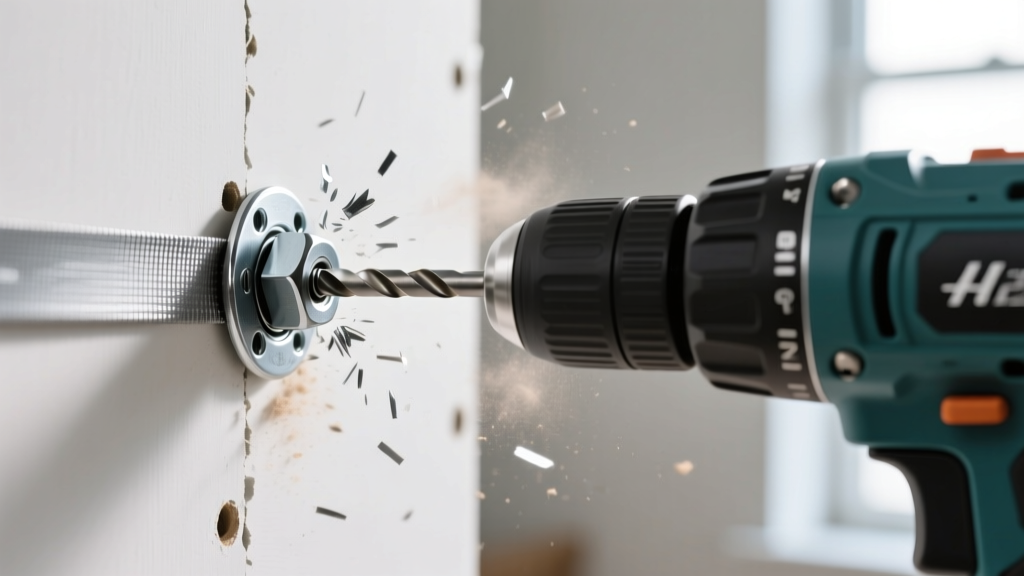
- Drill to Exact Spec: Use a sharp brad-point or carbide bit exactly matching the manufacturer's required hole size. Do not use spade bits, which tear the paper face.
- Insert and Set: Feed the toggle through the cavity, pull the strap tight to seat the toggle flat against the back of the gypsum board, and snap off the excess plastic strap flush with the wall surface.
- Torque and Seal: Insert the machine screw and tighten until snug (do not over-torque). If the wall is a rated assembly, inject ASTM E814 tested firestop sealant around the collar of the anchor to seal any micro-gaps.
By treating gypsum board anchorage as a structural calculation rather than an afterthought, contractors can avoid failed inspections, mitigate liability, and ensure the long-term safety of the built environment. For comprehensive testing data on specific fastener pull-out values, refer to the UL fire testing and building materials directories to verify the exact listings for your chosen hardware.
Written by
Priya KapoorPriya Kapoor is a real estate market analyst and construction economics researcher with expertise in housing affordability, development feasibility, and infrastructure investment. She holds a Master of Regional Planning from Cornell University and previously worked as a senior analyst at CBRE's Investment Properties group, where she modeled returns for $4B in mixed-use development pipelines. Priya now runs an independent research practice advising developers, municipalities, and REITs on construction cost forecasting and market timing. She publishes the quarterly "BuildMat Market Pulse" report tracking material price indices across 12 commodity categories. Based in Austin, TX, Priya serves on the board of Habitat for Humanity Austin and is a marathon runner.
More from Priya Kapoor
View all
Construction Cost
Cost to Build a 1600 Sq Ft Home in 2026: Full Breakdown
Accurate 2026 cost to build a 1600 sq ft home—material, labor, and regional pricing breakdowns included. Plan your budget with real-time estimates.
Aug 11, 2026

Wood & Lumber
Name the Types of Wood for Pressure Treatment and Preservation
Learn how to name the types of wood best suited for pressure treatment. Compare species treatability, chemical retention levels, and 2026 preservation costs.
Aug 4, 2026

Stone & Masonry
Stone Veneer Suppliers Lindenhurst: 2026 Cost Analysis
Analyze 2026 stone veneer costs in Lindenhurst, NY. Compare local supplier pricing, delivery fees, and Suffolk County installation labor rates.
Aug 4, 2026