Inside a Gypsum Board Factory: Dimensional Specs & Tolerances
Explore exact dimensional specifications, ASTM C1396 tolerances, and manufacturing controls inside a modern gypsum board factory.

The Continuous Line: How Factories Control Core Dimensions
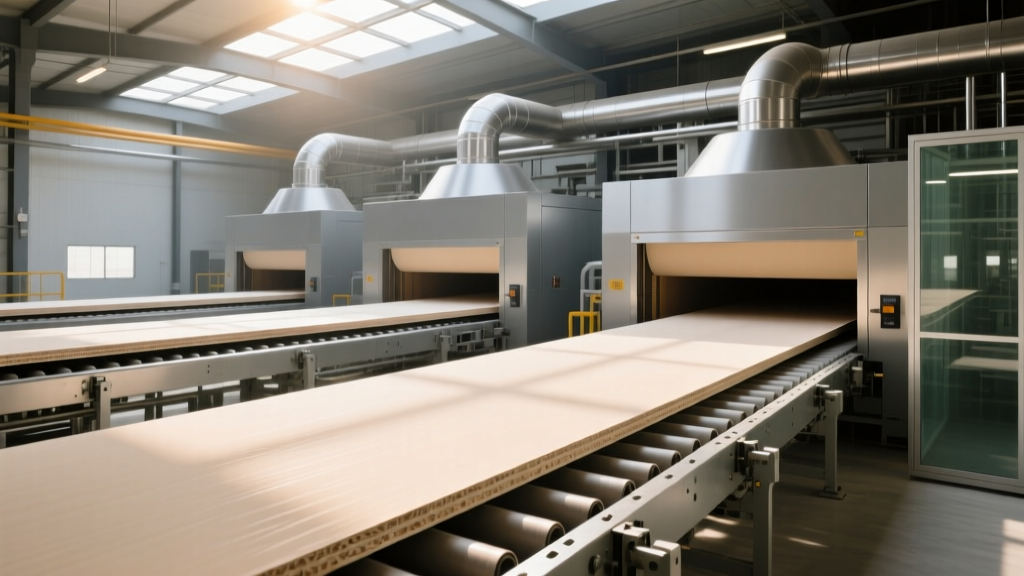
Modern gypsum board manufacturing is a high-speed, continuous extrusion and lamination process. Inside a commercial gypsum board factory, raw calcined gypsum (stucco) is mixed with water, paper fibers, and specific chemical additives to form a slurry. This slurry is poured between two continuous sheets of heavy-duty facing paper on a moving conveyor. The dimensional accuracy of the final panel is not achieved through post-cutting, but is locked in at the forming station and solidified in the kiln.
Once the continuous sandwich of paper and slurry exits the forming station, it travels through a multi-tiered kiln dryer. The kiln's temperature zones (typically ranging from 350°F to 500°F) drive off the free water without calcining the chemically bound water (dihydrate) back into hemihydrate. Over-drying causes "dead-burned" edges that crumble, while under-drying leaves residual moisture that compromises dimensional stability and leads to sagging post-installation.
ASTM C1396 Dimensional Tolerances: The Factory Baseline
Every reputable gypsum board factory calibrates its cutting and routing equipment to meet or exceed the baseline tolerances established in ASTM C1396 (Standard Specification for Gypsum Board). Below are the exact dimensional parameters and the maximum allowable factory deviations for standard panels.
| Dimension | Standard Factory Sizes | ASTM C1396 Tolerance | Metric Equivalent |
|---|---|---|---|
| Thickness | 1/4", 3/8", 1/2", 5/8" | ± 1/64 in. | ± 0.4 mm |
| Width | 48 in., 54 in. | ± 1/8 in. | ± 3.2 mm |
| Length | 8 ft to 16 ft | ± 1/4 in. | ± 6.4 mm |
| Squareness | All panels | ± 1/8 in. per 4 ft | ± 3.2 mm per 1.2 m |
| Tapered Edge Depth | Standard TE panels | 0.020 in. to 0.090 in. | 0.5 mm to 2.3 mm |
Decoding Factory Tolerances: Why Squareness and Thickness Dictate Performance
While length and width deviations are easily absorbed by framing layouts, thickness and squareness tolerances directly impact the structural and aesthetic performance of the installed system.
The Cascading Effect of Out-of-Square Boards
Squareness is measured by comparing the diagonals of a cut panel. If a factory's flying cutoff saw is misaligned, the resulting panels will be parallelograms rather than perfect rectangles. When installers hang out-of-square boards on a ceiling grid, the butt joints will not align flush. This forces the taper to compensate with excessive joint compound, leading to ridging, photographing, and ultimately, rejected Level 5 finishes. A deviation of just 1/8 inch over a 4-foot span translates to a 3/8-inch gap at the end of a 12-foot board.
Thickness Variances and Fire Ratings
Thickness tolerance (± 1/64 inch) is critical for fire-rated assemblies. UL (Underwriters Laboratories) design assemblies specify exact board thicknesses to achieve 1-hour or 2-hour fire resistance ratings. If a factory runs a 5/8-inch Type X board at the absolute minimum negative tolerance (0.609 inches instead of 0.625 inches), the core mass is reduced. While it may still pass the factory's internal QC, it compromises the thermal barrier in a real-world fire event, potentially voiding the assembly's UL listing if investigated.
Specialty Board Manufacturing: Density and Weight Variations
A gypsum board factory does not merely change the paper color to produce specialty boards; it fundamentally alters the slurry chemistry, aeration (foam) levels, and fiberglass reinforcement. These changes drastically affect the panel's weight and density specifications.
Modern factories inject precise volumes of foaming agents into the slurry to create microscopic air bubbles within the gypsum core. This reduces the weight of a standard 1/2-inch panel from roughly 2.0 lbs/sq ft down to 1.6 lbs/sq ft without sacrificing structural integrity. However, for Type X (fire-rated) boards, factories significantly reduce the foam injection and add chopped fiberglass strands to the slurry to maintain core cohesion at high temperatures, resulting in a heavier, denser panel.
Comparative Factory Specifications: Core Density and Weight
| Panel Type | ASTM Standard | Nominal Thickness | Factory Target Weight | Core Density Profile |
|---|---|---|---|---|
| Standard Lightweight | C1396 | 1/2 in. | 1.6 lbs/sq ft | Highly Aerated |
| Type X (Fire-Rated) | C1396 | 5/8 in. | 2.2 lbs/sq ft | Dense, Fiberglass Reinforced |
| Moisture Resistant (MR) | C1396 | 1/2 in. | 1.7 lbs/sq ft | Moderate Aeration, Wax Additives |
| Glass Mat (Exterior) | C1658 | 5/8 in. | 2.4 lbs/sq ft | Ultra-Dense, Siloxane Treated |
Factory Quality Control: Beyond the Tape Measure
Dimensional accuracy is only the first layer of factory quality control. Before a production run is cleared for shipping, the factory laboratory conducts destructive testing to ensure the physical properties match the dimensional specs.
- Humidified Deflection Test: Samples are cut to exact dimensions and placed in a humidity chamber (typically 90% RH at 90°F) for 24 hours. The factory measures the center-point sag. A 1/2-inch panel must not deflect more than 1/8 inch over a 24-inch span to pass.
- Core Hardness and Nail Pull: Using a Durometer, lab technicians test the surface hardness of the gypsum core. Concurrently, nail-pull resistance is tested; a standard 1/2-inch panel must withstand a minimum of 80 lbs of pull-out force, while Type X must exceed 90 lbs due to its denser, fiberglass-laced core.
- Foil Adhesion (for FSK faced boards): For specialty boards with foil backings, the factory conducts peel-strength tests to ensure the adhesive lamination survives the thermal expansion and contraction cycles of the kiln without delaminating.
Direct-from-Factory Sourcing vs. Distributor Verification
When procuring materials for large-scale commercial projects, general contractors often debate between buying through local distribution yards or sourcing direct from a gypsum board factory. Understanding how factories handle dimensional specs informs this decision.
The "Mill Run" Advantage
Ordering direct from the factory (often called a "mill run") guarantees that all panels for a specific project are pulled from the same continuous production run. This ensures absolute uniformity in tapered edge depth, core density, and paper tension. Distributor yards, conversely, mix inventory from multiple factories and production dates. Mixing a 1/2-inch board manufactured in January with one manufactured in August can result in visible seam ridging due to microscopic variations in the factory's forming plate calibration and seasonal humidity adjustments in the slurry mix.
Verifying Specs on the Job Site
Regardless of the supply chain route, site superintendents must verify factory specs upon delivery. Do not rely solely on the end-tape label. Use digital calipers to measure the thickness at the tapered edge and the board center. Check squareness by measuring diagonals on a random sample of 5 boards per bundle. If the diagonal variance exceeds 1/8 inch, reject the bundle; the factory's cutoff saw timing was out of sync, and attempting to hang those boards will cost more in drywall finishing labor than the material is worth.
Written by
David NakamuraDavid Nakamura is a licensed architect (AIA) and construction technology writer focused on sustainable building methods, mass timber engineering, and high-performance building envelopes. He holds a Master of Architecture from the University of Washington and is a certified Passive House Consultant (CPHC). David spent eight years at the Seattle firm Mithun, where he led the design of three LEED Platinum projects, before founding his own practice specializing in net-zero residential design. He serves on the editorial advisory board of GreenBuilder Magazine and has authored peer-reviewed papers on cross-laminated timber (CLT) connections for the Journal of Structural Engineering. In his spare time, David teaches woodworking at Pratt Fine Arts Center and kayaks the Puget Sound.
More from David Nakamura
View all
Construction Cost
Labor Cost to Build a Deck Per Sq Ft: 2026 Installation Guide
Discover the exact labor cost to build a deck per sq ft in 2026. This installation guide breaks down contractor rates, complexity factors, and hidden fees.
Aug 4, 2026

Construction Cost
How Much Does It Cost to Build a 3 Bedroom House? Financing Guide
Learn exactly how much it costs to build a 3 bedroom house and explore 2026 financing options, construction loan types, and budget frameworks for your build.
Aug 4, 2026

Construction Cost
Cost to Build a Tennis Court: 2026 Guide
How much does it cost to build a tennis court in 2026? Breakdowns for asphalt, concrete, and synthetic surfaces plus fencing and lighting.
Jul 30, 2026