Top Gypsum Board Manufacturers vs Alternative Wall Panels 2026
Compare top gypsum board manufacturers against MgO, fiber cement, and wood fiber alternatives. Analyze 2026 costs, fire ratings, and installation labor.

The Core Contenders: Leading Gypsum Board Manufacturers
When specifying interior wall and ceiling assemblies, the products produced by major gypsum board manufacturers remain the baseline for commercial and residential construction. The dominance of these manufacturers stems from a highly optimized supply chain, predictable fire performance, and low installation labor costs. In 2026, the market is anchored by three primary producers, each offering specialized product lines that compete directly with alternative panel systems.
USG Corporation (Sheetrock)
USG's flagship Sheetrock UltraLight Panels revolutionized the industry by reducing board weight by up to 25% compared to traditional 1/2-inch drywall. A standard 4x8 sheet weighs approximately 41 pounds, significantly reducing installer fatigue and hang times. Priced between $14.50 and $16.00 per sheet, UltraLight maintains standard ASTM C1396 compliance for physical properties while utilizing a proprietary foam-core technology that preserves structural rigidity.
National Gypsum Company (Gold Bond)
National Gypsum targets high-moisture and high-abuse environments with its Gold Bond XP line. These boards feature a treated core and a moisture- and mold-resistant face paper, achieving a score of 10 on the ASTM D3273 mold resistance test (the highest possible rating). At $18.00 to $21.00 per 4x8 sheet, XP boards are the standard for commercial restrooms, basements, and exterior soffit backing.
Georgia-Pacific (ToughRock)
GP's ToughRock Fireguard series represents the pinnacle of Type X gypsum technology. By incorporating specialized glass fibers and vermiculite into the gypsum core, Fireguard 1/2-inch boards achieve a 1-hour fire-resistance rating in specific wall assemblies under ASTM E119 testing, a benchmark that typically requires 5/8-inch standard Type X board. Priced around $17.00 to $19.00 per sheet, it allows builders to meet strict fire codes while minimizing material thickness and weight.
Alternative Wall Panel Systems: The Challengers
Despite the ubiquity of gypsum, alternative panel systems have carved out significant market share in niches where traditional paper-faced gypsum fails—specifically in continuous water exposure, extreme impact zones, and specialized acoustic applications.
Magnesium Oxide (MgO) Boards
MgO boards (such as DragonBoard or Promat) are cementitious panels bound by magnesium oxide. They are completely impervious to water and will not support mold growth, making them ideal for exterior sheathing, tile backers in wet rooms, and coastal construction. However, a 1/2-inch 4x8 sheet costs between $42.00 and $55.00. Furthermore, MgO boards are highly alkaline; if not properly sealed or if low-quality 'weeping' MgO is used, they can leach salts that corrode adjacent metal fasteners and framing.
Fiber Cement Panels
Products like James Hardie's HardieBacker or architectural fiber cement panels offer immense dimensional stability and impact resistance. Weighing over 60 pounds per 4x8 sheet, fiber cement is exceptionally dense and provides excellent acoustic mass. It is completely rot-proof and termite-proof. The primary drawback is workability: cutting fiber cement generates hazardous silica dust, requiring specialized HEPA vacuums and carbide-tipped scoring tools, which drastically increases labor time.
Wood Fiber and Cellulose Boards
Brands like Homasote or Mento produce structural and acoustic boards made from recycled cellulose and wood fibers. While they lack the fire resistance of gypsum (unless heavily treated with borates) and cannot be used in wet areas, they offer superior sound dampening and thermal insulation properties. They are frequently used as continuous insulation sheathing or specialized acoustic wall linings in recording studios and multi-family party walls.
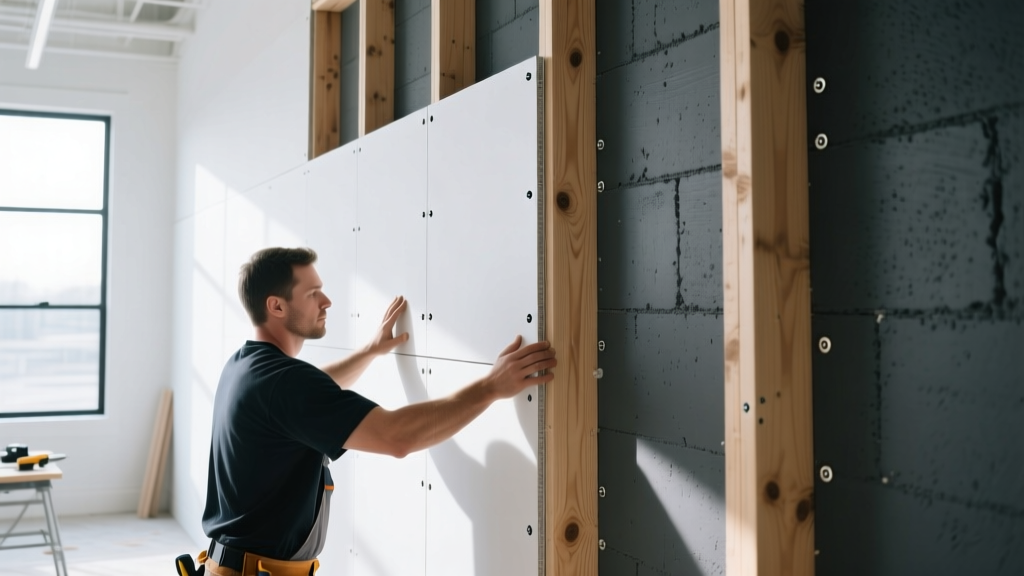
Head-to-Head Matrix: Gypsum vs. Alternatives
The following matrix compares standard 1/2-inch 4x8 panels across critical performance and economic metrics for 2026 construction planning.
| Metric | Standard Gypsum (USG/NG/GP) | MgO Board | Fiber Cement Panel | Wood Fiber Board |
|---|---|---|---|---|
| Material Cost (4x8) | $14.50 - $21.00 | $42.00 - $55.00 | $35.00 - $48.00 | $25.00 - $32.00 |
| Weight per Sheet | 41 - 52 lbs | 55 - 65 lbs | 60 - 75 lbs | 25 - 35 lbs |
| Fire Rating (ASTM E119) | Excellent (Type X rated) | Excellent (Non-combustible) | Excellent (Non-combustible) | Poor (Combustible) |
| Moisture Resistance | Poor to Moderate (XP variants) | Exceptional | Exceptional | Poor |
| Cutting Method | Score and snap utility knife | Score/snap or carbide saw | Carbide saw / shears (silica dust) | Utility knife / standard saw |
| Finishing (Tape/Mud) | Standard joint compound | Requires specialized mesh/polymer mud | Not typically finished smooth | Not finished smooth |
Hidden Costs: Installation, Tool Wear, and Labor Variances
When evaluating gypsum board manufacturers against alternative panel producers, contractors often make the mistake of comparing material costs alone. The true cost divergence occurs during installation and finishing.
Cutting fiber cement alternatives releases respirable crystalline silica. OSHA regulations mandate strict exposure controls, including water suppression or HEPA-filtered saws. This adds approximately 1.5 to 2.0 labor hours per 100 square feet compared to the score-and-snap method used for traditional gypsum board. Always factor in PPE compliance and tool blade degradation when bidding fiber cement interiors.
Gypsum board remains the undisputed king of speed. A two-person drywall crew can hang, tape, and apply two coats of mud to 1,000 square feet of standard gypsum in roughly three days. MgO boards, while cuttable with a knife, have brittle edges that chip easily, requiring corner beads on almost every external angle and specialized polymer-modified joint compounds to prevent joint cracking due to the board's high alkalinity. This finishing bottleneck can increase labor costs by 30% to 40% compared to standard gypsum finishing.
Fastener selection also introduces hidden costs. Standard drywall screws (fine-thread for metal, coarse-thread for wood) cost roughly $40 per 5lb box. MgO and fiber cement require corrosion-resistant, self-drilling screws with specialized winged heads to prevent the dense material from 'mushrooming' around the fastener. These specialized fasteners can cost two to three times more per pound, adding $150 to $300 to the hardware budget of a mid-sized commercial project.
Real-World Scenario Decision Framework
Selecting between products from top gypsum board manufacturers and alternative panels requires matching the material's physical properties to the specific environmental and regulatory demands of the space.
- Scenario A: Standard Commercial Office Partitions
Decision: Use 1/2-inch UltraLight Gypsum (USG) or ToughRock (GP).
Rationale: Fire codes are easily met with Type X variants, acoustic privacy is achieved with standard batt insulation, and the low material/labor cost maximizes ROI. Alternatives offer no performance advantage here. - Scenario B: Commercial Kitchen and Wet-Prep Areas
Decision: Use MgO Board or Glass-Mat Gypsum (e.g., Georgia-Pacific DensGlass).
Rationale: Paper-faced gypsum, even moisture-resistant XP variants, will eventually degrade under continuous high-humidity and direct water exposure. MgO provides a completely inorganic, rot-proof substrate for commercial tile and FRP (fiberglass reinforced plastic) wall panels. - Scenario C: High-Impact Corridor Wainscoting
Decision: Use Fiber Cement Panels or High-Abuse Gypsum (e.g., USG Sheetrock AbuseCore).
Rationale: Standard gypsum dents and punctures easily from cart and gurney traffic. Fiber cement offers extreme impact resistance, though if a smooth painted finish is required, specialized high-abuse gypsum boards with embedded fiberglass mesh provide a better balance of impact resistance and finishability. - Scenario D: Recording Studios or Multi-Family Demising Walls
Decision: Wood Fiber Acoustic Boards paired with decoupled Gypsum layers.
Rationale: Mass and decoupling are required for STC (Sound Transmission Class) ratings. Wood fiber boards provide excellent high-frequency sound absorption and thermal breaks, while the outer layers of dense 5/8-inch Type X gypsum provide the necessary low-frequency mass and fire separation.
Environmental and Supply Chain Considerations
In 2026, embodied carbon and Environmental Product Declarations (EPDs) heavily influence material selection for LEED and WELL-certified projects. Gypsum board manufacturers have made significant strides in reducing the carbon footprint of their products. Synthetic gypsum—captured as a byproduct of flue-gas desulfurization in coal-fired power plants—now accounts for a massive percentage of the core material in USG and National Gypsum products, diverting millions of tons of waste from landfills.
However, as coal plants are decommissioned, the supply of synthetic gypsum is tightening. Manufacturers are increasingly investing in advanced recycling facilities to reclaim post-consumer drywall, closing the loop on gypsum production. Conversely, MgO and fiber cement boards are highly energy-intensive to produce, requiring kiln temperatures that generate a significantly higher embodied carbon footprint per square foot. Wood fiber boards, while boasting the lowest embodied carbon and acting as a carbon sink, cannot meet the stringent non-combustibility requirements of commercial stairwells and elevator shafts.
Ultimately, while alternative panels excel in extreme moisture and high-impact niches, the continuous innovation by leading gypsum board manufacturers in weight reduction, fire chemistry, and synthetic material recycling ensures that gypsum remains the most cost-effective, code-compliant, and labor-efficient wall assembly for the vast majority of modern construction projects.
Written by
Sarah WhitfieldSarah Whitfield is a chartered quantity surveyor (MRICS) and construction cost analyst with 15 years of experience in material pricing, procurement strategy, and project budgeting. She earned her degree in Construction Management from the University of Reading (UK) and has worked on projects ranging from $2M custom homes to $180M mixed-use developments across North America and Europe. Sarah currently leads cost estimating for BuildMat Insight, maintaining a proprietary database of 4,000+ material price points updated quarterly. She is a frequent contributor to RSMeans cost data panels and has presented at the International Cost Engineering Council (ICEC) congress. Based in Denver, CO, Sarah is an avid trail runner and volunteer mentor for Women in Construction.
More from Sarah Whitfield
View all
Wood & Lumber
What Are the Different Types of Wood? A Builder's Guide
Compare structural softwoods, finish hardwoods, and engineered lumber. Analyze Janka ratings, MOE values, and 2026 pricing for construction.
Aug 4, 2026

Walls & Panels
Steel Framing vs Wood Framing: Corrosion and Moisture Defense
Compare steel framing vs wood framing for moisture resistance. Learn about galvanized coatings, condensation risks, and corrosion protection strategies.
Jul 21, 2026

Stone & Masonry
How to Cut Stone Veneer: Wet Saw vs Grinder Comparison
Compare the best tools for cutting stone veneer. We review wet saws, angle grinders, and chop saws to help you achieve clean, chip-free cuts.
Jul 21, 2026