What Is Gypsum Board Made Of? Composition & Selection Guide
Discover exactly what gypsum board is made of, from calcium sulfate chemistry to facers, and use this composition guide to select the right drywall.

Understanding what gypsum board is made of is the most critical step in specifying the correct drywall for any construction project. While often dismissed as a generic commodity, modern gypsum board is a highly engineered composite material. Its performance in fire resistance, moisture management, and acoustic isolation is dictated entirely by its chemical composition, core additives, and facer materials.
This guide deconstructs the exact material science behind gypsum board and provides a practical selection framework based on its physical makeup, ensuring you specify the right product for structural, environmental, and life-safety requirements.
The Core Chemistry: Calcium Sulfate Dihydrate
At its most fundamental level, the core of gypsum board is composed of calcium sulfate dihydrate (CaSO4·2H2O). This mineral can be sourced naturally through mining or synthetically produced as a byproduct of coal-fired power plants through Flue Gas Desulfurization (FGD). According to the Gypsum Association, synthetic FGD gypsum now accounts for a significant portion of North American manufacturing, offering high purity and reducing the environmental impact of mining.
During manufacturing, raw gypsum is crushed and subjected to calcination—a heating process that drives off approximately 75% of its chemically bound water. This transforms the dihydrate into calcium sulfate hemihydrate (CaSO4·0.5H2O), commonly known as stucco plaster or calcined gypsum.
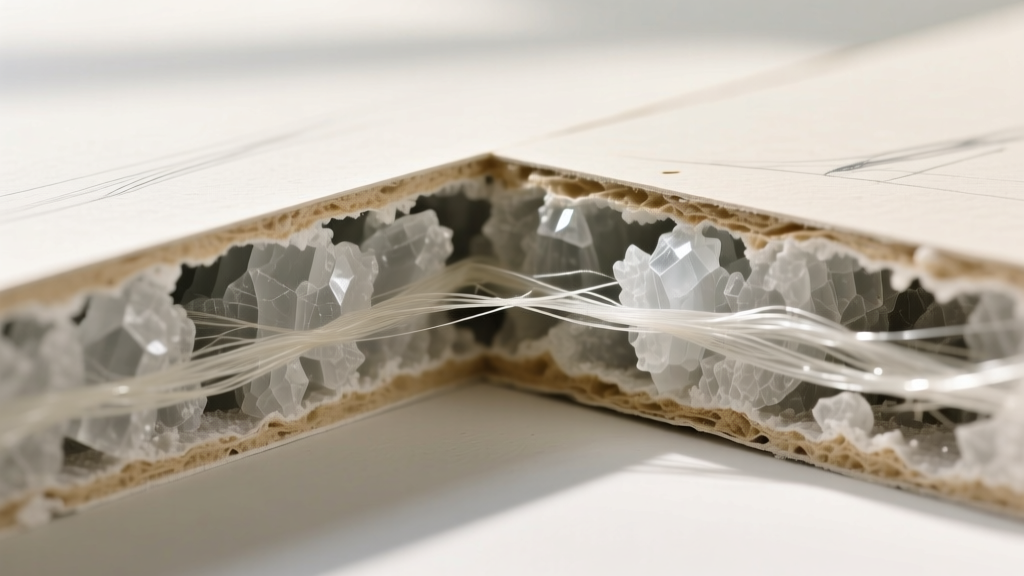
When mixed with water and additives at the plant, the hemihydrate rehydrates and recrystallizes into a rigid, interlocking dihydrate matrix. This recrystallization is the secret to gypsum's inherent fire resistance. When exposed to fire, the board undergoes calcination in reverse: the heat drives off the chemically bound water as steam, actively absorbing thermal energy and delaying heat transmission to the structural framing behind it.
Core Additives: Engineering Specific Performance Profiles
Pure gypsum is brittle and heavy. To achieve the diverse performance profiles required by modern building codes (such as ASTM C1396), manufacturers introduce precise chemical modifiers into the slurry before it sets. The specific combination of these additives dictates which board type is produced.
| Additive | Primary Function | Resulting Board Classification |
|---|---|---|
| Fiberglass Strands | Creates a structural web that holds the calcined core together after water is driven off by fire. | Type X and Type C Fire-Rated Board |
| Vermiculite / Perlite | Expands under extreme heat, filling micro-cracks and insulating the core during prolonged fire exposure. | Type C (Enhanced Fire-Rated) Board |
| Silicone / Wax Emulsions | Integrates hydrophobic properties throughout the core, preventing water absorption and wicking. | Moisture-Resistant (MR) Board |
| Starch (Corn/Wheat) | Migrates to the surface during drying to chemically bond the gypsum core to the paper facers. | All Paper-Faced Boards |
| Foaming Agents (Soap) | Introduces microscopic air bubbles into the slurry, reducing overall board weight without sacrificing rigidity. | Lightweight Panels (e.g., 1/2" UltraLight) |
Facer Technologies: The First Line of Defense
The core provides structural rigidity and fire resistance, but the facer material determines the board's surface durability, mold resistance, and suitability for exterior or high-humidity environments.
Paper Facers
Standard gypsum board uses a heavy manila paper on the face and a gray liner paper on the back. This paper is highly porous, allowing the board to "breathe" and manage ambient humidity. However, the cellulose in paper is a food source for mold. While modern EPA-recognized manufacturing processes treat paper facers to resist mold growth, paper-faced boards should never be used in areas with continuous, direct water exposure.
Glass Mat Facers
For exterior sheathing, tile backer boards, and high-moisture commercial environments, manufacturers replace paper with a woven fiberglass mat. Glass mat facers are entirely inorganic, rendering them immune to mold and highly resistant to water degradation. Products like Georgia-Pacific's DensGlass utilize a silicone-treated gypsum core combined with a glass mat to create a substrate that can withstand weather exposure during construction delays before the building envelope is sealed.
Foil Backing
In exterior walls in cold climates, a layer of aluminum foil is often laminated to the back of the gypsum board. This acts as a Class I vapor retarder, preventing warm, moisture-laden interior air from migrating into the wall cavity and condensing on the cold exterior sheathing.
Selection Matrix: Matching Composition to Application
Use this framework to select the correct board based on its material composition and the environmental demands of the project.
- Standard Interior Walls (White Board): Composed of a standard dihydrate core and paper facers. Select for general living spaces, bedrooms, and hallways where fire and moisture ratings are not explicitly mandated by code.
- Garages and Mechanical Shafts (Type X): Contains a minimum of 15% glass fiber by weight in the core. The 5/8-inch thickness provides a 1-hour fire rating per ASTM E119. Mandatory for walls separating a garage from living spaces.
- Commercial Corridors and Elevator Shafts (Type C): Features a higher concentration of glass fiber plus vermiculite. Often used in 1-inch thickness or multi-layer assemblies to achieve 2-hour to 4-hour fire ratings.
- Bathroom Ceilings and Kitchens (Green/Purple Board): Core is treated with silicone/wax emulsions, and the paper facers are treated with antimicrobial agents. Purple board offers superior mold resistance compared to standard green board.
- Exterior Soffits and Sheathing (Glass Mat Board): Features a water-resistant core encased in fiberglass mats. Required for unconditioned spaces, exterior ceilings, and areas exposed to weather prior to cladding installation.
Common Failure Modes and Edge Cases
Specifying the wrong material composition leads to predictable, costly failures. Avoid these common specification errors:
A frequent error is using moisture-resistant (green/purple) paper-faced gypsum board as a tile backer in wet shower areas. While the core resists water absorption, the paper facer will eventually degrade when exposed to continuous moisture behind grout lines. For direct water exposure, you must specify a glass-mat gypsum tile backer or a cementitious backer unit (CBU).
Sagging in High-Humidity Ceilings: If standard 1/2-inch gypsum board is installed on ceiling joists spaced 24 inches on-center in a humid environment (like an unconditioned attic space above), the board will absorb ambient moisture and sag between the joists. To prevent this, specify 5/8-inch board or specialized 1/2-inch sag-resistant boards that feature a denser, reinforced core matrix.
Screw Popping in Lightweight Boards: While lightweight boards reduce installer fatigue, their highly aerated, foamed cores have lower screw-holding strength than standard-density boards. When hanging heavy cabinets or commercial shelving, ensure fasteners penetrate the structural wood or metal framing, rather than relying solely on the gypsum core for shear strength.
By evaluating the exact chemical additives and facer materials of gypsum board, architects and contractors can move beyond generic specifications. Matching the board's physical composition to the specific environmental and life-safety demands of the space ensures long-term durability, code compliance, and optimal project economics.
Written by
Marcus ChenMarcus Chen is a licensed structural engineer (PE) and building materials analyst with over 12 years of experience across residential, commercial, and industrial construction. He holds a Master of Science in Civil Engineering from UC Berkeley and spent six years at Thornton Tomasetti before transitioning to independent consulting and technical writing. Marcus specializes in material selection for seismic-prone regions, concrete reinforcement strategies, and lifecycle cost analysis. His work has been cited by the American Concrete Institute (ACI) and the Structural Engineers Association of California (SEAOC). When he is not on a job site or at his desk, you will find him hiking the Sierra Nevada or restoring a 1920s craftsman bungalow in Oakland, CA.
More from Marcus Chen
View all
Construction Cost
How Much Did the Eiffel Tower Cost to Build?
How much did the Eiffel Tower cost to build in 1889? We adjust for inflation and compare its budget to modern skyscraper construction.
Aug 4, 2026

Fire Resistance
What Is a Fire Resistant Material? Testing & Certification Guide
Discover what is a fire resistant material through ASTM and UL testing. Learn how fire ratings, certifications, and assemblies work in construction.
Aug 4, 2026

Construction Cost
How Much Did the Burj Khalifa Cost to Build?
How much did the Burj Khalifa cost to build? We break down the $1.5B project and extract 5 money-saving strategies for your next build.
Jul 30, 2026