Gypsum Board for Interior Walls vs Plaster and Wood Paneling
Compare gypsum board for interior walls against wet plaster, MDF, and wood paneling. Analyze costs, fire ratings, and installation timelines.
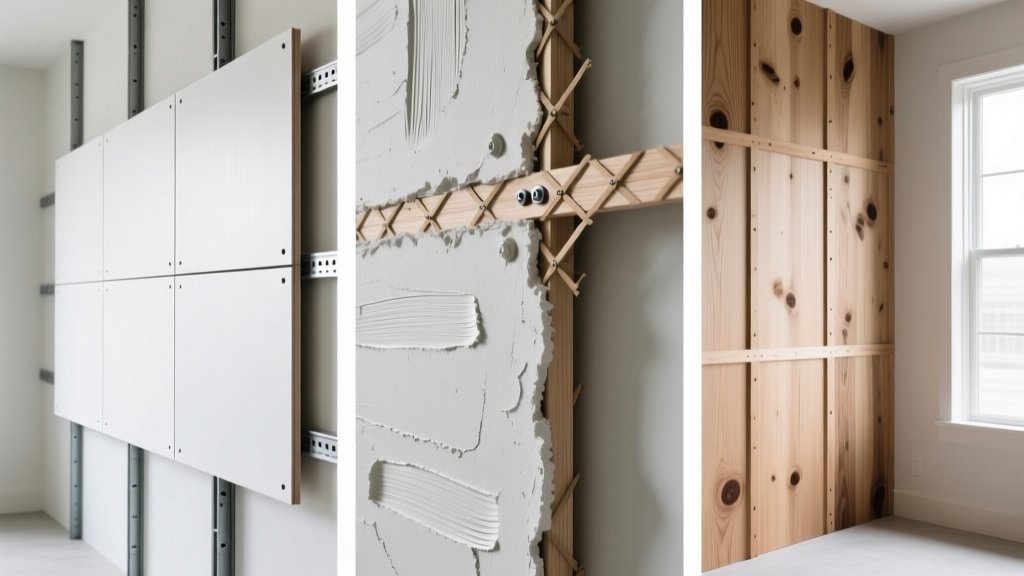
The Core Contenders: Material Breakdown
Selecting the right wall cladding dictates a project's budget, acoustic performance, and long-term durability. While gypsum board for interior walls remains the default specification for over 85% of North American residential and commercial builds, alternative materials like traditional wet plaster, Medium Density Fiberboard (MDF), and solid wood paneling offer distinct architectural and structural profiles. Understanding the exact trade-offs requires moving beyond surface-level aesthetics to examine material science, installation labor, and building code compliance.
The baseline for this comparison is standard 1/2-inch tapered-edge gypsum board (such as USG Sheetrock or CertainTeed regular), which weighs approximately 57 pounds per 4x8 sheet, or 41 pounds for ultra-light variants. We will measure this against 3-coat wet plaster, veneer plaster systems, paint-grade MDF paneling, and solid wood shiplap.
Comparative Data Matrix
| Material Specification | Material Cost (per sq ft) | Installed Cost (per sq ft) | Install Time (per 100 sq ft) | Base Fire Rating | Moisture Tolerance |
|---|---|---|---|---|---|
| 1/2" Standard Gypsum Board | $0.45 - $0.65 | $1.50 - $2.50 | 1.5 - 2 hours (hang only) | 15-30 mins (ASTM E119) | Low (Use MR board for wet areas) |
| 3-Coat Wet Plaster (over lath) | $1.20 - $2.00 | $8.00 - $14.00 | 8 - 12 hours + curing | 1 hour (ASTM E119) | Moderate (Highly durable when cured) |
| Veneer Plaster (over blue board) | $0.80 - $1.10 | $4.50 - $7.00 | 3 - 4 hours + curing | 30-60 mins | Low to Moderate |
| Paint-Grade MDF Paneling (1/2") | $1.50 - $2.80 | $3.50 - $5.50 | 2 - 3 hours | None (Combustible) | Very Low (Swells above 60% RH) |
| Solid Wood Shiplap (3/4" Pine) | $3.50 - $6.00 | $7.00 - $11.00 | 4 - 6 hours | None (Combustible) | High (Expands/contracts with humidity) |
Gypsum Board vs. Traditional Wet Plaster
The transition from wet plaster to gypsum board in the mid-20th century was driven entirely by labor economics, not material superiority. Plaster remains technically superior in several metrics, but the cost delta is severe.
Cost and Timeline Realities
A standard 3-coat plaster system (scratch, brown, and finish coats) applied over metal or rock lath requires highly skilled artisans. According to the Gypsum Association, while modern gypsum board systems can be hung, taped, and finished to a Level 4 standard in a matter of days, a 3-coat plaster wall requires mandatory curing times between coats. The brown coat alone needs up to 10 days to cure properly before the finish lime-putty coat can be applied. This extends project timelines by weeks, inflating general contractor overhead and carrying costs.
For projects demanding a plaster aesthetic without the timeline penalty, veneer plaster applied over specialized gypsum base (often called 'blue board') offers a middle ground. Blue board features a highly absorbent face paper designed to chemically bond with veneer plaster, yielding a rock-hard, monolithic surface for roughly half the cost of 3-coat plaster.
Acoustic and Structural Performance
Plaster's density gives it a distinct acoustic advantage. A standard wood-stud wall clad in 1/2-inch gypsum board on both sides yields a Sound Transmission Class (STC) rating of roughly 35. The same wall assembly finished with 7/8-inch 3-coat plaster pushes the STC rating to 42 or higher, significantly reducing airborne noise transfer. Plaster also adds substantial shear strength to wood-framed walls, acting as a structural diaphragm that gypsum board cannot replicate without specialized structural sheathing.
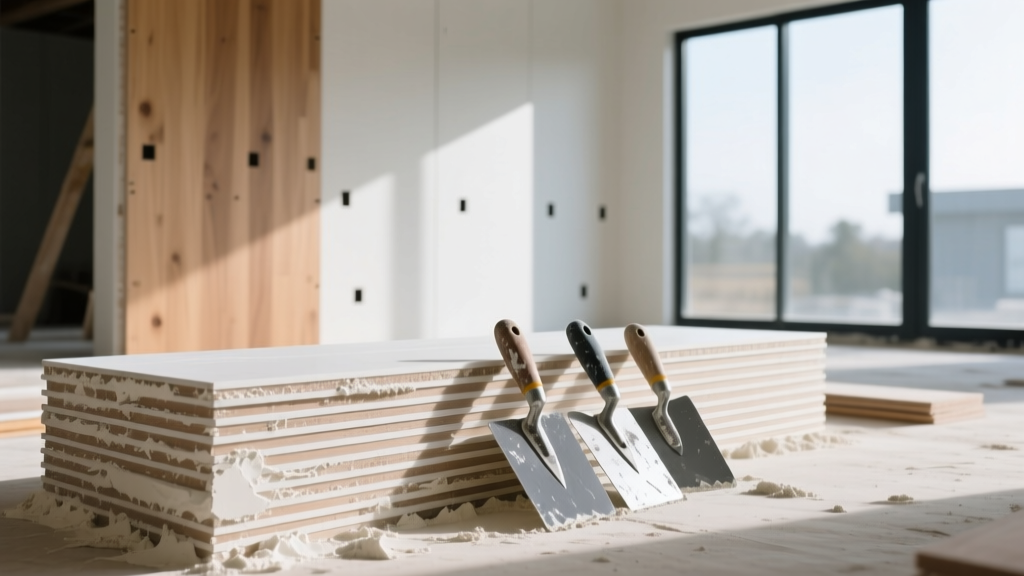
Gypsum Board vs. MDF and Wood Paneling
Architectural paneling—whether MDF or solid wood—is frequently used as a decorative overlay, but some builders attempt to use MDF as a primary wall cladding to bypass drywall finishing. This approach introduces severe code and environmental liabilities.
Fire Safety and Code Compliance
The National Fire Protection Association (NFPA) Life Safety Code strictly regulates the flame spread and smoke development indices of interior wall finishes. Standard 1/2-inch gypsum board is inherently non-combustible; its core consists of calcium sulfate dihydrate, which contains roughly 21% chemically combined water. When exposed to fire, this water calcines, actively retarding heat transmission and providing a baseline 15-to-30-minute fire barrier even in non-rated assemblies.
Conversely, MDF and solid wood paneling are combustible. MDF typically carries a Class C flame spread rating unless treated with expensive, specialized intumescent coatings. Using MDF as a primary wall cladding in commercial corridors or multi-family residential egress paths will almost universally fail fire marshal inspections, whereas gypsum board easily satisfies these baseline life-safety requirements.
Decision Framework: Which Material Fits Your Project?
Use this field-tested decision matrix to specify the correct interior wall material based on your project's primary constraints:
- Choose Standard Gypsum Board if: Your priority is budget efficiency, rapid enclosure, and straightforward code compliance. It is the undisputed champion for standard residential bedrooms, living areas, and commercial tenant build-outs. Specify Level 4 finish for flat paint and Level 5 (with a skim coat) for gloss paints or critical lighting conditions.
- Choose Veneer Plaster (over Blue Board) if: You are renovating a high-end historic property or luxury residence where the monolithic, hard-shell acoustics and impact resistance of plaster are required, but the project timeline cannot accommodate 3-coat curing schedules.
- Choose 3-Coat Wet Plaster if: You are executing a heritage restoration requiring curved radii, custom ornamental moldings, or specific historic lime-putty formulations that cannot be replicated with modern joint compounds.
- Choose Wood Paneling/Shiplap if: You are applying it as a decorative, breathable overlay over an existing, code-compliant gypsum board substrate in a climate-controlled, low-humidity environment.
- Avoid MDF as Primary Cladding: Restrict MDF strictly to factory-primed, decorative trim, wainscoting, or cabinetry. Never use it as a substitute for gypsum board in full-wall applications.
Installation and Fastening Nuances
When installing gypsum board for interior walls, fastener selection and spacing dictate the longevity of the finish. For 1/2-inch boards on wood framing spaced 16 inches on-center, use 1-1/4-inch coarse-thread drywall screws. Fasteners must be spaced a maximum of 12 inches apart along the edges and 16 inches in the field. Nails are largely obsolete for ceiling applications due to 'nail pop' caused by framing shrinkage, but ring-shank nails remain acceptable for wall fields if driven with a crowned hammer head to create a dimple for joint compound.
When integrating wood paneling over gypsum, never apply construction adhesive directly to the drywall paper face if you anticipate future removal; the adhesive will tear the paper and destroy the gypsum core. Instead, furr out the wall with 1x3 strapping screwed directly into the studs, and blind-nail the wood paneling to the strapping. This preserves the underlying fire-rated gypsum assembly and allows for future aesthetic changes without structural remediation.
Written by
Sarah WhitfieldSarah Whitfield is a chartered quantity surveyor (MRICS) and construction cost analyst with 15 years of experience in material pricing, procurement strategy, and project budgeting. She earned her degree in Construction Management from the University of Reading (UK) and has worked on projects ranging from $2M custom homes to $180M mixed-use developments across North America and Europe. Sarah currently leads cost estimating for BuildMat Insight, maintaining a proprietary database of 4,000+ material price points updated quarterly. She is a frequent contributor to RSMeans cost data panels and has presented at the International Cost Engineering Council (ICEC) congress. Based in Denver, CO, Sarah is an avid trail runner and volunteer mentor for Women in Construction.
More from Sarah Whitfield
View all
Wood & Lumber
What Are the Different Types of Wood? A Builder's Guide
Compare structural softwoods, finish hardwoods, and engineered lumber. Analyze Janka ratings, MOE values, and 2026 pricing for construction.
Aug 4, 2026

Walls & Panels
Steel Framing vs Wood Framing: Corrosion and Moisture Defense
Compare steel framing vs wood framing for moisture resistance. Learn about galvanized coatings, condensation risks, and corrosion protection strategies.
Jul 21, 2026

Stone & Masonry
How to Cut Stone Veneer: Wet Saw vs Grinder Comparison
Compare the best tools for cutting stone veneer. We review wet saws, angle grinders, and chop saws to help you achieve clean, chip-free cuts.
Jul 21, 2026