Gypsum Board Recycling: Code Compliance & Disposal Rules
Navigate gypsum board recycling codes, landfill bans, and LEED compliance. Learn disposal rules, contamination limits, and tipping fees for drywall.

The Chemical and Legal Mandate for Drywall Diversion
Gypsum board recycling is no longer an optional sustainability initiative; it is a strict regulatory requirement in numerous jurisdictions. The core driver behind these mandates is the chemical composition of drywall. Gypsum board consists primarily of calcium sulfate dihydrate. When disposed of in traditional municipal solid waste (MSW) or construction and demolition (C&D) landfills, the material is buried under organic waste, creating an anaerobic (oxygen-free) environment. In these conditions, sulfate-reducing bacteria metabolize the calcium sulfate, generating hydrogen sulfide (H2S) gas. H2S is highly toxic, corrosive to landfill infrastructure, and produces a severe nuisance odor that triggers regulatory fines.
To mitigate H2S generation, state environmental protection agencies and local municipalities have enacted strict landfill bans on gypsum-containing materials. General contractors and demolition firms must now implement rigorous source-separation protocols to comply with state codes and avoid severe financial penalties, which can exceed $25,000 per violation for illegal dumping of banned C&D materials.
Landfill operators are required to inspect incoming C&D loads. If a load contains more than 10% gypsum board by volume in a banned jurisdiction, the entire truckload will be rejected at the gate. The hauling contractor will incur a 'rejected load' fee (typically $150-$300) plus the cost of transport to a specialized transfer station, severely impacting project margins.
Jurisdictional Landfill Bans and Tipping Fee Matrix
Understanding the specific code requirements in your project's jurisdiction is critical for accurate estimating and site logistics. The Gypsum Association tracks these regulatory shifts, highlighting a clear trend toward total diversion mandates. Below is a matrix of current tipping fees and regulatory frameworks in states with strict gypsum landfill bans.
| State / Jurisdiction | Regulatory Code Reference | C&D Landfill Tipping Fee (Avg) | Gypsum Recycler Tipping Fee |
|---|---|---|---|
| Massachusetts | 310 CMR 19.000 (DEP Ban) | $110 - $135 / ton | $40 - $55 / ton |
| Washington State | WAC 173-350-360 | $95 - $120 / ton | $35 - $50 / ton |
| North Carolina | 15A NCAC 13B .1200 | $80 - $105 / ton | $30 - $45 / ton |
| Minnesota | MPCA C&D Deviations | $75 - $95 / ton | $25 - $40 / ton |
As demonstrated by the Massachusetts Department of Environmental Protection, the financial incentive to recycle is substantial. Diverting a 20-ton load of clean gypsum scrap saves a project between $1,100 and $1,900 compared to traditional C&D disposal.
Decoding LEED v4.1 and Green Building Codes
Beyond state-level environmental codes, gypsum board recycling is heavily weighted in green building certification programs. Under LEED v4.1, the Materials and Resources (MR) Credit: Construction and Demolition Waste Management requires projects to divert at least 50% (1 point) or 70% (2 points) of the total C&D debris by weight or volume.
Weight vs. Volume Calculations for Gypsum
Project managers must strategically choose whether to calculate diversion by weight or volume to maximize LEED points. Gypsum board is exceptionally dense compared to other C&D materials like cardboard, wood framing, or plastics.
- By Weight: Gypsum board scrap can constitute up to 40% of a new construction project's total waste weight. Tracking by weight makes hitting the 70% diversion threshold significantly easier if drywall is source-separated.
- By Volume: If tracking by volume, drywall takes up less cubic yardage than bulky items like acoustic ceiling tiles or packaging foam. Projects with high packaging waste should avoid volume-based tracking.
"To achieve the Innovation point for 100% diversion of a specific waste stream, many GCs target gypsum board. Because it is a single-material stream with established closed-loop recycling markets, achieving 100% diversion of drywall off-cuts is highly feasible and secures the bonus point under LEED v4.1."
— USGBC Waste Management Guidelines
Job-Site Separation: Compliance Checklists for GCs
The success of a gypsum recycling program hinges entirely on source separation at the job site. Once gypsum board is mixed with general trash, food waste, or wet materials, it is universally rejected by recycling facilities. General contractors must implement the following protocols to ensure code compliance and load acceptance.
Deploy dedicated, clearly labeled 30-yard roll-off dumpsters exclusively for clean gypsum. Position these bins directly adjacent to the primary drywall staging and cutting areas to minimize the walking distance for hangers and tapers. Use bright blue tarps to cover the bins at the end of each shift to prevent rain intrusion.
Pre-Demolition vs. New Construction Scrap
The regulatory and market treatment of demolition gypsum differs vastly from new construction off-cuts.
- New Construction (Clean) Scrap: Consists of unpainted, untextured off-cuts and scoring waste. This material is highly sought after by agricultural processors (who use it for soil amendment) and closed-loop wallboard manufacturers. It commands the lowest recycling tipping fees.
- Demolition (Tear-Out) Debris: Includes painted, textured, or wallpapered drywall. While banned from landfills in regulated states, it is generally rejected by agricultural recyclers due to the presence of VOCs, lead-based paints (in pre-1978 structures), and synthetic textures. It must be routed to specialized C&D processors that grind the material for use as daily landfill cover or Portland cement kiln feed.
Contamination Thresholds: What Recyclers Actually Accept
Recycling facilities utilize strict quality control matrices to process incoming loads. Exceeding the contamination threshold results in load rejection. According to industry standards referenced by the EPA's C&D debris management guidelines, facilities typically enforce a maximum 5% contamination limit by weight.
| Acceptable Materials (In Bin) | Prohibited Contaminants (Rejects Load) |
|---|---|
| Standard paper-faced gypsum board | Wood framing, backing blocks, or furring strips |
| Type X fire-rated board (unpainted) | Metal tracks, screws, or corner beads |
| Moisture-resistant (green/purple) board | Joint compound, tape, or plaster skim coats |
| Glass-mat gypsum (e.g., DensArmor) | Ceiling tiles, insulation, or plastic sheeting |
Edge Case - Joint Compound and Tape: While small amounts of dried joint compound on the tapered edges of off-cuts are unavoidable and generally tolerated, large globs of compound or rolls of paper tape left in the bin will trigger a contamination penalty. Subcontractors must be trained to dispose of sanding dust and tape in the general C&D bin, not the clean gypsum bin.
Documentation and Chain of Custody
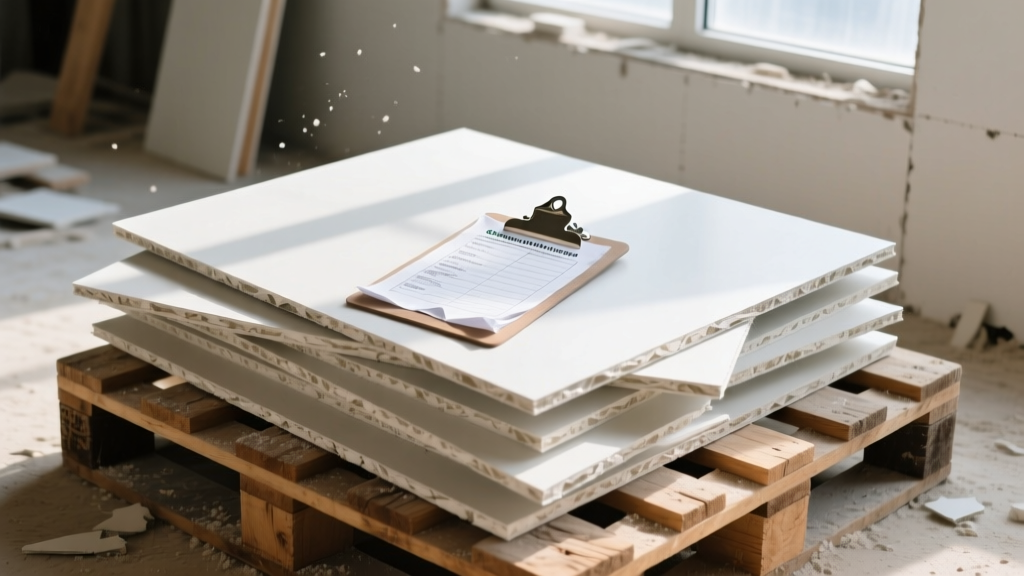
Code compliance and LEED certification both require an auditable chain of custody. A verbal agreement with a hauler is insufficient. Project administrators must secure the following documentation for every diverted load:
- Hauler Weigh Tickets: Must show the gross and tare weight of the truck, along with the specific date and project name.
- Facility Receipts: The recycling facility must issue a receipt explicitly stating the material received as 'Gypsum Board' or 'Clean Drywall'.
- End-Use Certificates: For stringent municipal codes (like those in California under CalGreen), the recycler may need to provide a certificate of processing proving the material was actually recycled into a new product (e.g., new wallboard, agricultural amendment, or cement additive) rather than merely used as Alternate Daily Cover (ADC) at a landfill, which some jurisdictions no longer count toward diversion goals.
Frequently Asked Compliance Questions
Is asbestos testing required before recycling demolition drywall?
Yes. Under NESHAP (National Emission Standards for Hazardous Air Pollutants) regulations, all suspect asbestos-containing materials (ACM) in commercial buildings and multi-family residential structures built before 1981 must be tested prior to demolition. If drywall or the joint compound applied to it tests positive for asbestos (>1%), it cannot be recycled. It must be abated, sealed in leak-tight containers, and disposed of in a licensed hazardous waste landfill.
Can moisture-resistant or mold-resistant drywall be recycled?
Moisture-resistant (green board) and mold-resistant (purple board) gypsum panels feature treated paper facers or fiberglass mats. Closed-loop wallboard manufacturers generally accept these in small quantities mixed with standard board. However, agricultural recyclers will reject loads containing fiberglass-mat panels (like Georgia Pacific DensGlass) because the fiberglass strands contaminate soil applications. Always verify the end-market of your local recycler before mixing specialty boards into the clean scrap bin.
How do we handle gypsum board scraps in jurisdictions without landfill bans?
Even in states without explicit landfill bans, disposing of gypsum in standard MSW landfills is increasingly restricted by private landfill operators due to H2S odor complaints. If local codes do not mandate recycling, GCs should still source-separate gypsum to negotiate lower tipping fees with specialized C&D transfer stations, which often aggregate and bale the material for shipment to regional recycling hubs in neighboring states.
Written by
Priya KapoorPriya Kapoor is a real estate market analyst and construction economics researcher with expertise in housing affordability, development feasibility, and infrastructure investment. She holds a Master of Regional Planning from Cornell University and previously worked as a senior analyst at CBRE's Investment Properties group, where she modeled returns for $4B in mixed-use development pipelines. Priya now runs an independent research practice advising developers, municipalities, and REITs on construction cost forecasting and market timing. She publishes the quarterly "BuildMat Market Pulse" report tracking material price indices across 12 commodity categories. Based in Austin, TX, Priya serves on the board of Habitat for Humanity Austin and is a marathon runner.
More from Priya Kapoor
View all
Construction Cost
Cost to Build a 1600 Sq Ft Home in 2026: Full Breakdown
Accurate 2026 cost to build a 1600 sq ft home—material, labor, and regional pricing breakdowns included. Plan your budget with real-time estimates.
Aug 11, 2026

Wood & Lumber
Name the Types of Wood for Pressure Treatment and Preservation
Learn how to name the types of wood best suited for pressure treatment. Compare species treatability, chemical retention levels, and 2026 preservation costs.
Aug 4, 2026

Stone & Masonry
Stone Veneer Suppliers Lindenhurst: 2026 Cost Analysis
Analyze 2026 stone veneer costs in Lindenhurst, NY. Compare local supplier pricing, delivery fees, and Suffolk County installation labor rates.
Aug 4, 2026