1/2 Gypsum Board R-Value: Thermal Specs and Assembly Guide
Discover the exact R-value of 1/2 gypsum board, how it impacts wall assembly thermal performance, and strategies to maximize insulation in modern builds.

The True R-Value of 1/2-Inch Gypsum Board
When evaluating the 1 2 gypsum board R-value (universally specified in construction documents as 1/2-inch drywall), the baseline thermal resistance is exactly R-0.45. This value is derived from the material's density and chemical composition—primarily calcium sulfate dihydrate. Unlike dedicated insulation materials such as closed-cell spray foam (R-6 to R-7 per inch) or fiberglass batts (R-3.1 to R-4.3 per inch), gypsum board is not designed to resist heat flow. Instead, it serves as a fire retardant, acoustic dampener, and structural shear element.
- 1/2-Inch Standard Board: R-0.45
- 5/8-Inch Standard Board: R-0.56
- Thermal Mass Benefit: High density (~50 lbs/ft³) allows gypsum to absorb and slowly release heat, stabilizing interior temperature swings, even though its absolute R-value is low.
Because the R-value of a single 1/2-inch panel is negligible in the context of modern energy codes (which typically mandate R-13 to R-21 for exterior walls depending on the climate zone), building scientists and architects evaluate gypsum board as a component of a complete wall assembly rather than an isolated insulator.
Whole-Wall vs. Center-of-Cavity Performance
A critical mistake in construction estimating and energy modeling is adding the R-value of the cavity insulation directly to the R-value of the 1/2-inch gypsum board. This yields the center-of-cavity R-value, which ignores the thermal bridging caused by wood or steel framing.
According to research published by Building Science Corporation, wood studs (which have an R-value of roughly R-1.25 per inch) act as thermal bridges, transferring heat much faster than the insulation between them. In a standard 2x6 framed wall, the framing factor (the percentage of the wall occupied by studs, plates, and headers) is typically 25%. This reduces the whole-wall R-value significantly.
Wall Assembly R-Value Matrix (Exterior Walls)
| Assembly Component | 2x4 Framing (16" O.C.) | 2x6 Framing (16" O.C.) |
|---|---|---|
| Interior 1/2" Gypsum Board | R-0.45 | R-0.45 |
| Cavity Insulation (Fiberglass Batt) | R-13.00 | R-19.00 |
| OSB/PLY Sheathing (1/2") | R-0.62 | R-0.62 |
| Center-of-Cavity Total | R-14.07 | R-20.07 |
| Whole-Wall Effective Total (Adjusted for 25% Framing Factor) | ~R-11.50 | ~R-16.20 |
To meet the US Department of Energy's recommendations for exterior walls in northern climate zones, which often require R-20 to R-30+ continuous insulation, the 1/2-inch gypsum board's minimal contribution must be supplemented by exterior rigid foam or mineral wool boards. You can review regional insulation mandates via the Department of Energy's insulation guidelines.
Specialty 1/2" Boards: Do They Alter Thermal Ratings?
Contractors frequently ask if upgrading to specialty 1/2-inch gypsum boards changes the wall's thermal profile. The short answer is no, but the structural and environmental behaviors do shift.
- Type X (Fire-Rated): Contains glass fibers to hold the calcined gypsum core together longer under extreme heat. The density is slightly higher, but the R-value remains R-0.45. Its primary thermal contribution is delaying heat transfer during a fire event, not daily energy conservation.
- Moisture-Resistant (Green/Purple Board): Features a treated paper facing and moisture-resistant core additives. Thermal conductivity is identical to standard board. Crucially, if this board gets wet and is not properly dried, its structural integrity fails, but its R-value does not fluctuate significantly before failure.
- Acoustic/Sound-Dampening Board: Products like CertainTeed SilentFX or USG Sheetrock EcoSmart feature viscoelastic polymers or high-density cores. While they dramatically reduce Sound Transmission Class (STC) ratings, their R-value hovers at R-0.45 to R-0.50.
High-Performance Alternatives: Insulated Gypsum Panels
When interior space is at a premium and adding exterior continuous insulation (CI) is architecturally or financially unfeasible, builders utilize insulated drywall panels. These products feature a standard 1/2-inch gypsum board factory-laminated to a layer of expanded polystyrene (EPS) or extruded polystyrene (XPS) foam.
Standard 1/2" Board: $14.00 - $18.00 per 4x8 sheet (R-0.45)
Insulated Panel (1" EPS + 1/2" Gypsum): $45.00 - $60.00 per 4x8 sheet (R-5.45 total)
Best Application: Basement finishing, garage interior walls, and retrofitting uninsulated masonry walls where exterior excavation is impossible.
While the Gypsum Association notes that standard panels dominate 95% of residential and commercial builds, insulated panels solve specific thermal bridging problems in retrofit scenarios. However, they require specialized fastening schedules and careful detailing around electrical boxes to prevent the foam layer from creating voids that compromise fire ratings.
Installation Errors That Destroy Assembly R-Values
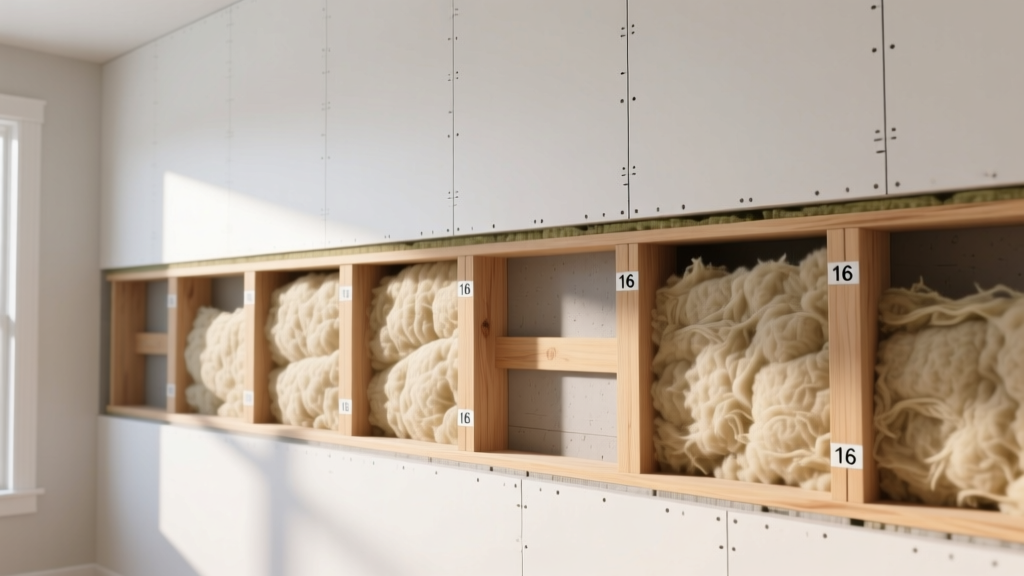
The 1/2-inch gypsum board is the final air barrier component in many interior assemblies. Poor installation of the drywall itself can undermine the R-value of the insulation hidden behind it through convective heat loss.
- Batt Compression at Edges: If framers bow the studs or drywall installers force the 1/2-inch board over protruding plumbing or wiring, the fiberglass batt behind the board compresses. Compressing an R-13 batt into a 2.5-inch space drops its effective R-value to roughly R-10, creating a localized cold spot that leads to interior condensation and mold.
- Unsealed Bottom Plates: The gap between the bottom edge of the 1/2-inch drywall and the subfloor is often covered by baseboard trim, but left unsealed. This allows cold air from the crawlspace or basement to infiltrate the wall cavity, rendering the cavity insulation useless via convective looping. Fix: Apply a continuous bead of acoustic sealant or expanding foam behind the bottom plate before drywall installation.
- Electrical Box Penetrations: Standard plastic electrical boxes punched into the 1/2-inch drywall create massive thermal and air leaks. Using sealed, gasketed electrical boxes or applying putty pads over standard boxes maintains the integrity of the interior air barrier.
Frequently Asked Questions
Does doubling up 1/2-inch drywall double the R-value?
Yes, mathematically. Two layers of 1/2-inch gypsum board will yield an R-value of 0.90 (0.45 + 0.45). However, the cost and labor of hanging a second layer of drywall far outweigh the thermal benefit. If you need an additional R-0.45, it is vastly more economical to upgrade cavity insulation or add a thin layer of exterior continuous insulation.
How does 1/2-inch gypsum compare to plaster in terms of insulation?
Traditional 3-coat cementitious plaster over wood lath has a slightly higher density than modern gypsum board, but its R-value is virtually identical (roughly R-0.40 to R-0.50 for a standard 3/4-inch thickness). Neither material serves as a primary thermal insulator.
Can I use 1/2-inch foil-faced gypsum board as a radiant barrier?
Foil-faced gypsum board (often used in commercial roof decks or specialized exterior sheathing) features a reflective aluminum surface. While the conductive R-value of the 1/2-inch core remains R-0.45, the foil facing acts as a radiant barrier, reflecting up to 95% of radiant heat. This is highly effective in attic assemblies or behind radiant floor heating systems, provided the foil faces an air gap of at least 3/4 inch to function properly.
Written by
Marcus ChenMarcus Chen is a licensed structural engineer (PE) and building materials analyst with over 12 years of experience across residential, commercial, and industrial construction. He holds a Master of Science in Civil Engineering from UC Berkeley and spent six years at Thornton Tomasetti before transitioning to independent consulting and technical writing. Marcus specializes in material selection for seismic-prone regions, concrete reinforcement strategies, and lifecycle cost analysis. His work has been cited by the American Concrete Institute (ACI) and the Structural Engineers Association of California (SEAOC). When he is not on a job site or at his desk, you will find him hiking the Sierra Nevada or restoring a 1920s craftsman bungalow in Oakland, CA.
More from Marcus Chen
View all
Construction Cost
How Much Did the Eiffel Tower Cost to Build?
How much did the Eiffel Tower cost to build in 1889? We adjust for inflation and compare its budget to modern skyscraper construction.
Aug 4, 2026

Fire Resistance
What Is a Fire Resistant Material? Testing & Certification Guide
Discover what is a fire resistant material through ASTM and UL testing. Learn how fire ratings, certifications, and assemblies work in construction.
Aug 4, 2026

Construction Cost
How Much Did the Burj Khalifa Cost to Build?
How much did the Burj Khalifa cost to build? We break down the $1.5B project and extract 5 money-saving strategies for your next build.
Jul 30, 2026