Gypsum Board Sheathing Costs: 2026 Pricing & Installation
Analyze 2026 gypsum board sheathing costs, including fiberglass mat material pricing, labor rates, hidden fastener expenses, and ROI versus wood panels.

The True Cost of Gypsum Board Sheathing in 2026
Specifying exterior sheathing requires balancing structural integrity, moisture management, and fire resistance against strict project budgets. While wood structural panels (OSB and plywood) dominate residential framing, gypsum board sheathing—specifically fiberglass-mat-faced, silicone-treated panels—is the mandatory baseline for commercial, multifamily, and zero-lot-line construction. In 2026, supply chain stabilization has normalized material costs, but labor and specialized accessory requirements continue to dictate the final installed price.
2026 Quick Cost Snapshot
- Material Cost (1/2" Fiberglass Mat): $1.25 – $1.65 per sq.ft.
- Material Cost (5/8" Type X Fire-Rated): $1.45 – $1.90 per sq.ft.
- Installation Labor: $0.65 – $1.10 per sq.ft.
- Total Installed Cost: $1.90 – $3.00 per sq.ft.
According to industry data tracked by the National Association of Home Builders (NAHB), while softwood lumber and OSB pricing remain highly volatile due to tariff fluctuations and mill closures, manufactured gypsum products have seen predictable, inflation-tied annual increases of roughly 3-4% heading into 2026.
Material Pricing: Fiberglass Mat vs. Wood Structural Panels
To understand the premium associated with gypsum board sheathing, it must be benchmarked against traditional wood alternatives. The primary products dominating the 2026 market include Georgia-Pacific DensGlass, USG Securock, and Saint-Gobain GlasRoc. These panels comply with ASTM C1177, ensuring the silicone-treated core resists water absorption while the fiberglass mat prevents mold and delamination.
| Sheathing Material (1/2" Nominal) | Avg. Cost / Sq.Ft. | Fire Rating | Moisture Resistance |
|---|---|---|---|
| 7/16" OSB (Standard) | $0.70 - $0.95 | Combustible | Low (Swells if wet) |
| 1/2" CDX Plywood | $1.30 - $1.75 | Combustible | Moderate |
| Gypsum Board Sheathing (Standard) | $1.25 - $1.65 | Non-combustible | High (ASTM D3273) |
| Gypsum Board Sheathing (5/8" Type X) | $1.45 - $1.90 | 1-Hour+ (ASTM E119) | High |
While standard 1/2" gypsum sheathing is now nearly cost-competitive with CDX plywood, the 5/8" Type X variant required for fire-rated exterior assemblies (such as zero-lot-line walls) commands a 15% to 20% premium. However, this material cost is frequently offset by reductions in commercial insurance premiums and the elimination of secondary fire-blocking materials.
Labor Variables and Hidden Installation Costs
The most common budgeting error in 2026 construction estimating is treating gypsum sheathing installation identically to OSB. Fiberglass-mat gypsum requires specific handling, cutting techniques, and fastening schedules that alter labor productivity.
1. Cutting and Scoring Inefficiencies
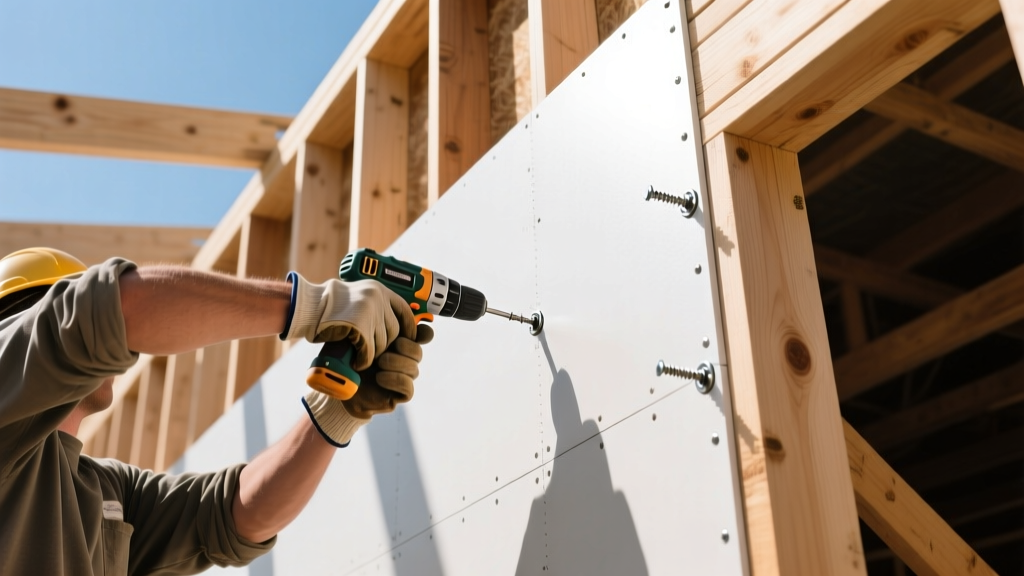
Unlike wood panels that can be rapidly crosscut with a circular saw, cutting fiberglass-mat gypsum with standard wood blades generates excessive silica dust, destroys the mat facing, and creates edge blowout. Crews must score the panel with a utility knife or use specialized carbide-grit scoring tools, then snap and cut the back mat. This reduces cutting speed by approximately 15%, increasing hanging labor costs by $0.10 to $0.15 per sq.ft.
2. The Fastener Premium
3. Joint Treatment and Air Barrier Integration
If the gypsum sheathing is serving as the primary water-resistive barrier (WRB) or air barrier substrate, joints must be treated. While some fluid-applied membranes can bridge 1/8" gaps without tape, most systems require fiberglass mesh tape embedded in a compatible joint compound or fluid-applied sealant at all board edges and corners. Budget an additional $0.35 to $0.60 per sq.ft. for taping and sealing labor and materials.
Gypsum Sheathing vs. Wood: The ROI Decision Matrix
Value engineering often targets gypsum sheathing for replacement with OSB to save upfront capital. However, The Gypsum Association emphasizes that substituting materials on commercial or high-density residential projects triggers cascading code and cost implications. Use this framework to evaluate the true ROI:
- Scenario A: Exterior Insulation and Finish Systems (EIFS) or Stucco Cladding.
Verdict: Mandatory Gypsum. Wood panels expand and contract significantly with moisture changes, causing telegraphing cracks in rigid stucco. Gypsum board sheathing provides dimensional stability, preventing costly warranty callbacks for cladding repair. - Scenario B: Zero-Lot-Line / Property Line Walls (Type V Construction).
Verdict: Mandatory 5/8" Type X Gypsum. Building codes require 1-hour or 2-hour fire-resistance ratings for exterior walls within 5 feet of a property line. Achieving this with wood sheathing requires complex, multi-layer intumescent wraps or interior fire-rated shaft wall assemblies that cost 3x more than simply sheathing the exterior with Type X gypsum. - Scenario C: Standard Residential Framing (Vinyl/Lap Siding).
Verdict: Value Engineer to OSB. Unless located in a severe wildfire zone (WUI) or high-humidity coastal region, the premium for gypsum sheathing yields negligible ROI under standard vinyl or fiber-cement lap siding.
Regional Pricing Fluctuations and Waste Factors
When calculating final estimates, adjust for regional logistics and waste. Gypsum board sheathing is heavy and brittle. A standard 4x8 panel weighs roughly 75 lbs, and 4x9 or 4x10 panels (used to span floor-to-floor heights in commercial framing) require specialized lifting equipment or larger crews, pushing labor rates up by 8-12% in high-union-density markets like the Northeast and Pacific Northwest.
Furthermore, factor in a 12% to 15% waste factor for gypsum sheathing, compared to the standard 7% to 10% for OSB. The brittle nature of the silicone-treated core means panels are more susceptible to corner-breakage during crane hoisting and forklift unloading. Panels exposed to standing water on the job site prior to installation—despite their moisture-resistant treatment—may suffer edge degradation, necessitating replacement.
Expert Specification Checklist for 2026
Before finalizing your sheathing schedule, verify the following technical parameters with your structural engineer and envelope consultant:
- Fastener Penetration: Ensure screws penetrate steel framing by a minimum of 3/8" or wood framing by 1-1/4". Over-driving screws will fracture the fiberglass mat, reducing pull-through strength by up to 40%.
- Spacing Schedule: Standard edge spacing is 8 inches on-center (o.c.), and field spacing is 12 inches o.c. High-wind zones (HVHZ) may require 4-inch edge spacing.
- Clearance Gaps: Maintain a 1/4" gap at the bottom edge of the sheathing above foundation mudsills to prevent capillary wicking of ground moisture into the panel core.
- UV Exposure Limits: While fiberglass-mat gypsum resists weather, manufacturers typically limit UV exposure to 6-12 months. If the cladding schedule will be delayed beyond this window, specify a UV-stable fluid-applied WRB immediately upon panel installation.
Accurate cost analysis for gypsum board sheathing extends far beyond the per-sheet invoice. By accounting for specialized fasteners, altered labor productivity, and the elimination of secondary fire-protection assemblies, contractors and developers can leverage this material to build safer, more durable envelopes without sacrificing the bottom line.
Written by
Priya KapoorPriya Kapoor is a real estate market analyst and construction economics researcher with expertise in housing affordability, development feasibility, and infrastructure investment. She holds a Master of Regional Planning from Cornell University and previously worked as a senior analyst at CBRE's Investment Properties group, where she modeled returns for $4B in mixed-use development pipelines. Priya now runs an independent research practice advising developers, municipalities, and REITs on construction cost forecasting and market timing. She publishes the quarterly "BuildMat Market Pulse" report tracking material price indices across 12 commodity categories. Based in Austin, TX, Priya serves on the board of Habitat for Humanity Austin and is a marathon runner.
More from Priya Kapoor
View all
Construction Cost
Cost to Build a 1600 Sq Ft Home in 2026: Full Breakdown
Accurate 2026 cost to build a 1600 sq ft home—material, labor, and regional pricing breakdowns included. Plan your budget with real-time estimates.
Aug 11, 2026

Wood & Lumber
Name the Types of Wood for Pressure Treatment and Preservation
Learn how to name the types of wood best suited for pressure treatment. Compare species treatability, chemical retention levels, and 2026 preservation costs.
Aug 4, 2026

Stone & Masonry
Stone Veneer Suppliers Lindenhurst: 2026 Cost Analysis
Analyze 2026 stone veneer costs in Lindenhurst, NY. Compare local supplier pricing, delivery fees, and Suffolk County installation labor rates.
Aug 4, 2026