Essential Gypsum Board Equipment for Professional Installers 2026
Discover the essential gypsum board equipment for 2026. Compare automatic tapers, sanders, and lifting tools to maximize drywall installation efficiency.

The Evolution of Drywall Installation: Why Equipment Matters
The transition from manual, labor-intensive drywall hanging to high-efficiency commercial installation is entirely driven by specialized gypsum board equipment. In 2026, the margin between a profitable drywall contract and a loss-making one is often dictated by tool selection. Proper equipment reduces physical fatigue, ensures compliance with stringent fire and acoustic ratings, and guarantees that fastener patterns and joint treatments meet the Gypsum Association (GA) standards. This comprehensive guide breaks down the essential machinery, hand tools, and automated systems required for professional-grade gypsum board installation, complete with current pricing, model specifications, and job-site troubleshooting.
Precision Cutting and Fastening Gear
While a standard utility knife remains a staple, professional crews rely on specialized cutting and fastening equipment to maintain a pace of 40 to 50 sheets per day per installer.
Specialized Cutting Tools
For electrical cutouts and circular fixtures, the Goldblatt G09516 Circle Cutter (retailing around $45) is indispensable. It scores perfect radii up to 16 inches without tearing the gypsum core. For straight rip cuts on 5/8-inch Type X fire-rated board, a track-guided scoring tool like the Stanley 99V with snap-off blades ensures the paper face remains intact, which is critical for maintaining the board's structural integrity and fire-resistance rating.
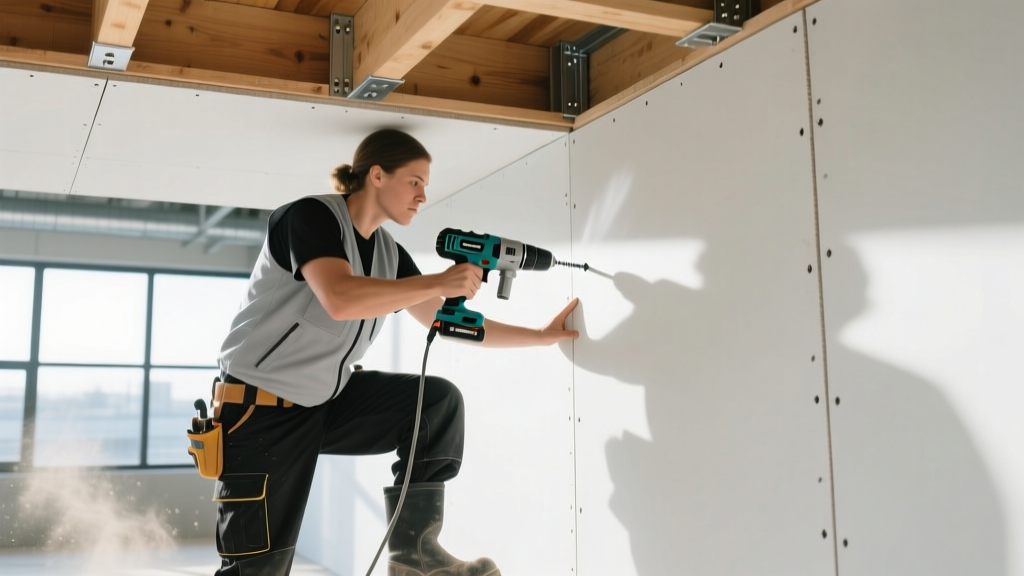
Cordless Auto-Feed Screw Guns
Driving 1-1/4 inch coarse-thread drywall screws manually is obsolete in commercial settings. The Makita XSF03Z 18V LXT Cordless Screw Gun (approx. $159 bare tool) paired with an auto-feed attachment is the industry benchmark. It operates at 4,000 RPM and features a push-drive technology that only engages the motor when the screw is pressed against the board, saving battery life.
Taping and Mudding: Manual vs. Automatic Equipment
Joint treatment is the most time-consuming phase of gypsum board finishing. Choosing between manual taping knives and automatic continuous-flow tapers depends on the scale of the project and the crew's expertise.
| Feature | Manual Taping (Banjo & Knives) | Automatic Tapers (e.g., TapeTech Bazooka) |
|---|---|---|
| Initial Equipment Cost | $80 - $150 | $450 - $600 |
| Application Speed | 10-12 linear ft / minute | 25-30 linear ft / minute |
| Mud Viscosity Requirement | Thick (peanut butter consistency) | Thinned (pudding consistency, ~28 oz water per gallon) |
| Learning Curve | Low (ideal for residential/patching) | High (requires specific wrist mechanics) |
| Best Use Case | Small rooms, complex angles, repairs | Long commercial runs, high ceilings, Level 5 finishes |
For large-scale commercial projects, the TapeTech 87TT Bazooka continuous taper applies tape and compound simultaneously. When paired with a mechanical mud pump (like the Tapetech PowerLuber), a two-person crew can tape a 10,000-square-foot warehouse in a fraction of the time required for manual methods.
Sanding and Dust Extraction: Meeting 2026 OSHA Standards
Sanding gypsum board joints generates massive amounts of respirable crystalline silica dust. Under OSHA's Respirable Crystalline Silica standard (29 CFR 1926.1153), dry sanding without dust extraction is heavily penalized. Professional contractors must invest in integrated vacuum sanding systems.
The Festool Planex LHS 2 225 (approx. $1,250 for the head unit) is the gold standard for ceiling and wall sanding. It features a variable-length telescoping handle and a brushless motor. Crucially, it must be paired with a HEPA-certified dust extractor like the Festool CT 36 ($650). This setup captures 99.9% of silica dust at the source, keeping the job site clean and ensuring OSHA compliance without the need for cumbersome PPE respirators. For budget-conscious crews, the Marshalltown DCS788 Dust Control Sander ($180) offers a localized vacuum shroud that connects to standard shop-vacs, though it lacks the ergonomic reach of the Planex.
Material Handling: Ceiling Hoists and Panel Lifts
Hanging 5/8-inch Type X gypsum board on ceilings manually is a primary cause of shoulder and spinal injuries in the trades. A 4x12 sheet of Type X weighs roughly 110 pounds.
The Telpro 77018 Drywall Lift ($220) is a staple on job sites. It features a 150-pound weight capacity and a winch system that allows a single operator to raise and position a sheet flush against ceiling joists. For multi-story commercial builds where materials must be moved to upper floors, contractors utilize motorized material hoists or specialized drywall carts with pneumatic tires to navigate rough subfloors without cracking the board edges.
Troubleshooting Common Equipment Failures
Even premium gypsum board equipment fails if not maintained. Here is a diagnostic guide for common job-site issues:
- Symptom: Auto-taper clogging mid-run.
Cause: Setting-type compound (hot mud) curing inside the tube, or failing to thin standard all-purpose mud sufficiently.
Fix: Flush the taper with warm water immediately after every use. Never leave setting-type compound in a continuous taper; use it only with standard air-drying compounds. - Symptom: Screw gun cam-out (screw strips the gypsum without setting).
Cause: Worn depth nose collar or battery voltage drop causing RPM fluctuations.
Fix: Replace the plastic depth collar (a $5 part that wears out every 50 sheets). Ensure batteries are kept at room temperature to maintain consistent 4,000 RPM output. - Symptom: Festool Planex leaving circular swirl marks.
Cause: Clogged abrasive mesh or operating the sander at too high an RPM on soft finishing coats.
Fix: Drop the RPM dial to setting 3 for final skim coats, and tap the abrasive mesh against a hard surface every 10 minutes to clear gypsum dust from the pores.
ROI Analysis: Calculating Equipment Upgrades
Investing in high-end gypsum board equipment requires capital, but the return on investment is realized through labor savings and reduced material waste.
Job-Site ROI Scenario: 5,000 Sq. Ft. Commercial Tenant Improvement
Manual Taping & Sanding:
- Labor: 3 finishers x 6 days = 144 man-hours.
- Labor Cost (@ $35/hr burden rate): $5,040.
- Material Waste (dropped mud, torn tape): ~$300.
Automatic Taping & HEPA Sanding:
- Labor: 2 finishers x 3.5 days = 56 man-hours.
- Labor Cost (@ $35/hr burden rate): $1,960.
- Equipment Amortization (per job): ~$150.
Total Savings per Project: $2,930.
Conclusion: The $2,500 investment in a TapeTech auto-taper and Festool sander pays for itself on the very first mid-sized commercial project.
Equipping a crew with the right gypsum board tools is not merely a matter of convenience; it is a fundamental business strategy. By leveraging auto-feed fasteners, continuous tapers, and HEPA-integrated sanders, contractors in 2026 can deliver Level 5 finishes faster, safer, and with significantly higher profit margins.
Written by
David NakamuraDavid Nakamura is a licensed architect (AIA) and construction technology writer focused on sustainable building methods, mass timber engineering, and high-performance building envelopes. He holds a Master of Architecture from the University of Washington and is a certified Passive House Consultant (CPHC). David spent eight years at the Seattle firm Mithun, where he led the design of three LEED Platinum projects, before founding his own practice specializing in net-zero residential design. He serves on the editorial advisory board of GreenBuilder Magazine and has authored peer-reviewed papers on cross-laminated timber (CLT) connections for the Journal of Structural Engineering. In his spare time, David teaches woodworking at Pratt Fine Arts Center and kayaks the Puget Sound.
More from David Nakamura
View all
Construction Cost
Labor Cost to Build a Deck Per Sq Ft: 2026 Installation Guide
Discover the exact labor cost to build a deck per sq ft in 2026. This installation guide breaks down contractor rates, complexity factors, and hidden fees.
Aug 4, 2026

Construction Cost
How Much Does It Cost to Build a 3 Bedroom House? Financing Guide
Learn exactly how much it costs to build a 3 bedroom house and explore 2026 financing options, construction loan types, and budget frameworks for your build.
Aug 4, 2026

Construction Cost
Cost to Build a Tennis Court: 2026 Guide
How much does it cost to build a tennis court in 2026? Breakdowns for asphalt, concrete, and synthetic surfaces plus fencing and lighting.
Jul 30, 2026