Lead Gypsum Board Code Compliance & Shielding Guide
Navigate lead gypsum board code compliance, NCRP shielding standards, lead equivalency matrices, and inspection-ready installation protocols.

The Regulatory Triad for Radiation Shielding
Lead gypsum board serves as the primary architectural radiation barrier in medical, dental, and industrial imaging facilities. Unlike standard drywall, its compliance is not governed solely by the International Building Code (IBC) or ASTM C1396, but heavily dictated by a specialized regulatory triad. The foundational standard for structural shielding design is the National Council on Radiation Protection and Measurements (NCRP), specifically Report No. 147 for medical X-ray imaging facilities. However, NCRP provides the physics and calculations; actual enforcement falls to state and local health departments, often coordinated through the Conference of Radiation Control Program Directors (CRCPD).
Before a single sheet of lead gypsum board is hung, a certified medical physicist or health physicist must generate a shielding design report. This document calculates the required lead equivalency (Pb eq) based on the equipment's maximum kilovoltage peak (kVp), workload (mA-minutes per week), use factor, and occupancy of adjacent spaces. Installing a generic 'standard' lead board without referencing this specific report is the most common cause of failed facility inspections and costly tear-outs.
⚠️ OSHA Compliance Warning: Lead Dust Hazard
Cutting, sanding, or routing lead gypsum board generates toxic lead dust, triggering strict enforcement under OSHA's Lead in Construction Standard (29 CFR 1926.62). Drywall installers must use HEPA-filtered vacuums attached to scoring tools, utilize wet-cutting methods, or rely exclusively on score-and-snap techniques. Respiratory protection (N100 or P100 filters) and mandatory blood lead level monitoring are legally required if airborne lead concentrations exceed the action level of 30 µg/m³ over an 8-hour TWA.
Decoding Lead Equivalency (Pb Eq) Matrices
Lead gypsum board is categorized by its lead equivalency, not just its physical thickness. The lead sheet laminated to the back of the gypsum core typically ranges from 1/32-inch to 1/8-inch thick. Below is the standard application matrix used by contractors to verify material alignment with the physicist's specifications.
| Lead Thickness | Pb Equivalency | Typical kVp Range | Common Facility Application |
|---|---|---|---|
| 1/32' (0.8mm) | 0.5mm Pb | Up to 70 kVp | Standard dental operatories, veterinary X-ray |
| 1/16' (1.6mm) | 1.0mm Pb | 70 - 100 kVp | General radiography, fluoroscopy, bone densitometry |
| 3/32' (2.4mm) | 1.5mm Pb | 100 - 125 kVp | CT scan suites, high-volume interventional radiology |
| 1/8' (3.2mm) | 2.0mm+ Pb | 125 - 150+ kVp | PET/CT suites, linear accelerator vaults (secondary barriers) |
Code-Compliant Installation Protocol
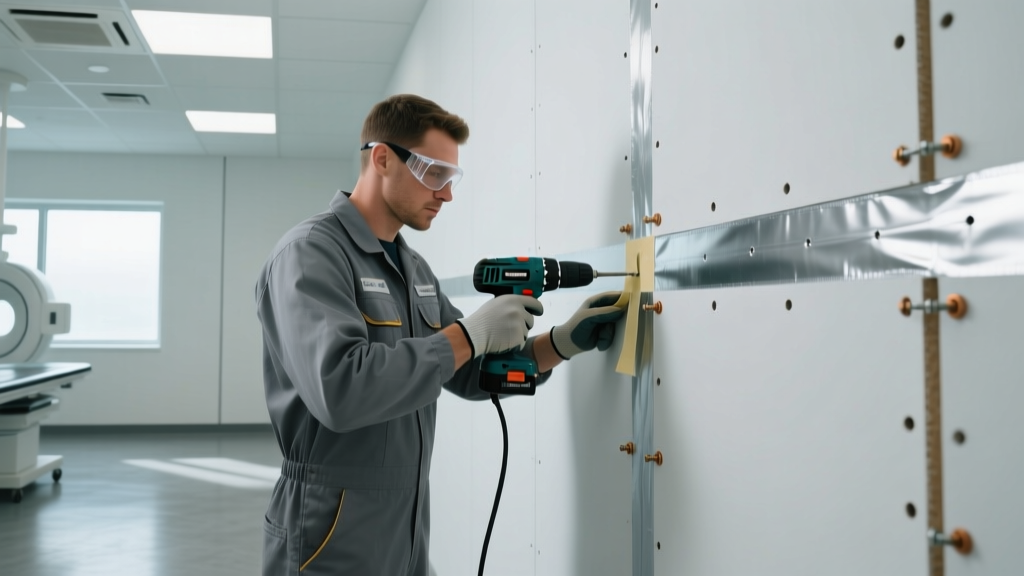
Installing lead gypsum board requires a fundamental shift from standard drywall practices. The overarching rule of radiation shielding is continuity. Any gap, unshielded fastener, or microscopic tear in the lead layer creates a 'streaming' path for scatter radiation, which will immediately fail a physicist's survey.
Step 1: Substrate and Framing Preparation
Because lead-lined drywall is exceptionally heavy (a 4x8 sheet of 1/16-inch lead board weighs approximately 110-130 lbs, compared to 50 lbs for standard 1/2-inch drywall), framing must be reinforced. Use 20-gauge or heavier steel studs spaced at a maximum of 16 inches on center. For walls exceeding 10 feet in height, or when using 1/8-inch lead boards, structural engineering sign-off is required to prevent stud deflection, which can crack the lead laminate.
Step 2: Cutting and Handling
Never use a drywall router or power saw on lead gypsum board. The required method is score-and-snap. Score the paper face deeply with a utility knife, snap the gypsum core over a straight edge, and then carefully cut the backing paper and lead sheet. When lifting, use drywall lifts or suction cups; dragging the board will crease the lead layer, compromising its shielding integrity.
Step 3: Fastening and the 'Cap' Requirement
Standard drywall screws pierce the lead, creating thousands of unshielded micro-holes. To maintain compliance, you must use one of two methods:
- Lead-Headed Screws: Specialized screws featuring a bonded lead washer under the head. These must be driven flush, not over-driven, to avoid fracturing the lead washer.
- Standard Screws with Lead Caps: If standard screws are used, every single screw head must be manually covered with a lead dot or a dab of lead-equivalent putty before taping and mudding.
Joint Treatment: The #1 Inspection Failure Point
The most frequent cause of failed radiation surveys is improper joint treatment. Standard paper tape and joint compound provide zero radiation shielding. All butt joints and tapered edges must be backed or covered with lead stripping.
- The Overlap Rule: When hanging sheets, the lead backing must overlap the adjacent sheet's lead backing by a minimum of 1/2 inch to 1 inch (verify with the physicist's report).
- Lead Stripping Tape: If a flush joint is unavoidable, apply a minimum 2-inch wide strip of adhesive-backed lead tape (matching the Pb eq of the wall) centered directly over the seam.
- Corner Treatment: Inside and outside corners are highly vulnerable. Install continuous lead stripping tape into the corner joint before applying standard joint compound. For outside corners, use lead-lined corner beads rather than standard metal or vinyl beads.
Pro-Tip: The Flashlight Test
Before the medical physicist arrives, turn off the room lights and have a helper shine a high-lumen flashlight against the back side of the wall (if accessible, such as from an unfinished adjacent room or ceiling plenum). Any pinholes of light visible through the joints or screw heads indicate a radiation leak that must be patched with lead putty or tape.
Managing Penetrations and Cutouts
Electrical outlets, HVAC registers, and medical gas outlets represent massive vulnerabilities in a lead-lined envelope. Code compliance requires that any penetration be shielded to match the surrounding wall's Pb equivalency.
- Electrical Boxes: Standard plastic or metal junction boxes block virtually no scatter radiation. You must install lead-lined putty pads (often called 'Ray-Bar pads' or 'MarShield pads') over the back and sides of the box. Alternatively, use pre-manufactured lead-backed electrical boxes.
- HVAC Ductwork: Air returns and supply vents penetrating a lead-lined wall require a lead-lined baffle or sleeve inside the ductwork to prevent radiation from streaming through the air path. The baffle must be angled so that no direct line-of-sight exists from the radiation source to the adjacent room.
- Plumbing and Medical Gas: Pipes penetrating the wall must be sleeved with lead wool or wrapped in lead sheeting extending at least 2 inches beyond the wall cavity on both sides.
Procurement and Cost Expectations
Budgeting for lead gypsum board requires accounting for both the premium material costs and the specialized labor. Prices fluctuate based on raw lead market indices, but contractors should use the following baseline estimates for 4x8 foot sheets:
- 1/32' (0.5mm Pb): $140 - $180 per sheet
- 1/16' (1.0mm Pb): $240 - $310 per sheet
- 3/32' (1.5mm Pb): $350 - $420 per sheet
- 1/8' (2.0mm Pb): $450 - $550+ per sheet
Labor costs typically run 2.5x to 3x higher than standard drywall installation due to the weight, OSHA safety protocols, and meticulous joint-taping requirements. Always factor in the cost of lead stripping tape ($40-$80 per roll), lead putty pads ($15-$25 each), and HEPA vacuum rentals.
The Medical Physicist Inspection: What to Expect
Final sign-off is not performed by the local building inspector, but by a licensed medical physicist. The physicist will operate the X-ray or CT equipment at its maximum rated kVp and workload, using a calibrated ionization chamber or Geiger-Müller survey meter to measure scatter radiation in all adjacent occupied spaces.
If the physicist detects readings exceeding the NCRP limit (typically 0.02 mSv per week for uncontrolled areas like public hallways, or 0.1 mSv per week for controlled areas like nurse stations), they will map the 'hot spots' on your floor plan. Remediation requires cutting open the finished drywall, applying additional lead stripping or putty, and re-finishing—a catastrophic cost that is entirely preventable through strict adherence to the continuity protocols outlined above.
Written by
Priya KapoorPriya Kapoor is a real estate market analyst and construction economics researcher with expertise in housing affordability, development feasibility, and infrastructure investment. She holds a Master of Regional Planning from Cornell University and previously worked as a senior analyst at CBRE's Investment Properties group, where she modeled returns for $4B in mixed-use development pipelines. Priya now runs an independent research practice advising developers, municipalities, and REITs on construction cost forecasting and market timing. She publishes the quarterly "BuildMat Market Pulse" report tracking material price indices across 12 commodity categories. Based in Austin, TX, Priya serves on the board of Habitat for Humanity Austin and is a marathon runner.
More from Priya Kapoor
View all
Construction Cost
Cost to Build a 1600 Sq Ft Home in 2026: Full Breakdown
Accurate 2026 cost to build a 1600 sq ft home—material, labor, and regional pricing breakdowns included. Plan your budget with real-time estimates.
Aug 11, 2026

Wood & Lumber
Name the Types of Wood for Pressure Treatment and Preservation
Learn how to name the types of wood best suited for pressure treatment. Compare species treatability, chemical retention levels, and 2026 preservation costs.
Aug 4, 2026

Stone & Masonry
Stone Veneer Suppliers Lindenhurst: 2026 Cost Analysis
Analyze 2026 stone veneer costs in Lindenhurst, NY. Compare local supplier pricing, delivery fees, and Suffolk County installation labor rates.
Aug 4, 2026