Gypsum Board Asbestos: Code Compliance and Testing Rules
Navigate gypsum board asbestos code compliance. Learn NESHAP thresholds, EPA testing protocols, joint compound risks, and 2026 abatement costs.

The Anatomy of Suspect Drywall Systems
When addressing gypsum board asbestos concerns, it is critical to distinguish between the drywall panel itself and the finishing materials applied to it. The gypsum core (calcium sulfate dihydrate) and the paper facers of standard drywall panels have never historically contained asbestos. The hazard in legacy wall and ceiling assemblies is almost exclusively concentrated in the finishing compounds.
Between 1940 and the late 1970s, manufacturers routinely added chrysotile (white asbestos) to drywall joint compounds, skim coats, and textured ceiling paints (such as Artex). The asbestos fibers provided tensile strength, improved fire resistance, and prevented the compound from shrinking or cracking as it cured. While the U.S. Consumer Product Safety Commission (CPSC) banned asbestos in wall-patching compounds in 1977, existing inventory was legally sold and applied well into the early 1980s. Therefore, any gypsum board system finished before 1985 must be treated as suspect.
Federal and State Compliance Framework
Renovating or demolishing structures with suspect gypsum assemblies triggers strict federal oversight, primarily governed by the Environmental Protection Agency (EPA) and the Occupational Safety and Health Administration (OSHA). State and local environmental agencies often enforce stricter thresholds, but federal baselines dictate the minimum compliance requirements.
| Regulation | Governing Body | Trigger Threshold | Primary Requirement |
|---|---|---|---|
| NESHAP (40 CFR Part 61, Subpart M) | EPA | 160 sq. ft., 260 lin. ft., or 35 cu. ft. of friable ACM | Mandatory inspection prior to demolition/renovation; specific wet-removal and disposal protocols. |
| Construction Standard (29 CFR 1926.1101) | OSHA | Any disturbance of PACM or known ACM | Worker protection, negative pressure enclosures, HEPA filtration, and specific Class I-IV work practices. |
| RRP Rule (40 CFR Part 745) | EPA | Target housing (pre-1978) > 6 sq. ft. per room | Lead-safe practices (often overlaps with asbestos); requires certified renovators if lead paint is on the drywall. |
For commercial demolitions, the EPA NESHAP guidelines require a thorough facility inspection by a certified asbestos inspector before any structural components, including drywall, are disturbed. Failing to conduct this inspection can result in penalties exceeding $100,000 per day per violation.
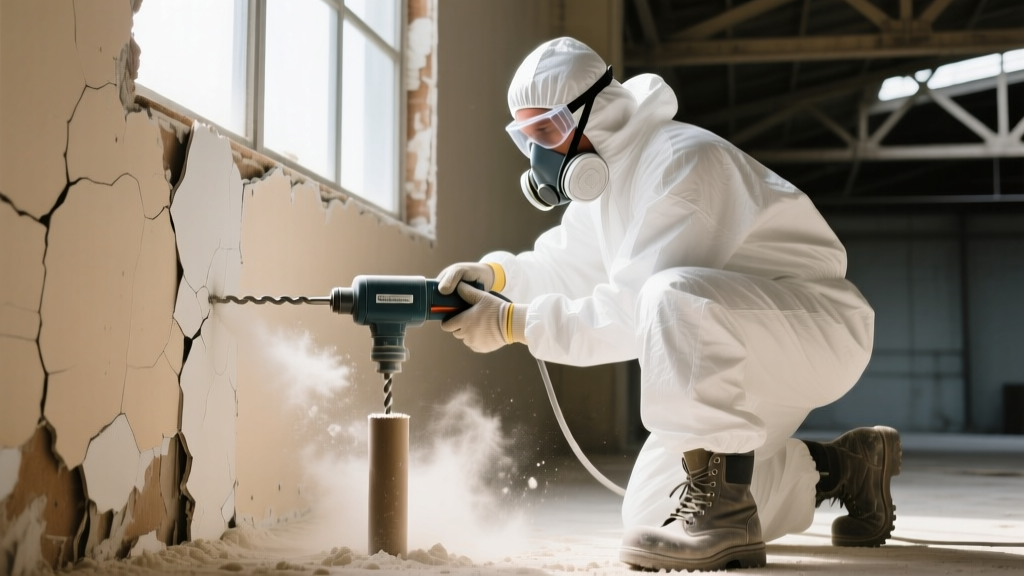
Mandatory Testing Protocols for Gypsum Assemblies
Visual identification of asbestos in drywall mud is impossible. Compliance requires bulk sampling analyzed by an NVLAP (National Voluntary Laboratory Accreditation Program) accredited laboratory.
Sampling Methodology
- Preparation: Shut down HVAC systems and seal supply/return vents with polyethylene sheeting to prevent fiber migration.
- Wetting: Mist the suspect joint compound with amended water (water mixed with a surfactant like dish soap) to suppress airborne fibers during extraction.
- Extraction: Use a 1-inch to 2-inch coring tool to extract a sample that penetrates through the paint layer, the joint compound, and into the paper face of the gypsum board. This ensures the laboratory analyzes the actual finishing material, not just the surface paint.
- Containment: Place the core sample in a clean, sealable plastic bag or glass vial, and seal the sampling hole immediately with duct tape or a small dab of spackle.
Laboratory Analysis: PLM vs. TEM
The standard analytical method for bulk drywall samples is Polarized Light Microscopy (PLM) under EPA Method 600. However, joint compounds often contain high levels of talc, mica, and calcium carbonate, which can interfere with PLM visual estimation. If PLM results indicate less than 10% asbestos, compliance best practices dictate requesting a point-count analysis (minimum 400 points) to prevent false negatives. For highly friable or heavily degraded textured ceiling finishes over drywall, Transmission Electron Microscopy (TEM) may be required to accurately identify ultra-fine chrysotile fibrils.
2026 Abatement Cost Structures and Timelines
Budgeting for asbestos abatement requires accounting for mobilization, engineering controls, labor, and third-party air monitoring. The following data reflects national averages for Q1 2026 commercial and high-end residential projects.
Cost Breakdown: Drywall Asbestos Abatement
- Initial Testing & Inspection: $450 - $850 (Includes up to 10 bulk samples and comprehensive report)
- Per-Sample Lab Fee (PLM): $35 - $65 per sample
- Abatement Mobilization & Containment Setup: $1,800 - $3,500 (Covers poly sheeting, negative air machines, HEPA units, and decon chambers)
- Drywall & Joint Compound Removal: $12.00 - $18.50 per square foot of wall/ceiling area
- Third-Party Air Monitoring & Clearance Testing: $600 - $1,200 per day (Aggressive final clearance using blowers and TEM/PCM analysis)
- Hazardous Waste Disposal: $85 - $150 per cubic yard (Dependent on local landfill tipping fees)
Timelines are heavily dictated by the containment setup. A standard 2,000 sq. ft. residential interior with asbestos-containing joint compound typically requires 2 days for containment setup, 3 days for wet-removal and HEPA-vacuuming, and 1 day for clearance testing, totaling roughly one week before standard drywall replacement can begin.
Decision Matrix: Abatement vs. Encapsulation
Removal is not always the legally mandated or financially optimal path. Under OSHA's asbestos construction standards, if the material is in good condition and will not be disturbed, it can be managed in place. Use this matrix to determine the compliant course of action:
| Project Scenario | Material Condition | Compliant Strategy | Rationale |
|---|---|---|---|
| Full structural demolition | Any | Class I Removal | NESHAP requires removal of friable ACM prior to wrecking ball or heavy machinery demolition. |
| Gutting to the studs (remodel) | Any | Class I Removal | Drywall cannot be removed intact; breaking it generates massive fiber release. |
| Surface painting / minor repair | Intact, no flaking | Bridging Encapsulation | Applying a specialized elastomeric sealant locks fibers in place; avoids abatement costs. |
| Running new electrical/plumbing | Intact | Class III Glovebag | Localized, wet-cutting using mini-enclosures (glovebags) limits exposure without full room abatement. |
Frequently Asked Compliance Questions
Can I legally remove asbestos drywall myself in a single-family home?
The EPA NESHAP regulations generally exempt single-family residential dwellings with four or fewer units from commercial abatement requirements. However, state laws (such as those in California, New York, and Massachusetts) frequently override this exemption, requiring licensed abatement contractors for any ACM removal regardless of property type. Furthermore, OSHA regulations apply if you hire even a single employee or handyman to perform the work. Homeowners performing DIY removal assume massive personal health risks and potential liability if fibers migrate to neighboring properties.
Does the gypsum board core need to be tested?
No. Accredited inspectors focus sampling on the joint compound, tape seams, skim coats, and textured ceiling finishes. The gypsum core and paper backing are not manufactured with asbestos. However, if the drywall was installed in a high-moisture area and backed by asbestos-containing mastic or insulation, the entire assembly must be evaluated as a composite system.
What happens if a contractor disturbs asbestos drywall without testing?
Unauthorized disturbance of PACM is a severe violation. The contractor faces OSHA citations (often exceeding $15,000 per willful violation), EPA fines, and potential civil litigation from building occupants. The building owner will be forced to halt construction, pay for emergency decontamination by a licensed hazmat crew, and undergo aggressive clearance testing, which can delay projects by months and cost tens of thousands of dollars in remediation.
'Always mandate a Phase II Asbestos Survey from an independent, third-party environmental consultant before finalizing renovation budgets. Relying on contractor assumptions regarding pre-1985 drywall finishes is the leading cause of catastrophic budget overruns in commercial retrofitting.'
Written by
Sarah WhitfieldSarah Whitfield is a chartered quantity surveyor (MRICS) and construction cost analyst with 15 years of experience in material pricing, procurement strategy, and project budgeting. She earned her degree in Construction Management from the University of Reading (UK) and has worked on projects ranging from $2M custom homes to $180M mixed-use developments across North America and Europe. Sarah currently leads cost estimating for BuildMat Insight, maintaining a proprietary database of 4,000+ material price points updated quarterly. She is a frequent contributor to RSMeans cost data panels and has presented at the International Cost Engineering Council (ICEC) congress. Based in Denver, CO, Sarah is an avid trail runner and volunteer mentor for Women in Construction.
More from Sarah Whitfield
View all
Wood & Lumber
What Are the Different Types of Wood? A Builder's Guide
Compare structural softwoods, finish hardwoods, and engineered lumber. Analyze Janka ratings, MOE values, and 2026 pricing for construction.
Aug 4, 2026

Walls & Panels
Steel Framing vs Wood Framing: Corrosion and Moisture Defense
Compare steel framing vs wood framing for moisture resistance. Learn about galvanized coatings, condensation risks, and corrosion protection strategies.
Jul 21, 2026

Stone & Masonry
How to Cut Stone Veneer: Wet Saw vs Grinder Comparison
Compare the best tools for cutting stone veneer. We review wet saws, angle grinders, and chop saws to help you achieve clean, chip-free cuts.
Jul 21, 2026