Gold Bond XP Hi-Impact Gypsum Board Buyer Selection Guide
Discover if Gold Bond XP Hi-Impact gypsum board fits your project. Compare specs, costs, and ideal applications for high-traffic commercial walls.

Core Technology: Defining Gold Bond XP Hi-Impact
Gold Bond XP Hi-Impact gypsum board by National Gypsum is a specialized 5/8-inch Type X panel engineered for environments requiring simultaneous resistance to moisture, mold, and severe physical abuse. Unlike standard impact-resistant boards that rely solely on dense cores, this product integrates a woven fiberglass mesh directly into the gypsum core during manufacturing. This structural reinforcement prevents the core from shattering or penetrating upon high-impact strikes, while the XP (eXtreme Protection) treated face and back paper provides inherent moisture and mold resistance.
According to the ASTM C1629 classification standard, gypsum panels are categorized by their ability to withstand surface abuse and impact. Gold Bond XP Hi-Impach meets the stringent 'Impact-Resistant' classification, surviving a 60-pound leather bag drop test without core penetration. This dual-threat capability makes it a primary specification for architects designing schools, hospitals, and high-traffic commercial corridors where both wall durability and indoor air quality (IAQ) are non-negotiable.
Specification Matrix: Where to Deploy XP Hi-Impact
Specifying hi-impact drywall across an entire project is cost-prohibitive and structurally unnecessary. The following framework isolates the exact zones where the premium material cost yields a measurable return on investment through reduced maintenance and extended lifecycle.
| Application Zone | Risk Profile | Recommended Panel | Justification |
|---|---|---|---|
| School Corridors & Stairwells | High impact (carts, backpacks, foot traffic) | Gold Bond XP Hi-Impact (5/8") | Prevents core penetration from wheeled carts and heavy blunt force. |
| Hospital Patient Rooms | Medium impact, strict hygiene/moisture | Gold Bond XP Hi-Impact (5/8") | Combines gurney impact resistance with mold resistance for sanitation. |
| Elevator Lobbies | High surface abrasion, low direct impact | Standard Abuse-Resistant (No mesh) | Mesh reinforcement is unnecessary for surface scuffing; saves material cost. |
| Commercial Restrooms (Dry Zones) | Low impact, high ambient moisture | Standard XP (Moisture-Resistant) | Impact risk is minimal; standard XP handles moisture at 40% lower cost. |
Cost Analysis and 2026 Pricing Realities
Budgeting for hi-impact gypsum requires separating material costs from labor premiums. As of 2026, supply chain stabilization has normalized drywall pricing, but specialized panels still command a significant multiplier over commodity boards.
Material & Labor Cost Breakdown (Per Square Foot)
- Standard 5/8" Type X: $0.45 - $0.55 (Material) | $0.65 - $0.85 (Installed)
- Gold Bond XP (Standard Moisture): $0.55 - $0.65 (Material) | $0.80 - $1.00 (Installed)
- Gold Bond XP Hi-Impact: $0.95 - $1.25 (Material) | $1.40 - $1.75 (Installed)
The installed cost premium for XP Hi-Impact is driven by a 12% to 18% labor slowdown during the hanging phase. The embedded fiberglass mesh requires specialized scoring techniques and heavier-duty utility blades, directly increasing the time required to cut panels around electrical boxes, HVAC vents, and corners. However, facility managers typically report a full ROI within 36 months due to the elimination of drywall patching and repainting in high-traffic corridors.
Installation Nuances: Cutting and Fastening
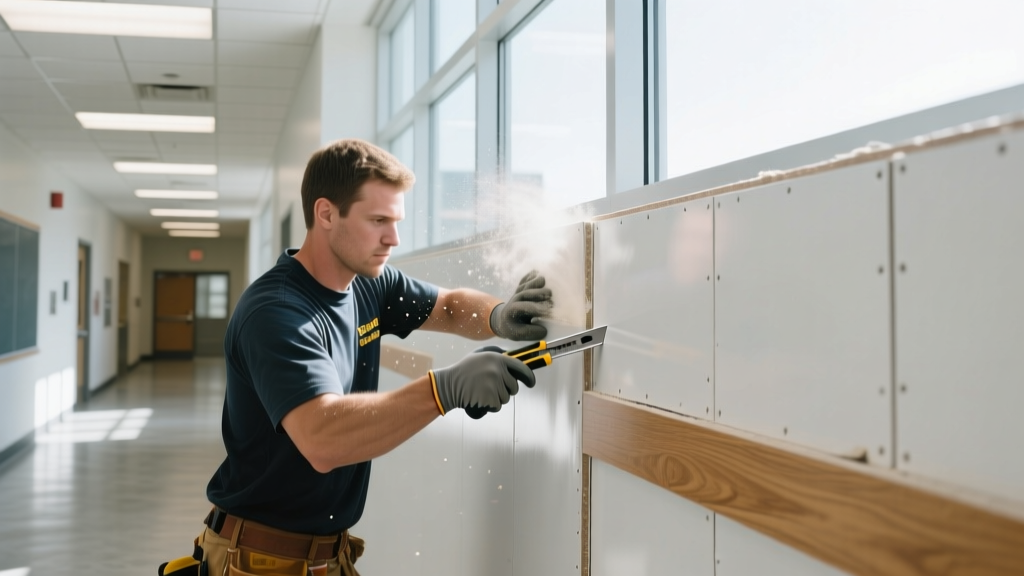
The most common field failure with mesh-reinforced gypsum board occurs during the cutting phase. Contractors accustomed to standard score-and-snap methods often leave jagged edges or fail to sever the internal mesh, leading to blown-out seams and compromised fire ratings.
Step-by-Step Cutting Protocol
- Deep Score the Face: Use a heavy-duty utility knife with a fresh, hooked blade. You must score deeply enough to cut through both the XP face paper and the upper layer of the embedded fiberglass mesh.
- Snap the Core: Apply sharp, even pressure behind the score line to snap the gypsum core. The mesh will hold the panel together, preventing the catastrophic shattering seen in standard Type X boards.
- Sever the Back: Bend the panel backward to expose the back paper and lower mesh layer. Run the knife along the hinge line to cleanly cut through the remaining mesh and paper.
- Rasp the Edges: Use a drywall rasp to smooth the edge. The fiberglass mesh can leave micro-fraying that prevents tight butt joints if not sanded down.
Fastener Schedule and Framing
According to the Gypsum Association's GA-216 application guidelines, hi-impact boards require strict adherence to fastener schedules to maintain structural integrity under duress. For 5/8" XP Hi-Impact applied to 20-gauge steel studs spaced 16 inches on center:
- Screw Type: 1-5/8" Type S bugle-head, fine-thread drywall screws.
- Wall Spacing: Maximum 12 inches on center (o.c.) in the field, 8 inches o.c. at edges and ends. (Note: This is denser than the standard 16" field spacing for regular Type X).
- Penetration Depth: Screw heads must dimple the face paper without breaking the paper surface. Over-driving compromises the XP moisture barrier and reduces pull-through resistance.
Finishing to Level 4 and Level 5
Because hi-impact boards are typically installed in high-visibility commercial corridors, finishing standards are critical. The XP treated paper is highly non-porous compared to standard gypsum paper. This means joint compound dries slower and can experience 'photographing' (where the tape and mud are visible through the paint under oblique lighting).
Critical Finishing Rule: Do not use standard paper tape on XP Hi-Impact joints. The non-porous face paper prevents adequate moisture transfer, leading to blistering. Specify fiberglass mesh tape embedded in setting-type joint compound (e.g., 45-minute or 90-minute hot mud) for the first coat, followed by two coats of high-build lightweight topping compound.
For areas with severe natural light (e.g., corridors with large skylights or floor-to-ceiling windows), a Level 5 finish is mandatory. Apply a skim coat of Level 5 finishing compound across the entire panel surface to equalize the porosity difference between the XP paper and the joint compound.
Alternative Comparisons: XP Hi-Impact vs. Fiber-Reinforced Panels
When specifying for impact resistance, architects often cross-shop Gold Bond XP Hi-Impact against fiber-reinforced gypsum panels (such as USG Securock or Georgia-Pacific DensArmor). Understanding the physical differences dictates the correct selection.
Gold Bond XP Hi-Impact: Features traditional paper facers treated for mold resistance. Advantage: The paper surface is significantly easier to finish to a smooth Level 4 or 5 compared to glass-mat or fiber-reinforced surfaces. It requires less skim coating and yields a superior painted finish. Disadvantage: The paper facer, while treated, is still organic and can be compromised by prolonged standing water.
Fiber-Reinforced / Glass-Mat Panels: Utilize a paperless, fiberglass-mat facing. Advantage: Complete immunity to paper-based mold growth and superior performance in areas subject to actual water intrusion (e.g., behind commercial tile in shower surrounds). Disadvantage: The surface is rough, heavily textured, and highly porous. Finishing requires aggressive skim coating, and the exposed fiberglass fibers can cause skin irritation for installers during sanding.
Common Failure Modes to Avoid
To ensure the manufacturer's warranty and fire-rating assemblies remain valid, avoid these frequent specification and installation errors:
- Mismatched Joint Compound: Using standard all-purpose pre-mixed mud over setting-type compounds on the mesh-reinforced core leads to shrinkage cracks at the joints due to the panel's high rigidity.
- Improper Clearance: Failing to maintain a 1/2-inch gap between the bottom edge of the XP Hi-Impact board and the concrete subfloor. Wicking moisture from the slab will eventually degrade the bottom edge, negating the XP treatment.
- Over-sanding the Facers: Aggressive sanding of the XP treated paper removes the moisture-resistant coating, exposing the raw gypsum core to ambient humidity and compromising the mold-resistant properties.
Written by
Sarah WhitfieldSarah Whitfield is a chartered quantity surveyor (MRICS) and construction cost analyst with 15 years of experience in material pricing, procurement strategy, and project budgeting. She earned her degree in Construction Management from the University of Reading (UK) and has worked on projects ranging from $2M custom homes to $180M mixed-use developments across North America and Europe. Sarah currently leads cost estimating for BuildMat Insight, maintaining a proprietary database of 4,000+ material price points updated quarterly. She is a frequent contributor to RSMeans cost data panels and has presented at the International Cost Engineering Council (ICEC) congress. Based in Denver, CO, Sarah is an avid trail runner and volunteer mentor for Women in Construction.
More from Sarah Whitfield
View all
Wood & Lumber
What Are the Different Types of Wood? A Builder's Guide
Compare structural softwoods, finish hardwoods, and engineered lumber. Analyze Janka ratings, MOE values, and 2026 pricing for construction.
Aug 4, 2026

Walls & Panels
Steel Framing vs Wood Framing: Corrosion and Moisture Defense
Compare steel framing vs wood framing for moisture resistance. Learn about galvanized coatings, condensation risks, and corrosion protection strategies.
Jul 21, 2026

Stone & Masonry
How to Cut Stone Veneer: Wet Saw vs Grinder Comparison
Compare the best tools for cutting stone veneer. We review wet saws, angle grinders, and chop saws to help you achieve clean, chip-free cuts.
Jul 21, 2026