National Gypsum Board Code Compliance: Fire & Moisture Rules
Ensure your project meets IBC standards with our National Gypsum board code compliance guide covering Gold Bond fire, moisture, and acoustic ratings.

Navigating IBC Standards with National Gypsum Board
When specifying drywall for commercial, institutional, and multi-family residential projects, code compliance is non-negotiable. National Gypsum, primarily through its Gold Bond product line, manufactures gypsum boards engineered to meet stringent International Building Code (IBC) requirements. However, selecting the right board requires more than just checking a generic material box; it demands a precise understanding of ASTM testing standards, UL fire-rated assemblies, and local jurisdiction amendments.
Under the master specification ASTM C1396, gypsum board is categorized by physical properties, core composition, and facing materials. For architects and contractors working within the 2024 and upcoming 2026 IBC adoption cycles, understanding how National Gypsum's specific product lines map to these codes is critical for passing inspections and ensuring life-safety compliance.
- ASTM C1396: Standard Specification for Gypsum Board.
- ASTM E119: Standard Test Methods for Fire Tests of Building Construction and Materials.
- IBC Chapter 7: Fire and Smoke Protection Features.
- IBC Chapter 12: Interior Environment (Acoustics and Moisture).
Fire-Rated Assemblies: Type X vs. Type C Compliance
Fire resistance is the most heavily scrutinized aspect of gypsum board installation. The IBC mandates specific hourly fire-resistance ratings for structural elements, exit enclosures, and occupancy separations. National Gypsum addresses these requirements through its Gold Bond Fire-Shield (Type X) and Gold Bond Fire-Shield C (Type C) product lines.
Understanding the Core Differences
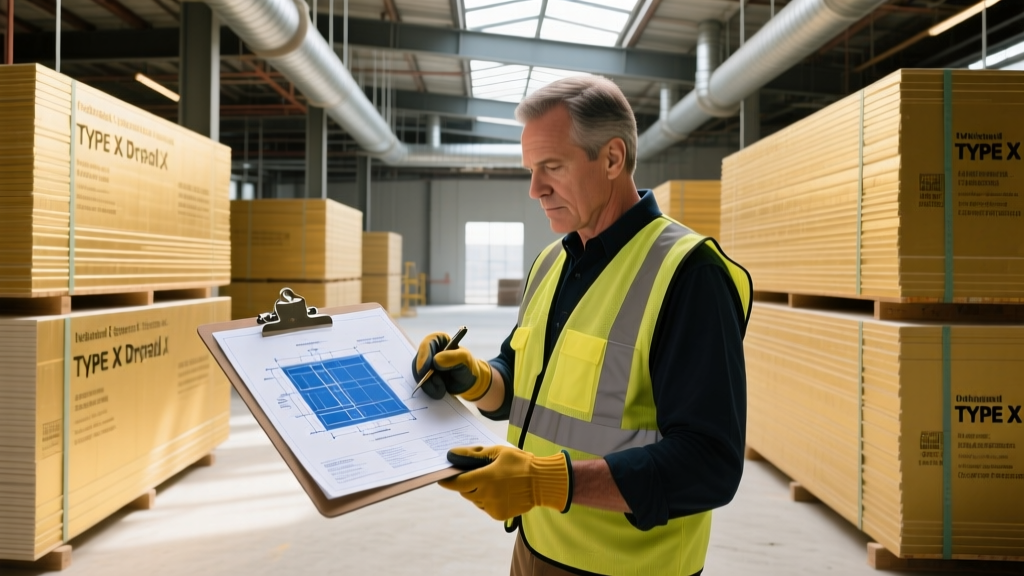
Standard 1/2-inch gypsum board does not qualify for 1-hour fire ratings in most single-layer assemblies. Type X boards, like the 5/8-inch Gold Bond Fire-Shield, incorporate glass fibers into the core to delay structural collapse during a fire. However, for 2-hour rated assemblies or wood-framed party walls, Type C is often required by the UL design. Type C boards contain enhanced glass fibers and vermiculite additives that prevent the gypsum core from shrinking and pulling away from the fasteners during the intense heat and thermal shock of the ASTM E119 hose stream test.
| Product Line | Thickness | Type | Common UL Design | Hourly Rating |
|---|---|---|---|---|
| Gold Bond Fire-Shield | 5/8" | Type X | U419 (Wood Stud) | 1-Hour |
| Gold Bond Fire-Shield C | 5/8" | Type C | U305 (Steel Stud) | 2-Hour |
| Gold Bond Fire-Shield | 1/2" | Type X (Special) | V453 (Ceiling) | 1-Hour |
For comprehensive assembly details and fastener spacing requirements, always consult the National Gypsum Company technical literature and the UL Product IQ database before finalizing your submittals.
Moisture and Mold Resistance: Navigating ASTM D3273
IBC Section 1210 explicitly requires moisture-resistant materials in wet areas, such as commercial restrooms, shower surrounds, and janitor closets. Furthermore, modern building codes and green building standards (like LEED and WELL) heavily penalize materials prone to microbial growth.
National Gypsum's Gold Bond XP line is engineered with a moisture- and mold-resistant core and facing paper. To meet code, the board must be tested under ASTM D3273 (Standard Test Method for Resistance to Growth of Mold on the Surface of Interior Coatings in an Environmental Chamber). Gold Bond XP consistently achieves a perfect score of 10, indicating no mold growth under extreme laboratory conditions.
Inspector's Note: A common code violation occurs when contractors treat mold-resistant gypsum board as a waterproofing membrane. Gold Bond XP is moisture-resistant, not waterproof. For direct water exposure areas (like commercial shower stalls), a liquid-applied or sheet waterproofing membrane must still be applied over the XP board to comply with IBC and ANSI A108 standards.
When to Specify XP vs. Standard Board
- Mandatory for XP: Backer board for tile in wet areas, elevator lobby walls adjacent to restrooms, and unconditioned corridors in high-humidity climates.
- Standard Board Acceptable: Interior partition walls in climate-controlled office spaces, retail dry zones, and ceiling plenums above finished spaces.
Shaftliner and Area Separation Wall Compliance
Elevator shafts, mechanical chases, and stairwells require specialized fire containment to prevent the vertical spread of smoke and flames. IBC Section 713 governs shaft enclosures, typically demanding 2-hour fire-resistance ratings.
National Gypsum manufactures Gold Bond Shaftliner panels specifically for these applications. Available in 1-inch and 1.5-inch thicknesses, these panels feature a specialized edge profile designed to slide into H-shaped aluminum or steel studs. This creates a self-supporting, fire-rated shaftwall system that can be erected from one side before the elevator cab or mechanical equipment is installed.
For multi-family townhomes, IBC Section 708 requires 2-hour fire barriers between dwelling units. National Gypsum's Area Separation Wall systems utilize 1-inch shaftliner panels sandwiched between H-studs, with aluminum breakaway clips attaching the assembly to the adjacent wood framing. This allows one unit to burn and collapse without pulling the fire wall down, a critical life-safety mechanism that standard drywall cannot replicate.
Acoustical Code Requirements (IBC Chapter 12)
Sound transmission is a major factor in multi-family and hospitality construction. IBC Section 1206 mandates that walls and floor-ceiling assemblies separating dwelling units must achieve a minimum Sound Transmission Class (STC) of 50 (or 45 if field-tested). National Gypsum addresses this through the Gold Bond SoundBreak XP line.
SoundBreak XP features a viscoelastic polymer layer sandwiched between two high-density gypsum cores. This constrained-layer damping technology dissipates sound wave energy. When installed in a standard steel-stud assembly with mineral wool insulation, SoundBreak XP can achieve STC ratings well into the 60s, providing a comfortable margin of error above the code minimum and protecting against field-installation variables that typically degrade acoustic performance.
Common Code Violations and Inspection Failures
Even when the correct National Gypsum products are specified, improper installation or detailing can result in failed inspections. Based on current field reports and guidelines from the Gypsum Association, avoid these frequent compliance traps:
- Missing Firestopping at Perimeters: Fire-rated walls must extend continuously from the floor to the underside of the floor or roof deck above. Leaving a gap at the top of the wall and attempting to seal it with standard joint compound is a direct violation of IBC Section 715. You must use a tested, listed firestop sealant or a deflection track system.
- Incorrect Fastener Spacing: UL designs dictate exact screw spacing (e.g., 12 inches on center for walls, 8 inches for ceilings). Deviating from the UL design voids the fire rating. Inspectors will frequently measure fastener patterns during rough-in.
- Unlisted Joint Treatments: Using a competitor's joint compound or mesh tape with National Gypsum fire-rated boards can void the assembly's UL listing. Always specify compatible setting-type compounds (like Gold Bond ProSet) and paper tape to maintain the tested design's integrity.
- Piercing Rated Assemblies: Running unprotected electrical conduits or plumbing through a 1-hour or 2-hour rated Gold Bond wall without installing listed putty pads or firestop collars compromises the entire assembly. Refer to the International Code Council (ICC) guidelines for allowable penetration sizes and protection methods.
Successful code compliance with National Gypsum board relies on treating the product not just as a surface covering, but as an integral component of a tested, life-safety building system. Always verify the specific UL design number on your architectural drawings and cross-reference it with the manufacturer's latest technical data sheets prior to procurement.
Written by
David NakamuraDavid Nakamura is a licensed architect (AIA) and construction technology writer focused on sustainable building methods, mass timber engineering, and high-performance building envelopes. He holds a Master of Architecture from the University of Washington and is a certified Passive House Consultant (CPHC). David spent eight years at the Seattle firm Mithun, where he led the design of three LEED Platinum projects, before founding his own practice specializing in net-zero residential design. He serves on the editorial advisory board of GreenBuilder Magazine and has authored peer-reviewed papers on cross-laminated timber (CLT) connections for the Journal of Structural Engineering. In his spare time, David teaches woodworking at Pratt Fine Arts Center and kayaks the Puget Sound.
More from David Nakamura
View all
Construction Cost
Labor Cost to Build a Deck Per Sq Ft: 2026 Installation Guide
Discover the exact labor cost to build a deck per sq ft in 2026. This installation guide breaks down contractor rates, complexity factors, and hidden fees.
Aug 4, 2026

Construction Cost
How Much Does It Cost to Build a 3 Bedroom House? Financing Guide
Learn exactly how much it costs to build a 3 bedroom house and explore 2026 financing options, construction loan types, and budget frameworks for your build.
Aug 4, 2026

Construction Cost
Cost to Build a Tennis Court: 2026 Guide
How much does it cost to build a tennis court in 2026? Breakdowns for asphalt, concrete, and synthetic surfaces plus fencing and lighting.
Jul 30, 2026