Code Compliance for Painted Gypsum Board: Fire, Moisture, and Finish
Navigate IBC and ASTM code requirements for painted gypsum board. Expert guide on Type X fire ratings, moisture traps, and GA-214 finish levels.
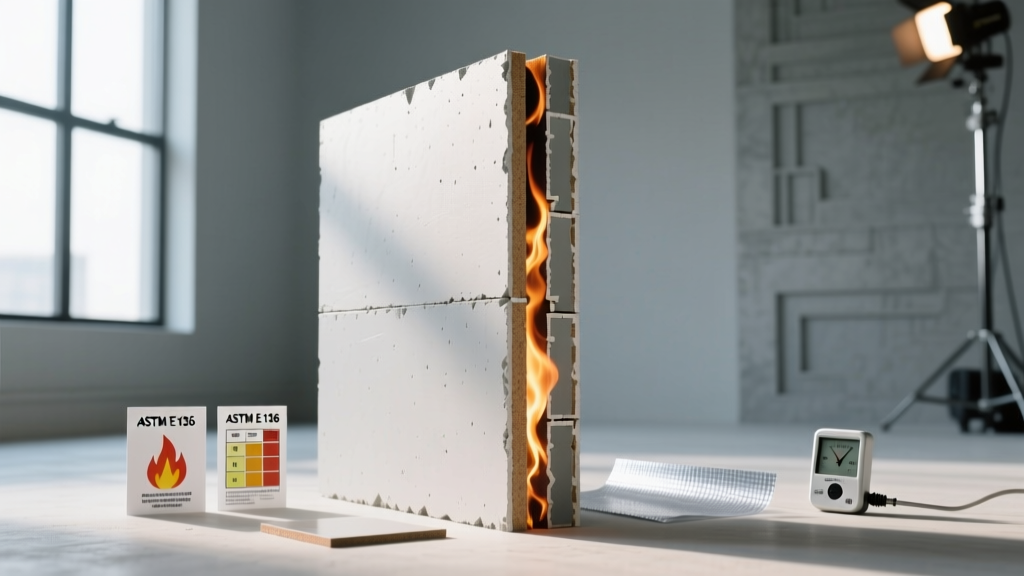
How Paint Affects Type X Fire-Resistance Ratings
When specifying or inspecting fire-resistance-rated partitions, a common point of confusion on the job site is whether applying paint to Type X gypsum board voids the assembly's Underwriters Laboratories (UL) listing. Under ASTM E119 and UL 263 testing protocols, standard architectural coatings do not compromise the 1-hour or 2-hour fire rating of 5/8-inch Type X boards—such as USG Sheetrock Brand Firecode X or National Gypsum Gold Bond XP Fire-Shield—provided the dry film thickness remains within standard architectural limits.
Standard latex and acrylic paints typically yield a dry film thickness of 1.5 to 2.0 mils per coat. A two-coat system results in roughly 3 to 4 mils of total thickness, which is well below the threshold that would alter the thermal transmission properties of the gypsum core during a fire. However, code compliance issues arise when contractors combine heavy drywall textures (e.g., skip trowel or heavy knockdown) with multiple coats of high-build paint. If the total non-combustible surfacing thickness exceeds 1/16 inch, the material is at risk of spalling during the mandatory hose-stream test of the ASTM E119 protocol, potentially leading to a failed inspection if the specific assembly was not tested with that exact texture-and-paint profile.
Applying intumescent (fire-retardant) paint over standard 1/2-inch regular gypsum board does not magically create a code-compliant, UL-listed fire-rated assembly. The International Building Code (IBC) Chapter 7 requires fire-resistance-rated walls to be constructed as complete, tested systems. Intumescent coatings must be part of a specific, tested UL design number; they cannot be used as a field-applied substitute to upgrade a non-rated partition to a 1-hour rating.
Moisture-Resistant Boards and Permeability Traps
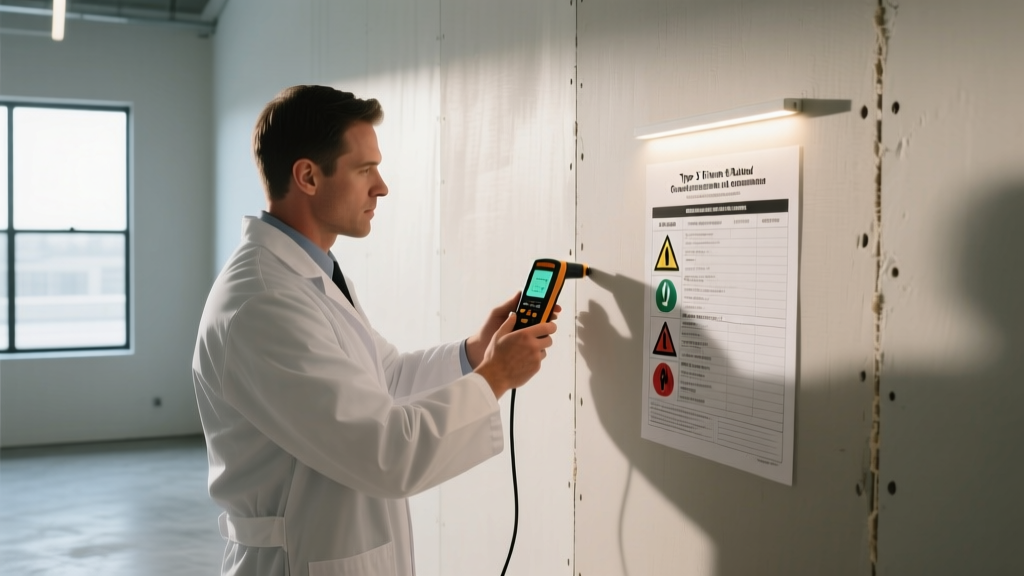
In wet areas and high-humidity environments, the IBC mandates the use of moisture-resistant (MR) or water-resistant (WR) gypsum board, governed by ASTM C1396. While green-faced boards offer basic water resistance, modern purple-faced boards (like USG Mold Tough) provide enhanced mold and moisture resistance. The critical code intersection occurs when selecting the paint system for these specialized boards.
The Vapor Retarder Conflict
Paints possess varying permeability (perm) ratings. High-gloss epoxy coatings, oil-based enamels, and certain specialty waterproofing paints act as Class I vapor retarders (≤ 0.1 perms). According to IBC Section 1402.3, installing a Class I vapor retarder on the interior warm-in-winter side of a wall cavity is strictly prohibited in Climate Zones 1 through 4, and heavily restricted in Zones 5 and 6, unless the wall assembly has specific exterior drying potential.
If a contractor paints an MR gypsum board in a Zone 3 commercial bathroom with a low-perm epoxy paint, any moisture that migrates into the wall cavity from the exterior or from plumbing condensation becomes trapped. The Gypsum Association explicitly warns that trapping moisture inside a wall cavity negates the mold-resistant properties of the board's facing paper, leading to concealed microbial growth and structural degradation of the gypsum core.
For painted MR gypsum board in commercial restrooms or locker rooms, specify 100% acrylic latex paints with a perm rating greater than 1.0 (Class III vapor retarder or vapor permeable). This allows incidental cavity moisture to dry to the interior while still providing a washable, scrubbable surface that meets commercial sanitation codes.
GA-214 Finish Levels: Matching Paint Sheen to Code Specs
The Gypsum Association's GA-214 standard dictates the required level of drywall finish based on the final decoration type, lighting conditions, and texture. Inspectors and architects frequently cite GA-214 in project specifications, making it a binding document for code and contract compliance. Applying the wrong paint sheen over an under-specified finish level is one of the most common aesthetic and contractual failures in commercial construction.
| GA-214 Level | Description & Joint Treatment | Required Paint / Finish Type | Code / Spec Application |
|---|---|---|---|
| Level 1 | Tape embedded in compound; no wiping or finishing. | None (Unpainted) | Plenum spaces, attics, concealed fire-barriers. |
| Level 2 | Tape wiped; one coat over joints and fasteners. | Heavy textures only | Garages, warehouse storage, utility rooms. |
| Level 3 | Two coats over joints; one coat over fasteners. | Medium to heavy textures, flat paints. | Public areas with heavy texture, low-sidelight corridors. |
| Level 4 | Three coats over joints; two coats over fasteners. | Flat, matte, or low-luster paints; light textures. | Standard commercial offices, residential living spaces. |
| Level 5 | Level 4 plus a skim coat of joint compound over the entire surface. | Gloss, semi-gloss, enamel, or any paint under severe sidelighting. | Lobbies, hospitals, areas with critical glazing or spot lighting. |
VOC Limits and Indoor Air Quality Compliance
Painting interior gypsum board triggers strict compliance requirements regarding Volatile Organic Compounds (VOCs). For commercial projects pursuing LEED v4.1 certification, WELL Building Standard, or simply complying with local environmental regulations, the paint applied to the drywall must meet stringent chemical emission limits.
The South Coast Air Quality Management District (SCAQMD) Rule 1168 is the baseline standard adopted by most national green building codes. When specifying paint for interior gypsum partitions, adhere to the following maximum VOC limits:
- Flat and Matte Interior Wall Paints: Maximum 50 grams per liter (g/L).
- Non-Flat (Eggshell, Satin, Semi-Gloss) Interior Wall Paints: Maximum 100 g/L.
- Drywall Primers and Sealers: Maximum 100 g/L.
- High-Performance Architectural Coatings (Epoxies/Urethanes): Maximum 200-300 g/L (requires specific ventilation protocols during application).
According to the EPA guidelines on indoor air quality, off-gassing from non-compliant paints applied to large expanses of gypsum board can cause severe sick-building syndrome symptoms. Inspectors verifying LEED compliance will require the contractor to submit the manufacturer's technical data sheet (TDS) and Safety Data Sheet (SDS) for the exact primer and topcoat used on the drywall to verify the VOC content before the walls are enclosed or the building is occupied.
Remediation Matrix: Common Painted Drywall Code Violations
When painted gypsum board fails inspection or post-occupancy performance testing, the root cause usually traces back to a mismatch between the substrate, the coating, and the environmental code requirements. Use the following matrix to diagnose and remediate common field failures.
| Observed Failure / Violation | Code / Standard Reference | Required Remediation |
|---|---|---|
| Joint banding / photographing through semi-gloss paint in a corridor with sidelighting. | GA-214 (Level 5 requirement); Project Specs. | Sand existing paint to degloss. Apply a full Level 5 skim coat of joint compound over the entire gypsum surface. Prime with PVA drywall sealer and repaint. |
| Concealed mold growth behind vinyl wallcovering or epoxy paint on MR board in an exterior wall. | IBC Section 1402.3 (Vapor Retarders); ASTM C1396. | Remove impermeable coating. Remediate mold per EPA protocols. Replace damaged gypsum board. Repaint with a vapor-permeable acrylic latex (perm rating > 1.0). |
| Peeling / delamination of paint over green-faced water-resistant board in a commercial shower. | IBC Section 1210 (Wet Areas); TCNA Handbook. | Gypsum board (even WR) is not an approved substrate for direct paint in continuous wet zones (shower stalls). Remove paint and board. Replace with cementitious backer board and a waterproof membrane system. |
| Failed fire inspection due to heavily textured and painted 1-hour rated partition. | IBC Chapter 7; ASTM E119. | Verify the specific UL Design Number. If the design does not explicitly allow heavy textures + paint, scrape the texture down to the gypsum paper facing, apply a Level 3 smooth finish, and repaint with standard latex. |
Written by
Priya KapoorPriya Kapoor is a real estate market analyst and construction economics researcher with expertise in housing affordability, development feasibility, and infrastructure investment. She holds a Master of Regional Planning from Cornell University and previously worked as a senior analyst at CBRE's Investment Properties group, where she modeled returns for $4B in mixed-use development pipelines. Priya now runs an independent research practice advising developers, municipalities, and REITs on construction cost forecasting and market timing. She publishes the quarterly "BuildMat Market Pulse" report tracking material price indices across 12 commodity categories. Based in Austin, TX, Priya serves on the board of Habitat for Humanity Austin and is a marathon runner.
More from Priya Kapoor
View all
Construction Cost
Cost to Build a 1600 Sq Ft Home in 2026: Full Breakdown
Accurate 2026 cost to build a 1600 sq ft home—material, labor, and regional pricing breakdowns included. Plan your budget with real-time estimates.
Aug 11, 2026

Wood & Lumber
Name the Types of Wood for Pressure Treatment and Preservation
Learn how to name the types of wood best suited for pressure treatment. Compare species treatability, chemical retention levels, and 2026 preservation costs.
Aug 4, 2026

Stone & Masonry
Stone Veneer Suppliers Lindenhurst: 2026 Cost Analysis
Analyze 2026 stone veneer costs in Lindenhurst, NY. Compare local supplier pricing, delivery fees, and Suffolk County installation labor rates.
Aug 4, 2026