Gypsum Moisture Resistant Board vs Cement Board: Wet Area Guide
Compare gypsum moisture resistant board against cement board and glass mat alternatives. Discover costs, ASTM standards, and exact use cases for wet areas.

Selecting the correct substrate for high-humidity and wet environments is one of the most common failure points in residential and commercial construction. Water intrusion behind tile or paint leads to structural rot, mold proliferation, and costly remediation. When builders and renovators evaluate substrates, the primary debate centers on gypsum moisture resistant board versus traditional cementitious backer boards. While both are engineered to handle damp conditions, their chemical compositions, weight profiles, and water-exposure limits make them suitable for entirely different applications.
As of current building codes adopted for 2026 construction, the distinction between 'moisture-resistant' and 'waterproof' is strictly enforced. Misapplying a moisture-resistant gypsum panel in a direct-spray zone is a direct violation of ANSI tile installation standards and manufacturer warranties. This guide breaks down the exact specifications, costs, and failure modes of moisture-resistant gypsum against its primary alternatives: cement board and glass mat gypsum.
The Core Contenders Defined
To make an accurate material selection, you must understand the physical makeup of each panel type. The market is dominated by three distinct categories of wet-area substrates.
1. Gypsum Moisture Resistant Board (Green/Purple Board)
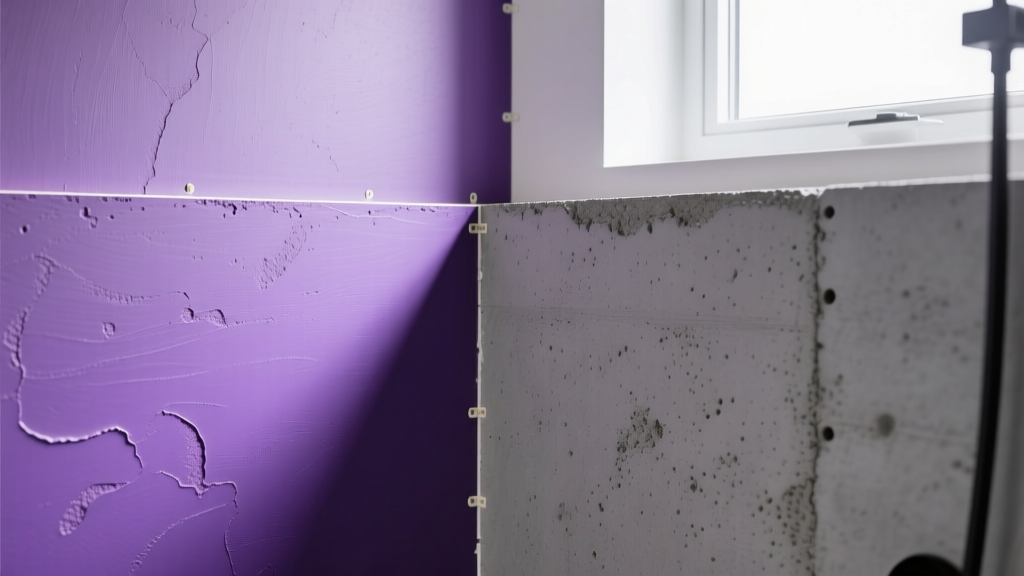
Standard moisture-resistant gypsum (historically known as 'green board') features a water-resistant core and a treated paper facing. Modern premium iterations (often colored purple, such as USG Sheetrock Mold Tough or CertainTeed M2Tech) utilize fiberglass mats or specialized antimicrobial paper facers. These panels meet ASTM C1396 standards for water-resistant gypsum backing panels. They are designed to withstand high ambient humidity but will degrade if subjected to standing water or continuous direct spray.
2. Cement Backer Board
Cement boards, like USG Durock or James Hardie HardieBacker, are composed of Portland cement, aggregate, and glass mesh. They are completely impervious to water damage; the material will not rot, swell, or lose structural integrity even if fully submerged. However, they are not waterproof barriers—water can pass through the seams and core to the framing behind them, necessitating a separate liquid or sheet membrane.
3. Glass Mat Gypsum (Fiberglass-Faced)
Products like Georgia-Pacific DensShield or USG Securock utilize a silicone-treated, water-resistant gypsum core faced with fiberglass mats on both sides. They bridge the gap between traditional gypsum and cement board, offering superior mold resistance (ASTM D3273) and easier installation than cement, while handling more direct moisture than paper-faced gypsum.
Head-to-Head Comparison Matrix
| Feature | Moisture-Resistant Gypsum (Purple/Green) | Cement Board (1/2 in.) | Glass Mat Gypsum |
|---|---|---|---|
| Water Exposure Limit | High humidity only (no direct spray) | Direct spray / full submersion | Direct spray (with sealed seams) |
| Weight (per 4x8 sheet) | ~52 - 58 lbs | ~75 - 95 lbs (varies by brand) | ~55 - 62 lbs |
| Cutting Method | Score and snap (utility knife) | Carbide scorer or grinder (silica dust) | Score and snap (utility knife) |
| Mold Resistance (ASTM D3273) | Score 10 (Premium Purple) / 5 (Standard Green) | Inorganic (does not feed mold) | Score 10 |
| Material Cost (per sq. ft.) | $0.50 - $0.75 | $1.25 - $1.60 | $0.85 - $1.10 |
Deep Dive: Gypsum Moisture Resistant Board Applications
Gypsum moisture resistant board remains the undisputed champion for whole-room bathroom walls, kitchen backsplashes, and laundry room enclosures where direct water spray is not a factor. Its primary advantage is workability. A standard 1/2-inch panel can be scored and snapped with a utility knife in seconds, and it accepts standard coarse-thread drywall screws.
Where It Wins
- Ambient Humidity Zones: Bathroom walls outside the shower/tub footprint, powder rooms, and basement finishing where relative humidity frequently exceeds 60%.
- Kitchen Soffits and Backsplashes: Provides a stable, moisture-tolerant base for tile mastic in areas subject to occasional splashing.
- Cost Efficiency: Material and labor costs are significantly lower than cement board. Drywall finishers can hang and tape moisture-resistant gypsum at standard production rates.
Where It Fails (Critical Edge Cases)
The most common catastrophic failure occurs when contractors use moisture-resistant gypsum inside shower enclosures to save money. Even when sealed with tile and grout, moisture vapor migrates through the grout lines. Over time, the gypsum core absorbs this vapor, swells, and loses its structural bond to the paper or mat facer. According to the EPA guidelines on indoor moisture, once gypsum board reaches a moisture content above 16%, dormant mold spores activate and proliferate rapidly within the wall cavity.
Under current Tile Council of North America (TCNA) guidelines and ANSI A108.11, standard paper-faced water-resistant gypsum (green board) is strictly prohibited as a backing material in direct wet areas (showers, tub surrounds, and steam rooms). Using it in these zones will void the warranty of your waterproofing membrane and tile setting materials.
Evaluating the Alternatives: Cement and Glass Mat
When your project crosses the threshold from 'damp' to 'wet', you must transition to an alternative substrate.
Cement Board: The Heavy-Duty Standard
For shower pans, tub surrounds, and steam showers, cement backer boards like USG Durock are the industry baseline. Cement board provides a rigid, dimensionally stable surface that will not deflect when wet, preventing tile cracking. Installation Nuance: Cement board requires alkali-resistant screws (standard drywall screws will corrode). Furthermore, cutting cement board with a grinder generates respirable crystalline silica. OSHA mandates strict dust containment and PPE protocols for this process, which slows down installation and increases labor costs.
Glass Mat Gypsum: The Modern Compromise
Glass mat gypsum panels (like DensShield) have largely cannibalized the market share of cement board in residential construction. The silicone-integrated core repels water, while the fiberglass facing eliminates the organic paper that mold feeds on. Installation Nuance: Unlike cement board, which requires a separate sheet membrane (like Kerdi) or liquid roll-on waterproofing, many glass mat boards can be tiled directly onto after taping the seams with fiberglass mesh and setting compound. However, for heavy stone tiles or continuous-use commercial steam showers, a dedicated liquid waterproofing membrane over the glass mat is still highly recommended.
2026 Cost and Labor Breakdown
When budgeting a wet-area renovation or new build, material cost is only half the equation. The labor disparity between hanging gypsum and hanging cement board drastically alters the final price per square foot.
| Cost Category | Moisture-Resistant Gypsum | Cement Board | Glass Mat Gypsum |
|---|---|---|---|
| Panel Material (1/2 in.) | $0.55 / sq. ft. | $1.40 / sq. ft. | $0.95 / sq. ft. |
| Fasteners & Tape | $0.05 / sq. ft. | $0.15 / sq. ft. | $0.10 / sq. ft. |
| Labor (Hang & Finish) | $1.50 - $2.00 / sq. ft. | $3.50 - $5.00 / sq. ft. | $1.80 - $2.50 / sq. ft. |
| Total Installed Cost | $2.10 - $2.60 / sq. ft. | $5.05 - $6.55 / sq. ft. | $2.85 - $3.55 / sq. ft. |
Note: Costs exclude the final waterproofing membrane, tile, and setting materials. Cement board labor is higher due to the physical weight of the panels, the need for specialized carbide scoring tools, and the slower cutting process.
The 'Direct Spray' Decision Framework
Use this practical flowchart to determine the correct substrate for your specific zone. Do not default to the cheapest option; default to the code-compliant option for the specific water exposure level.
- Is the area subject to direct, continuous water spray or submersion?
- Yes (Shower walls, tub surrounds, steam rooms): Use Cement Board or Glass Mat Gypsum. You must apply a liquid or sheet waterproofing membrane over the seams and fasteners before tiling.
- No (Proceed to step 2).
- Is the area subject to high ambient humidity, occasional splashing, or condensation?
- Yes (Bathroom walls outside shower, kitchen backsplashes, laundry rooms): Use premium Gypsum Moisture Resistant Board (Purple/Fiberglass-faced). Standard green board is acceptable but offers inferior mold resistance.
- No (Proceed to step 3).
- Is the area a standard living space with normal humidity fluctuations?
- Yes: Use standard Regular Gypsum Board.
When installing any backer board in a wet zone, never place fasteners within 2 inches of the shower pan or tub flange edge. Driving a screw too close to the bottom edge creates a micro-fracture in the board, allowing capillary action to wick standing water directly into the core of the substrate.
Final Substrate Selection Criteria
The choice between gypsum moisture resistant board and its alternatives is not about finding a universally 'better' product, but about matching the material's physical limitations to the architectural environment. Gypsum moisture resistant board offers unmatched speed, cost-efficiency, and ease of finishing for damp, high-humidity zones. However, the moment the design introduces direct water contact, the project must pivot to cementitious or glass-mat substrates to ensure long-term structural integrity and code compliance. Always verify the specific ASTM rating on the panel's end tape before installation to ensure it matches the environmental demands of the space.
Written by
Sarah WhitfieldSarah Whitfield is a chartered quantity surveyor (MRICS) and construction cost analyst with 15 years of experience in material pricing, procurement strategy, and project budgeting. She earned her degree in Construction Management from the University of Reading (UK) and has worked on projects ranging from $2M custom homes to $180M mixed-use developments across North America and Europe. Sarah currently leads cost estimating for BuildMat Insight, maintaining a proprietary database of 4,000+ material price points updated quarterly. She is a frequent contributor to RSMeans cost data panels and has presented at the International Cost Engineering Council (ICEC) congress. Based in Denver, CO, Sarah is an avid trail runner and volunteer mentor for Women in Construction.
More from Sarah Whitfield
View all
Wood & Lumber
What Are the Different Types of Wood? A Builder's Guide
Compare structural softwoods, finish hardwoods, and engineered lumber. Analyze Janka ratings, MOE values, and 2026 pricing for construction.
Aug 4, 2026

Walls & Panels
Steel Framing vs Wood Framing: Corrosion and Moisture Defense
Compare steel framing vs wood framing for moisture resistance. Learn about galvanized coatings, condensation risks, and corrosion protection strategies.
Jul 21, 2026

Stone & Masonry
How to Cut Stone Veneer: Wet Saw vs Grinder Comparison
Compare the best tools for cutting stone veneer. We review wet saws, angle grinders, and chop saws to help you achieve clean, chip-free cuts.
Jul 21, 2026