GP Gypsum Board vs USG Sheetrock: Which Drywall Wins?
Compare GP gypsum board against USG Sheetrock and National Gypsum. Analyze specs, mold resistance, fire ratings, and current pricing for commercial builds.

The Core Showdown: GP ToughRock vs. USG Sheetrock UltraLight
When specifying standard interior wall and ceiling assemblies, the choice often narrows down to Georgia-Pacific's ToughRock line and USG's Sheetrock brand. While both manufacturers produce panels that strictly comply with ASTM C1396 (Standard Specification for Gypsum Board), their core engineering philosophies diverge significantly in weight and density.
USG pioneered the lightweight drywall category with Sheetrock UltraLight, removing up to 13 pounds from a standard 4x8 sheet of 1/2-inch board. This reduction drastically minimizes hanger fatigue and lowers freight costs on high-rise commercial projects. Conversely, GP gypsum board (specifically the standard ToughRock line) retains a denser, heavier gypsum core. Many veteran finishing contractors prefer this density because it offers superior screw retention and a more rigid feel during installation, reducing the likelihood of fastener pop in environments with minor structural settling or HVAC-induced framing movement.
Scoring and Snapping Mechanics
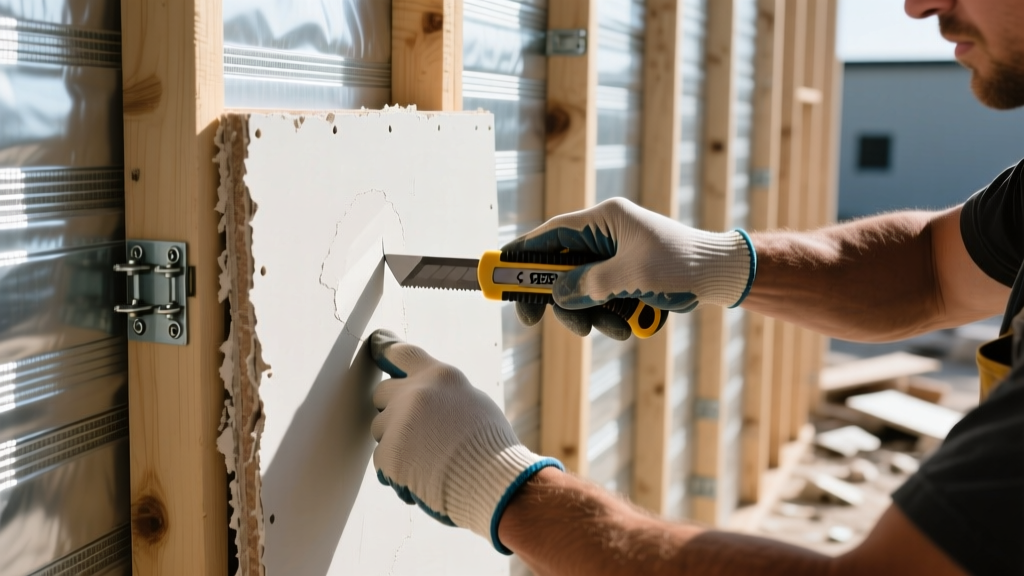
On the job site, the fracture mechanics of the core matter. GP ToughRock is engineered with a highly uniform core that yields a remarkably clean snap when scored with a utility knife. USG UltraLight, due to its aerated core and synthetic reinforcement additives, can occasionally produce a slightly more jagged edge upon snapping, requiring a bit more attention during the taping and mudding phases to hide the bevel.
Moisture and Mold Defense: Fiberglass Mat vs. Treated Paper
The most critical technical divergence between GP and its competitors lies in moisture and mold management. For decades, the industry standard for damp environments was green-faced, paper-backed drywall treated with chemical mold inhibitors. USG continues to offer this via their Mold Tough line. However, GP disrupted this space by heavily investing in fiberglass-mat technology, most notably with DensArmor Plus for interiors and DensGlass for exterior sheathing.
When tested under ASTM D3273 (the standard environmental chamber test for mold resistance), paper-faced boards with chemical treatments typically score an 8 or 9 out of 10. The chemical treatments eventually degrade, especially if the board is subjected to repeated wetting and drying cycles. GP DensArmor Plus, which replaces the paper facing on both the front and back with a woven fiberglass mat, inherently scores a perfect 10. Fiberglass is an inorganic material; it simply does not provide a food source for mold spores.
Edge Case: High-Humidity Commercial Interiors
For facilities like indoor aquatic centers, commercial kitchens, or hospital hydrotherapy rooms, specifying GP's fiberglass-mat gypsum board is a non-negotiable best practice. While USG does offer Securock (a glass-mat board), it is primarily marketed and optimized for exterior sheathing and roof decks, whereas GP has specifically calibrated DensArmor Plus for interior finishing, accepting standard joint compounds and textures without the excessive absorption issues sometimes seen in exterior-grade glass-mat boards.
Fire-Rated Assemblies and Core Cohesion
In commercial construction, 5/8-inch Type X gypsum board is the backbone of passive fire protection. Both GP Firestop Type X and USG Firecode X incorporate glass fibers into the gypsum core to maintain structural cohesion when the calcined gypsum dehydrates under extreme heat. Both products are heavily tested and listed in hundreds of Underwriters Laboratories (UL) and UL Environment designs.
However, architects and firestop contractors must be meticulous about assembly compatibility. A 1-hour or 2-hour fire rating applies to the entire assembly (studs, fasteners, spacing, insulation, and board), not just the panel itself. GP maintains an extensive, easily searchable database of UL designs on the Georgia-Pacific Gypsum portal. When substituting GP Type X for a competitor's board in a pre-specified UL design, the general contractor must verify that the substitution is permitted under the specific design's 'Design Substitution' clause, as core densities and edge profiles (tapered vs. square) can alter the thermal transmission profile.
| Feature | GP Gypsum Board (ToughRock / Dens) | USG (Sheetrock / Securock) | National Gypsum (Gold Bond) |
|---|---|---|---|
| Standard 1/2' Weight | ~57 lbs (Denser core) | ~44 lbs (UltraLight) | ~52 lbs (XP line) |
| Mold Tech | Fiberglass mat (DensArmor Plus) | Chemical-treated paper (Mold Tough) | Chemical-treated paper (XP) |
| Type X Fire Core | Glass fiber reinforced (Firestop) | Glass fiber reinforced (Firecode) | Glass fiber reinforced (Fire-Shield) |
| Exterior Sheathing | DensGlass (Gold mat) | Securock (Glass mat) | eXP (Glass mat) |
| Edge Profile | Optimized tapered edge | Micro-beveled edge | Standard tapered edge |
Current Market Pricing and Supply Dynamics
Drywall pricing remains highly sensitive to regional freight costs, energy prices (natural gas is heavily used in the calcination process), and local housing starts. As of the current market cycle, here is the baseline pricing structure for standard commercial volumes (pallet quantities):
- Standard 1/2-inch 4x8 (ToughRock vs. Sheetrock): $14.50 to $16.50 per sheet. USG UltraLight occasionally commands a $0.50 to $1.00 premium per sheet due to the proprietary lightweight additives, though this is often offset by reduced labor and freight costs.
- 5/8-inch Type X 4x8 (Firestop vs. Firecode): $18.00 to $22.00 per sheet. Pricing here is heavily commoditized; contractors typically award bids based on local distributor inventory rather than brand loyalty.
- Premium Mold/Moisture 1/2-inch 4x8 (DensArmor Plus vs. Mold Tough): $24.00 to $29.00 per sheet. GP's fiberglass-mat boards carry a distinct manufacturing premium, but they eliminate the risk of callbacks for mold remediation in high-liability commercial builds.
Decision Framework: When to Specify GP Over Alternatives
Strategic Specification Guide
- IF the project is a multi-story residential build where hanger fatigue and hoisting logistics are the primary bottlenecks, THEN specify USG Sheetrock UltraLight to maximize labor efficiency.
- IF the project involves high-moisture commercial interiors (hospitals, schools, natatoriums) where long-term liability and indoor air quality are paramount, THEN specify GP DensArmor Plus. The inorganic fiberglass mat provides permanent mold resistance that chemical treatments cannot match.
- IF the framing contractor is working with light-gauge steel that is prone to minor twisting, THEN specify standard GP ToughRock. Its denser core provides superior screw-holding power, reducing fastener pop callbacks during the first year of HVAC cycling.
- IF you are specifying exterior sheathing behind a rainscreen cladding system, THEN evaluate GP DensGlass against USG Securock based strictly on the specific manufacturer's warranty requirements for the weather-resistive barrier (WRB) being applied over it.
Contractor Installation Quirks and Finishing
From a finishing perspective, GP gypsum board is widely praised for its consistent paper bonding. Delamination during the sanding of heavy joint compound is exceptionally rare with ToughRock. However, when cutting GP's fiberglass-mat boards (DensArmor), crews must use sharp blades and proper PPE; the fiberglass strands can cause skin irritation and require more rigorous dust management than standard paper-faced boards. Always score the face, snap the core, and cut the back mat to ensure a factory-like edge for taping.
Written by
David NakamuraDavid Nakamura is a licensed architect (AIA) and construction technology writer focused on sustainable building methods, mass timber engineering, and high-performance building envelopes. He holds a Master of Architecture from the University of Washington and is a certified Passive House Consultant (CPHC). David spent eight years at the Seattle firm Mithun, where he led the design of three LEED Platinum projects, before founding his own practice specializing in net-zero residential design. He serves on the editorial advisory board of GreenBuilder Magazine and has authored peer-reviewed papers on cross-laminated timber (CLT) connections for the Journal of Structural Engineering. In his spare time, David teaches woodworking at Pratt Fine Arts Center and kayaks the Puget Sound.
More from David Nakamura
View all
Construction Cost
Labor Cost to Build a Deck Per Sq Ft: 2026 Installation Guide
Discover the exact labor cost to build a deck per sq ft in 2026. This installation guide breaks down contractor rates, complexity factors, and hidden fees.
Aug 4, 2026

Construction Cost
How Much Does It Cost to Build a 3 Bedroom House? Financing Guide
Learn exactly how much it costs to build a 3 bedroom house and explore 2026 financing options, construction loan types, and budget frameworks for your build.
Aug 4, 2026

Construction Cost
Cost to Build a Tennis Court: 2026 Guide
How much does it cost to build a tennis court in 2026? Breakdowns for asphalt, concrete, and synthetic surfaces plus fencing and lighting.
Jul 30, 2026