Sheetrock Wall Anchors: 2026 Cost & Quantity Calculator Guide
Calculate exact costs and quantities for sheetrock wall anchors. 2026 pricing, load matrices, and estimation frameworks for commercial and residential jobs.
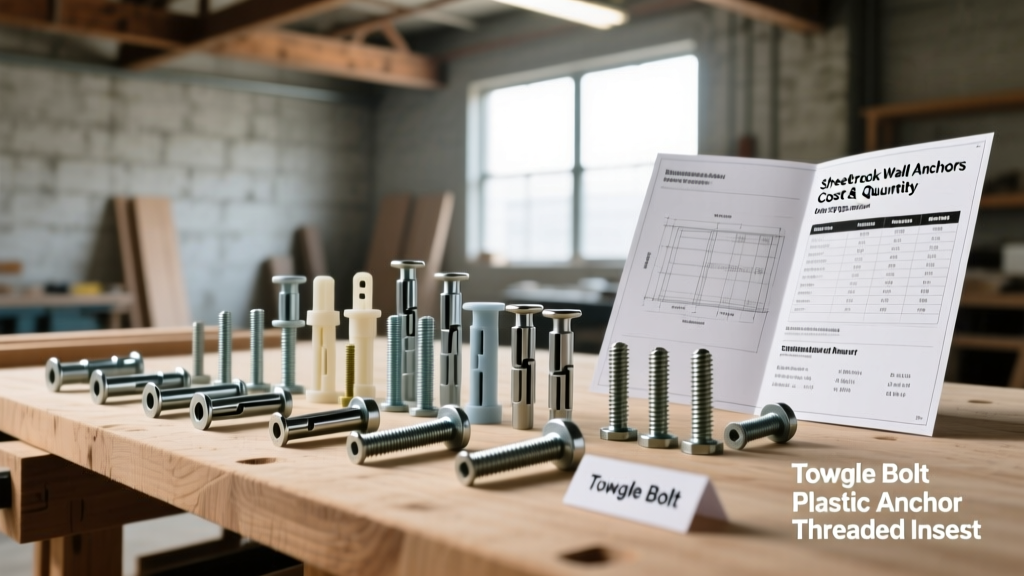
The Hidden Costs of Drywall Fastening
Estimating sheetrock wall anchors is rarely a priority during the initial takeoff phase, yet it remains a frequent source of budget overruns and structural callbacks. When contractors under-specify anchors for commercial fit-outs or high-load residential cabinetry, the result is either catastrophic fixture failure or expensive mid-project change orders to upgrade fastening hardware. Accurate quantity calculation requires moving beyond basic "anchors per square foot" rules of thumb and instead calculating based on fixture weight, dynamic load factors, and specific drywall thickness.
This guide provides a comprehensive 2026 cost estimation framework, unit pricing matrices, and quantity calculators tailored for both residential remodels and large-scale commercial gypsum board installations.
Sheetrock Wall Anchor Types & 2026 Unit Pricing
The market for drywall fasteners is segmented by load capacity and installation mechanism. Pricing fluctuates based on raw material costs (zinc, steel, engineered polymers), but the 2026 bulk pricing tiers below reflect current distributor rates for standard 1/2-inch and 5/8-inch gypsum board applications.
| Anchor Category | Brand / Model Example | Max Static Load (1/2" Drywall) | 2026 Bulk Cost (per 100 units) | Primary Application |
|---|---|---|---|---|
| Plastic Expansion | Hillman Ribbed Plastic Anchor | 20 lbs | $3.50 - $6.00 | Light picture frames, smoke detectors |
| Self-Drilling Threaded | ITW Brands E-Z Ancor Twist-In | 50 lbs | $28.00 - $42.00 | Towel bars, light shelving, curtain rods |
| Hollow Wall (Molly) | Hillman Zinc-Plated Molly Bolt | 75 lbs | $45.00 - $65.00 | Medium cabinetry, heavy mirrors |
| Strap Toggle | Cobra Anchors Toggler Snaptoggle | 265 lbs (1/2"), 356 lbs (5/8") | $115.00 - $165.00 | Heavy shelving, commercial whiteboards, TVs |
While self-drilling zinc anchors (like the E-Z Ancor) save roughly $0.85 per unit in labor compared to strap toggles, they are strictly limited to static, straight-pull loads. For any fixture subject to dynamic loading (e.g., a fold-down desk or a wall-mounted TV on an articulating arm), you must spec strap toggles. The labor savings of threaded anchors are instantly negated if a dynamic load causes the gypsum core to crumble around the zinc threads.
Quantity Calculator Framework: Estimating Anchors per Project
To calculate the exact quantity of sheetrock wall anchors required, estimators should abandon area-based heuristics and adopt a Fixture-Load Multiplier Method. This requires breaking the project down into three distinct fastening zones.
Step 1: Categorize Fixtures by Load Class
- Light Duty (Under 20 lbs): Acoustic panels, light artwork, basic electrical plates. (Spec: Plastic expansion or small threaded anchors).
- Medium Duty (20 - 75 lbs): Bathroom vanities, floating shelves, coat racks. (Spec: Self-drilling zinc or standard molly bolts).
- Heavy Duty (75+ lbs): Commercial whiteboards, heavy bookshelves, wall-mounted boilers. (Spec: Strap toggles or snap toggles).
Step 2: Apply the Fastener Density Formula
Calculate the base quantity using the linear footage of the fixture and the manufacturer's required fastener spacing.
Base Anchor Quantity = (Total Linear Feet of Fixture × Fasteners per LF) + (Discrete Heavy Fixtures × Anchors per Fixture)
Step 3: Factor in the Waste and Missed-Stud Multiplier
In hollow drywall anchoring, you will inevitably hit a metal or wood stud when drilling a blind hole intended for a toggle bolt. When this happens, the toggle bolt is wasted, and you must switch to a standard wood/metal stud screw.
For commercial projects with 16-inch on-center metal stud framing, assume a 15% to 25% miss rate where a hollow-wall anchor hole strikes a stud. Always multiply your heavy-duty toggle bolt quantity by 1.25 to account for wasted toggles, and add a proportional amount of standard #10 self-tapping metal framing screws to your takeoff.
Real-World Cost Breakdown: 10,000 Sq Ft Office Fit-Out
To demonstrate the calculator in action, consider a 2026 commercial office fit-out featuring 5/8-inch USG Sheetrock. The scope includes 450 linear feet of heavy commercial shelving, 60 large acoustic wall panels, and 30 heavy-duty magnetic whiteboards.
| Fixture Type | Qty / Dimensions | Anchor Spec | Calculation Logic | Total Anchors | Estimated Cost |
|---|---|---|---|---|---|
| Heavy Shelving | 450 LF | Strap Toggles (4 per 4ft section) | 450 / 4 × 4 = 450 base. × 1.25 waste = 562 | 562 | $815.00 |
| Acoustic Panels | 60 Units (3x5 ft) | Self-Drilling Zinc (4 per panel) | 60 × 4 = 240 base. + 10% waste = 264 | 264 | $92.50 |
| Whiteboards | 30 Units | Strap Toggles (6 per board) | 30 × 6 = 180 base. × 1.25 waste = 225 | 225 | $326.00 |
| Total Project Anchor Cost (Materials Only) | $1,233.50 | ||||
While $1,233.50 is a minor line item in a multi-million dollar fit-out, underestimating the strap toggles could lead to $4,000+ in drywall repair and repainting if a whiteboard tears out of the gypsum core due to improper anchor selection.
Fire-Rated Assembly Penetrations: A Critical Specification Detail
When anchoring into 5/8-inch Type X fire-rated sheetrock (such as USG Sheetrock Brand Firecode C), the anchor penetrates the calcined gypsum core. According to the Gypsum Association GA-216 Standards, minor penetrations for anchors do not typically void a 1-hour or 2-hour fire rating, provided the anchor does not create an unsealed through-hole that allows smoke and flame passage.
However, heavy-duty toggle bolts require large clearance holes (up to 1/2-inch for a 1/4-inch toggle). If the toggle bolt is installed in a fire-rated partition and the fixture is later removed, the resulting 1/2-inch void compromises the membrane. Estimators must include a line item for intumescent firestop sealant (e.g., 3M Fire Barrier Sealant) to patch abandoned toggle holes in rated assemblies, a detail frequently missed in standard drywall takeoffs.
Common Estimation Mistakes & Failure Modes
Avoid these frequent errors that lead to structural failures and blown budgets:
- Ignoring Dynamic vs. Static Loads: A 50-lb shelf holding 50 lbs of static books is vastly different from a 50-lb fold-down Murphy desk that experiences dynamic shock loads when deployed. Always spec strap toggles for articulating or moving fixtures, regardless of the base weight.
- Over-Torquing Self-Drilling Anchors: Zinc threaded anchors rely on the shear strength of the gypsum core. If installers use high-torque impact drivers instead of standard clutched drills, the zinc threads will ream out the gypsum, reducing the holding power by up to 80%. Include a note in your installation specs requiring clutch-drill settings for threaded anchors.
- Failing to Account for Multi-Layer Drywall: In commercial soundproofing or shaft walls, drywall is often installed in two or three layers (e.g., two layers of 5/8-inch board). Standard 2-inch toggle bolts will not clear the 1.25-inch thickness plus the fixture bracket. Estimators must spec extra-long toggle straps or specialized multi-layer molly bolts, which carry a 30% to 40% price premium over standard lengths.
For comprehensive installation tolerances and substrate thickness requirements, always cross-reference your anchor selections with the USG Drywall Construction Manual and verify bulk hardware specs via industrial suppliers like the Grainger Wall Anchors Buying Guide. Accurate estimation of sheetrock wall anchors bridges the gap between a clean budget and a structurally sound, code-compliant interior build.