Type C Gypsum Board Fire Rating: 2026 Cost and ROI Analysis
Analyze Type C gypsum board fire rating costs for 2026. Compare material pricing, labor rates, and assembly requirements against standard Type X drywall.

The Economics of Type C Gypsum Board Fire Ratings
In commercial and multi-family residential construction, passive fire protection is non-negotiable. While standard Type X drywall handles basic 1-hour fire separation requirements, achieving 2-hour, 3-hour, or 4-hour fire ratings traditionally required stacking multiple layers of Type X, driving up labor, material weight, and structural loads. The type c gypsum board fire rating represents a specialized, high-performance tier of drywall engineered to achieve extended fire resistance with fewer layers. However, this enhanced performance comes with a distinct cost profile. This 2026 cost analysis breaks down the material premiums, labor savings, and hidden expenses associated with Type C gypsum board, helping contractors and developers determine when the upgrade yields a positive return on investment.
2026 Material Cost Breakdown: Type C vs. Type X vs. Standard
To understand the financial impact of specifying Type C, we must first establish the baseline material costs. Type C panels are strictly manufactured in 5/8-inch thicknesses and feature a highly reinforced core. Prices below reflect Q1 2026 national averages for commercial-volume purchases (pallet quantities) from major distributors.
| Gypsum Board Type | Thickness | Core Composition | Cost per Sq. Ft. | Cost per 4x12 Sheet |
|---|---|---|---|---|
| Standard Regular | 1/2 in. | Standard Gypsum | $0.38 - $0.44 | $18.25 - $21.15 |
| Firecode X (Type X) | 5/8 in. | Gypsum + Glass Fibers | $0.52 - $0.61 | $24.95 - $29.30 |
| Firecode C (Type C) | 5/8 in. | Gypsum + Glass Fibers + Vermiculite | $0.78 - $0.95 | $37.45 - $45.60 |
At first glance, Type C carries a 50% to 60% material premium over Type X. However, evaluating drywall costs strictly on a per-sheet basis is a critical estimating error. The true cost must be evaluated at the assembly level, factoring in the specific Underwriters Laboratories (UL) design required for the project.
The Calcination Factor: Why Type C Commands a Premium
The price difference between Type X and Type C is rooted in core chemistry. When gypsum (calcium sulfate dihydrate) is exposed to fire, it undergoes calcination—the chemical process where trapped water molecules are driven off as steam. Once the water is gone, the standard gypsum core shrinks, cracks, and falls away from the fasteners, exposing the framing to heat.
Type X panels incorporate glass fibers to hold the calcined core together. Type C panels go significantly further. According to technical data from the Gypsum Association, Type C cores are formulated with vermiculite and specialized binders. When exposed to extreme heat, the vermiculite expands, filling the voids left by the evaporating water. This prevents the core from shrinking and maintains the structural integrity of the board on the steel or wood studs for a significantly longer duration. This advanced chemical engineering is what allows a single layer of 5/8-inch Type C to match or exceed the fire performance of two layers of 5/8-inch Type X in specific UL assemblies.
Assembly Labor Costs and Multi-Layer Economics
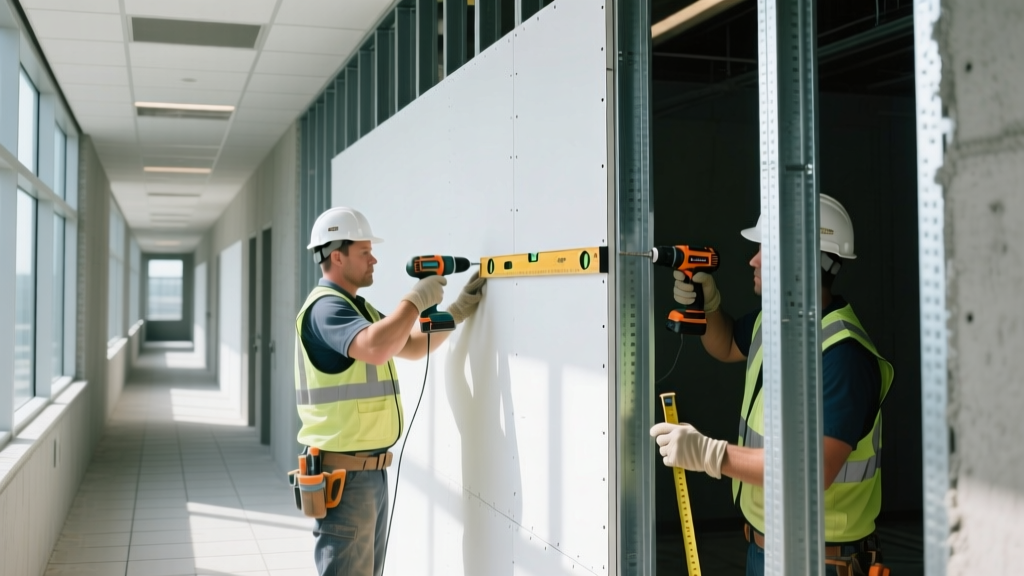
The primary financial justification for the type c gypsum board fire rating is labor reduction in multi-layer assemblies. Installing a 2-hour rated wall using Type X typically requires two layers of 5/8-inch board on each side of the stud cavity. Using Type C, many 2-hour UL designs (such as UL U419 or V450) permit a single layer of 5/8-inch Type C on each side.
Labor Rate Comparison (Per Sq. Ft. of Wall Area)
- 2-Hour Assembly (2 Layers Type X per side): $1.85 - $2.40 / sq. ft. (Includes staggering joints, dual screw patterns, and intermediate taping).
- 2-Hour Assembly (1 Layer Type C per side): $0.95 - $1.25 / sq. ft. (Standard single-layer hanging and finishing).
While the Type C material costs roughly $0.25 more per square foot than a single sheet of Type X, the labor savings of eliminating the second layer yields a net savings of $0.65 to $1.15 per square foot of wall area. On a 50,000 sq. ft. commercial corridor project, this translates to $32,500 to $57,500 in direct labor savings, easily offsetting the material premium.
Hidden Costs in Fire-Rated Drywall Installations
When budgeting for high-hour fire-rated assemblies, estimators frequently overlook the ancillary materials required to maintain the rating's continuity. The drywall is only one component of the tested assembly. Budgeting for a type c gypsum board fire rating must also include:
- Fire-Rated Joint Compound: Standard all-purpose mud is not rated. You must use setting-type compounds or specific fire-rated taping compounds approved by the assembly manufacturer (e.g., USG Firecode Joint Compound).
- Intumescent Firestop Sealants: Penetrations for HVAC, plumbing, and electrical require firestop sealants like 3M Fire Barrier Sealant CP 25WB+, which costs $12 to $18 per tube.
- Putty Pads: Electrical outlet boxes on opposite sides of a fire-rated wall must be separated by a specific horizontal distance or wrapped in intumescent putty pads ($4.50 - $7.00 per pad).
- Specialized Fasteners: Fire-rated assemblies dictate exact screw lengths and spacing (often 8 inches on center for walls). Using standard coarse-thread drywall screws instead of the specified fine-thread, bugle-head steel framing screws can void the rating.
- Third-Party Inspection Fees: In 2026, most municipal building departments require third-party special inspectors to verify firestop and fire-rated drywall assemblies prior to closing walls, adding $1,500 to $3,500 per project phase.
The High-Rise ROI: Space Savings vs. Material Premium
In high-density urban construction, floor space is the ultimate currency. A standard 2-hour demising wall using double-layer Type X on 6-inch steel studs, with 1-inch air gaps and finishing, can consume up to 8.5 inches of total wall thickness. By utilizing single-layer Type C assemblies, that same 2-hour rating can often be achieved on a 3-5/8 inch or 4-inch stud cavity, reducing the total wall thickness to roughly 5.5 inches.
Shaving 3 inches off every corridor and unit demising wall in a 40-story high-rise yields hundreds of square feet of reclaimable, leasable floor space. In 2026 Tier-1 real estate markets where commercial space leases for $80 to $150 per square foot annually, the spatial ROI of specifying Type C over double-layer Type X vastly eclipses the initial material cost premium. Developers should work with architects during the schematic design phase to optimize wall thicknesses using National Gypsum or USG assembly guides to maximize net leasable area.
Decision Matrix: Selecting the Right Fire Assembly
Use the following framework to determine if the type c gypsum board fire rating is the correct specification for your project scope.
| Project Scenario | Required Rating | Recommended Material | Financial Rationale |
|---|---|---|---|
| Standard Tenant Demising Walls | 1-Hour | 5/8 in. Type X | Type C is overkill; single-layer Type X meets code at the lowest cost. |
| Corridor Walls / Elevator Shafts | 2-Hour | 5/8 in. Type C | Single-layer Type C eliminates the labor cost of hanging and taping a second layer of Type X. |
| High-Rise Shaft Walls / Area Separation | 2 to 4-Hour | Shaftliner / Type C Hybrid | Space savings maximize leasable square footage; structural load is reduced by eliminating redundant layers. |
| Moisture-Prone Fire Walls (Kitchens/Baths) | 2-Hour | Mold/Moisture Resistant Type C | Products like Gold Bond XP Fire-Shield C prevent costly mold remediation while maintaining fire ratings. |
Sourcing and Supply Chain Considerations for 2026
Unlike standard Type X, which is stocked in high volumes by every local lumber yard and big-box distributor, Type C is a specialty commercial product. Lead times for specific brands—such as USG Firecode C, CertainTeed Firestop C, or Gold Bond XP Fire-Shield C—can range from 2 to 6 weeks depending on regional manufacturing capacity. General contractors must lock in drywall subcontracts and finalize fire-assembly schedules at least 60 days before the scheduled hang date to avoid project delays. Furthermore, because Type C is heavier and denser than standard board, ensure your drywall subcontractor's labor estimates account for the increased physical fatigue and potential need for mechanical panel lifters on large-scale commercial jobs.
Written by
Priya KapoorPriya Kapoor is a real estate market analyst and construction economics researcher with expertise in housing affordability, development feasibility, and infrastructure investment. She holds a Master of Regional Planning from Cornell University and previously worked as a senior analyst at CBRE's Investment Properties group, where she modeled returns for $4B in mixed-use development pipelines. Priya now runs an independent research practice advising developers, municipalities, and REITs on construction cost forecasting and market timing. She publishes the quarterly "BuildMat Market Pulse" report tracking material price indices across 12 commodity categories. Based in Austin, TX, Priya serves on the board of Habitat for Humanity Austin and is a marathon runner.
More from Priya Kapoor
View all
Construction Cost
Cost to Build a 1600 Sq Ft Home in 2026: Full Breakdown
Accurate 2026 cost to build a 1600 sq ft home—material, labor, and regional pricing breakdowns included. Plan your budget with real-time estimates.
Aug 11, 2026

Wood & Lumber
Name the Types of Wood for Pressure Treatment and Preservation
Learn how to name the types of wood best suited for pressure treatment. Compare species treatability, chemical retention levels, and 2026 preservation costs.
Aug 4, 2026

Stone & Masonry
Stone Veneer Suppliers Lindenhurst: 2026 Cost Analysis
Analyze 2026 stone veneer costs in Lindenhurst, NY. Compare local supplier pricing, delivery fees, and Suffolk County installation labor rates.
Aug 4, 2026