Supplier of Gypsum Board: Navigating Specs and Dimensions
Learn how to evaluate a supplier of gypsum board based on ASTM dimensional tolerances, edge profiles, core densities, and custom specification requirements.
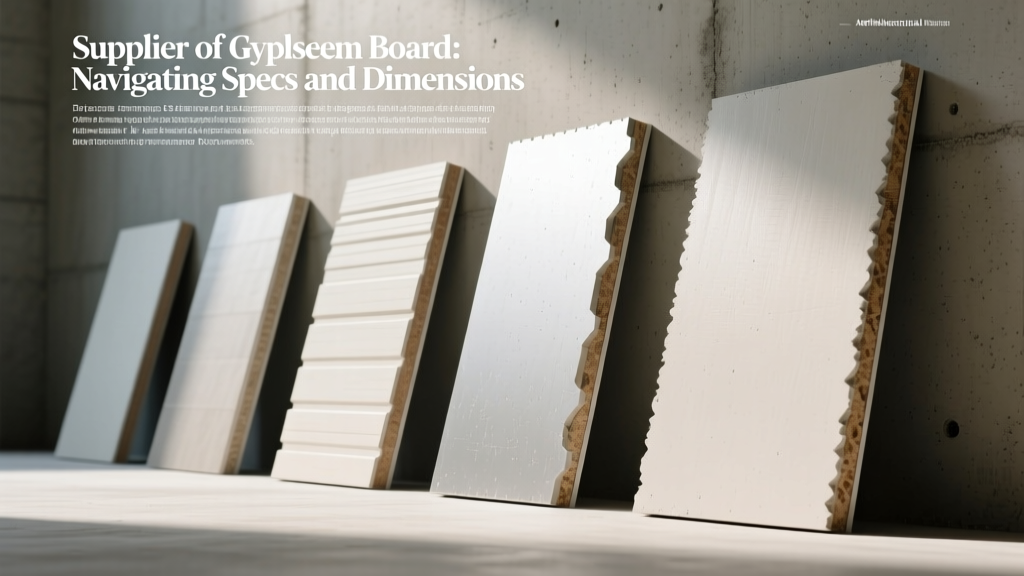
The Standard Dimension Matrix: What to Expect from Your Supplier
Procuring drywall for commercial or high-end residential projects requires more than just ordering 'half-inch sheets.' When evaluating a supplier of gypsum board, understanding the precise dimensional matrix and how it aligns with your framing and finishing requirements is critical. While standard sizes dominate the market, knowing the exact specifications prevents costly field modifications and finishing defects.
The following matrix outlines the standard dimensional offerings you should expect from any reputable domestic manufacturer. Use this as a baseline when reviewing supplier submittals.
| Nominal Thickness | Actual Thickness (Imperial) | Metric Equivalent | Standard Widths | Standard Lengths | Primary Application |
|---|---|---|---|---|---|
| 1/4 in. | 0.250 in. | 6.4 mm | 48 in. | 8, 10, 12 ft. | Curved walls, multi-layer overlays |
| 3/8 in. | 0.375 in. | 9.5 mm | 48 in. | 8, 10, 12 ft. | Residential ceilings, double-layer repair |
| 1/2 in. | 0.500 in. | 12.7 mm | 48, 54 in. | 8 to 16 ft. | Standard interior walls and ceilings |
| 5/8 in. | 0.625 in. | 15.9 mm | 48, 54 in. | 8 to 16 ft. | Fire-rated assemblies, acoustic walls |
Decoding ASTM C1396: Tolerances That Make or Break Installation
The benchmark for gypsum board manufacturing in North America is ASTM C1396 (Standard Specification for Gypsum Board). When vetting a supplier of gypsum board, you must demand documentation proving adherence to these strict dimensional tolerances:
- Width Tolerance: ±1/16 inch (±1.6 mm)
- Length Tolerance: ±1/8 inch (±3.2 mm)
- Thickness Tolerance: ±1/64 inch (±0.4 mm)
- Edge Squareness: Must not deviate more than 1/32 inch in 2 feet (±1.3 mm in 610 mm)
The Hidden Cost of Negative Thickness Tolerances
If a supplier consistently manufactures 1/2-inch board at the absolute negative limit of the tolerance (effectively 15/32 inch), the physical depth of the tapered edge changes. The factory-applied taper is calibrated for a true 0.500-inch core. When the board is undersized, the taper becomes shallower relative to the face paper. Finishers will be forced to apply a wider, thicker feathering coat of joint compound to hide the seam, increasing material consumption by up to 15% and elevating the risk of 'joint photographing' under critical lighting conditions.

Metric vs. Imperial: The International Supplier Trap
As global supply chains expand, procurement teams frequently source from international manufacturers. This introduces a massive, often overlooked dimensional trap regarding metric conversions.
True 1/2-inch gypsum board is exactly 12.7 mm. However, many overseas suppliers manufacture 12.5 mm board and label it as a '1/2-inch equivalent.' While a 0.2 mm difference sounds negligible, it creates severe integration issues with North American framing systems.
Field Insight: Standard 25-gauge metal studs and resilient channels are engineered with flange depths and clip clearances expecting 12.7 mm stock. Installing 12.5 mm board on these systems leaves a 0.2 mm gap at the fastener head. When the drywall screw is driven, the board can over-compress or 'crush in' at the stud face, causing localized dimpling that is nearly impossible to hide with standard Level 4 finishing.
Always require your supplier of gypsum board to explicitly state the metric measurement on the submittal if the product is imported, and reject 12.5 mm stock for projects utilizing precision metal framing.
Edge Profiles: Beyond the Standard Taper
The edge profile dictates how the board interfaces at the seams. While Tapered Edge (TE) is the default for 95% of interior applications, specialized projects require you to instruct your supplier to provide alternative millings.
Available Edge Specifications
- Tapered Edge (TE):strong> The long edges are depressed to allow for embedding joint tape and compound, creating a monolithic surface. Standard on almost all 1/2 in. and 5/8 in. boards.
- Square Edge (SE):strong> Edges are cut perfectly flush with the face. Used for multi-layer base plies, overlay applications, or when the board will receive a full veneer plaster finish.
- Beveled Edge (BE):strong> The edge is cut at an angle (usually 45 degrees). Requested for specific acoustic sealant applications or when creating intentional shadow-line reveals in high-end architectural ceilings.
When ordering custom edge profiles, be aware that suppliers typically require a minimum order quantity (often a full truckload or 40,000 sq. ft.) to reconfigure the board-setting machinery at the plant.
Core Density and Weight Variations by Product Grade
Dimensions are only half the specification. The core density—driven by the chemical formulation of the gypsum slurry and the inclusion of glass fibers—drastically alters the weight and structural performance of the board. Review the technical data sheets from manufacturers like USG or CertainTeed to verify these weight specifications before finalizing your purchase order.
| Board Type | Nominal Thickness | Approx. Weight (lbs/sq. ft.) | Core Characteristics |
|---|---|---|---|
| Standard Regular | 1/2 in. | 1.6 lbs | Standard aerated gypsum core |
| Ultra-Lightweight | 1/2 in. | 1.2 lbs | Highly aerated core with polymer binders |
| Type X (Fire-Rated) | 5/8 in. | 2.2 lbs | Dense core reinforced with glass fibers |
| Type C (Enhanced Fire) | 5/8 in. | 2.4 lbs | Higher density, vermiculite additive for shrinkage resistance |
| Moisture Resistant (MR) | 1/2 in. | 1.7 lbs | Standard core with silicone/wax water-repellent additives |
Logistical Impact: The shift from standard 5/8-inch Type X (2.2 lbs/sq. ft.) to 1/2-inch Ultra-Lightweight (1.2 lbs/sq. ft.) reduces the payload weight of a standard flatbed truck by nearly 45%. This can significantly lower your freight costs and reduce the risk of forklift-related edge damage during site unloading.
The Procurement Checklist: Auditing Your Supplier's Submittals
To ensure the supplier of gypsum board meets your project's exact dimensional and performance criteria, mandate that their technical submittal package includes the following verified data points:
- ASTM Compliance Statement: Explicit declaration of compliance with ASTM C1396 for dimensions and ASTM C473 for physical properties (water absorption, surface hardness).
- Actual Thickness Certification: Mill test reports or batch-specific thickness verification, especially critical for fire-rated assemblies where a 1/64-inch deficit can void the UL design.
- Combustibility Rating: Confirmation of non-combustible status per ASTM E136.
- Thermal Resistance (R-Value):strong> Exact R-value (typically R-0.45 for 1/2 in. and R-0.56 for 5/8 in.) to ensure alignment with the building envelope's energy model.
- VOC Emissions: GREENGUARD Gold or similar certification to guarantee the board and its paper facers will not off-gas volatile organic compounds that violate indoor air quality specs.
By enforcing this level of dimensional and material scrutiny, you transform the procurement process from a simple commodity purchase into a strategic quality-control measure, ensuring the drywall delivered to the job site installs flawlessly and performs to the architect's exact specifications.
Written by
James ThorntonJames Thornton is a construction industry veteran with 25 years of hands-on experience in wood framing, lumber grading, and residential building codes. He started as a framing carpenter in rural Oregon, earned his ICC Residential Building Inspector certification, and eventually became a senior plan reviewer for the City of Portland Bureau of Development Services. James holds a B.S. in Wood Science & Technology from Oregon State University and is a certified lumber grader through the West Coast Lumber Inspection Bureau (WCLIB). He has inspected over 3,000 residential construction sites and authored the city's internal guide on advanced framing techniques (2x6 at 24" O.C.). James lives in Bend, OR, where he builds custom timber-frame cabins and competes in lumberjack sports.
More from James Thornton
View all
Insulation
Best Home Insulation Materials: Complete 2026 Guide
Compare top home insulation materials for 2026. Find R-values, installed costs per square foot, and best uses for fiberglass, spray foam, and mineral wool.
Aug 4, 2026

Sustainable Building
Certify Your Green Building Material for LEED and WELL
Step-by-step guide to certifying a green building material for LEED v5 and WELL v2. Master EPDs, HPDs, and VOC limits for 2026 project specifications.
Aug 4, 2026

Stone & Masonry
Veneer Stacked Stone Panels: Interior Design & Style Showcase
Discover how veneer stacked stone panels transform interiors. Explore modern design profiles, material pairings, and technical installation specs.
Aug 4, 2026