How Much is Gypsum Board? 2026 Repair & Patching Costs
Discover how much gypsum board costs for repairs in 2026. Breakdowns of material prices, labor rates, and troubleshooting guides for water and impact damage.

Diagnosing Drywall Failures: When to Patch vs. Replace
When homeowners and contractors ask, "how much is gypsum board," they are rarely looking to buy a single 4x8 sheet for a new build. More often, this question arises mid-repair, staring at a water-stained ceiling or a doorknob-sized hole. In 2026, the raw material cost of gypsum board remains remarkably low, but the total cost of a repair is driven by the ecosystem of patching compounds, tapes, primers, and skilled labor required to make the fix invisible.
Troubleshooting drywall failures requires understanding both the material science of the board and the economics of the repair. A standard half-inch sheet might cost under $20, but if you are repairing a 2x2 foot section, your material waste factor is 75%, and your labor cost remains fixed due to the mandatory drying times between joint compound coats. According to the Gypsum Association guidelines, proper repair requires matching the original board's thickness, edge taper, and core density to prevent visible telegraphing under directional light.
How Much is Gypsum Board? 2026 Material Cost Breakdown
Before cutting out a damaged section, you must identify the specific grade of the existing wall. Installing standard board in a high-humidity bathroom or a fire-rated garage separation wall will fail building inspections and lead to premature degradation. Below is the 2026 pricing matrix for standard 4x8 sheets, which form the baseline for calculating your material outlay.
| Board Type | Thickness | Brand Example | 2026 Sheet Price (4x8) | Cost Per Sq Ft |
|---|---|---|---|---|
| Standard UltraLight | 1/2 inch | USG Sheetrock | $15.50 | $0.48 |
| Fire-Rated (Type X) | 5/8 inch | USG Firecode C | $25.00 | $0.78 |
| Moisture/Mold Resistant | 1/2 inch | CertainTeed M2Tech | $23.50 | $0.73 |
| Glass Mat (Exterior/Wet) | 5/8 inch | GP DensGlass | $44.00 | $1.37 |
While the per-square-foot cost is minimal, purchasing a full sheet for a minor patch means you are paying for 32 square feet of material to fix 4 square feet of damage. This is where specialized repair panels (pre-cut 2x2 or 1x4 sections) become cost-effective, despite their higher per-square-foot markup.
Troubleshooting Specific Drywall Failures & Repair Costs
Scenario 1: Water-Damaged Ceilings (Sagging and Staining)
Water compromises the gypsum core's structural integrity, causing the paper facing to delaminate and the board to sag between joists. Do not attempt to patch water-damaged drywall; it must be cut out.
The Fix: Cut out the damaged section using a drywall router or jab saw. Treat the exposed cavity with a fungicide like Concrobium if mold is present. Screw in a new piece of moisture-resistant gypsum board using 1-1/4 inch coarse-thread drywall screws. Tape the seams with USG Sheetrock paper tape and embed it in a setting-type compound like Durabond 45. Setting compounds are chemically cured, making them highly resistant to the residual moisture that might still be in the framing.
Estimated Cost: $18 for materials (board, mud, tape). Professional labor will trigger a minimum call-out fee, typically ranging from $250 to $400, as the contractor must visit the site three times to accommodate mud drying schedules.
Scenario 2: High-Traffic Impact Holes (Doorknobs)
A common DIY mistake is using self-adhesive fiberglass mesh patches over doorknob holes. In high-traffic areas, the constant vibration of the door slamming causes the mesh to flex, leading to a visible halo or "telegraphing" around the patch.
The Fix: Cut a clean square around the damage. Install a rigid backer board (such as a StrapPatch or a custom-cut piece of 1/2-inch plywood) behind the hole, securing it with construction adhesive and drywall screws. Cut your gypsum board patch to fit, leaving a 1/8-inch gap for compound. Use a taping knife to apply Sheetrock All-Purpose joint compound, feathering it out at least 12 inches in all directions to blend the transition. Sand with 120-grit, then 150-grit sandpaper.
Estimated Cost: Under $12 for DIY materials. If hiring a pro, expect to pay $150 to $225, as this is considered a minor, single-visit patch if the pro uses quick-setting hot mud.
Scenario 3: Truss Uplift and Corner Cracking
Diagonal cracks radiating from the corners of doors and windows, or horizontal cracks where the ceiling meets the wall, are rarely tape failures. They are structural movement issues caused by truss uplift or lumber shrinkage. Standard paper tape will tear under this tension.
The Fix: Scrape out the failed joint compound and remove the torn tape. Do not use paper tape for the repair. Instead, install a flexible composite tape like Strait-Flex. These tapes feature a rigid polymer spine that allows the drywall to move independently without fracturing the mud layer. Apply two coats of lightweight topping compound over the composite tape.
Estimated Cost: $22 for a roll of composite tape and a tub of lightweight mud. Professional repair costs average $300 to $500 due to the extensive scraping, re-taping, and texturing required to match the surrounding wall.
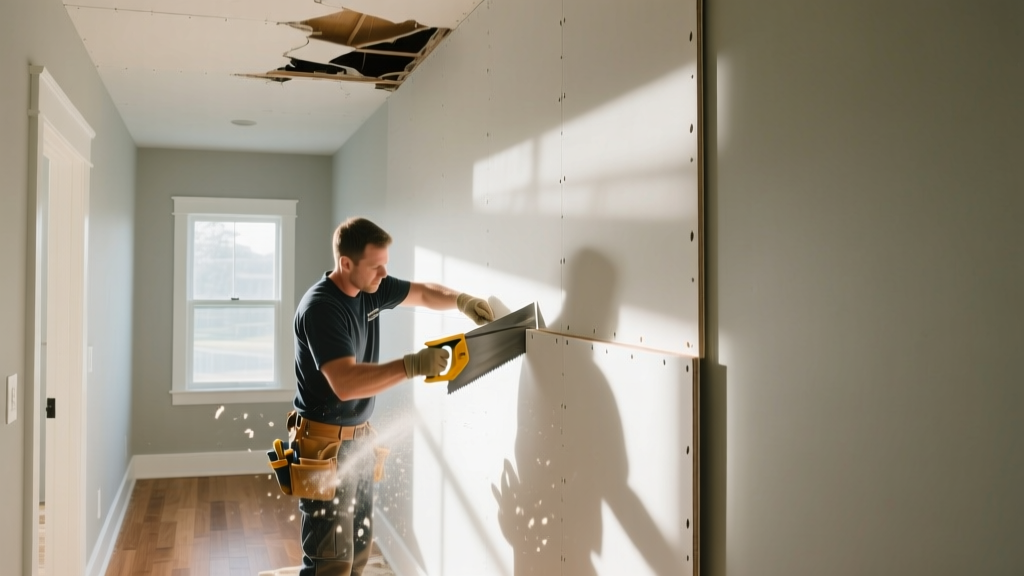
Labor vs. DIY: Calculating the True Cost of Repair
When evaluating how much gypsum board repairs actually cost, labor is the dominant variable. According to Angi drywall repair cost data, the national average for minor drywall repairs hovers around $300, largely because drywall finishing is a multi-day process bottlenecked by evaporation rates.
The golden rule of drywall repair: The material is cheap, but the calendar time is expensive. A 2x2 patch requires three coats of mud, each needing 12 to 24 hours to dry before sanding and reapplication.
If you are a competent DIYer, your primary investment is time. However, if you are paying a contractor, you are paying for their minimum trip charge. It is highly recommended to batch multiple small repairs (e.g., the doorknob hole, the hairline ceiling crack, and the outlet blowout) into a single service call to maximize the value of that $300 minimum fee.
Pro Tips for Sourcing and Minimizing Repair Waste
- Match the Edge Taper: Standard gypsum board features a tapered edge to allow mud to sit flush. If your patch requires a butt joint (cutting across the non-tapered middle of the board), you must float the joint compound out to 24 inches to hide the hump. Always try to use factory-tapered edges for your patch seams.
- Never Use Lightweight Mud for Taping: Lightweight all-purpose compounds lack the adhesive strength to hold paper tape. Always use a setting-type compound (hot mud) or standard-weight All-Purpose for the embedding coat. Reserve lightweight mud for the final topping coat to save sanding effort.
- Prime with PVA: Joint compound is highly porous. If you paint directly over a sanded patch with standard latex wall paint, the mud will absorb the paint's binder, leaving a dull, flat spot known as "flashing." Always seal the patch with a dedicated PVA (Polyvinyl Acetate) drywall sealer before applying your color coat.
Frequently Asked Questions
Can I use standard gypsum board to patch a Type X fire-rated wall?
No. Building codes require that any repair to a fire-rated assembly (such as the wall separating an attached garage from the living space) must be patched with the same 5/8-inch Type X fire-rated board. Using standard 1/2-inch board compromises the assembly's fire-resistance rating and will fail a municipal inspection. Refer to USG Sheetrock product data for exact fire-rating specifications.
Why does my drywall patch show up when the sun hits the wall?
This phenomenon, called "photographing" or "flashing," occurs because the texture and porosity of the joint compound differ from the paper facing of the gypsum board. Even if the patch is perfectly flat, it will reflect light differently. To fix this, apply a heavy-nap roller coat of PVA primer specifically over the patch to equalize the surface porosity before painting.
How much does a 4x12 sheet of gypsum board cost compared to a 4x8?
In 2026, a 1/2-inch 4x12 sheet of standard drywall costs between $28 and $34. While this covers 48 square feet (compared to 32 on a 4x8), the 4x12 sheets are significantly heavier, more prone to snapping during transport, and usually require two people or a mechanical lift to install on ceilings. For small troubleshooting repairs, 4x8 sheets or pre-cut patch panels remain the most practical choice.
Written by
Elena RodriguezElena Rodriguez is a civil engineer and technical writer specializing in concrete technology, masonry systems, and ASTM/ACI compliance. She earned her B.S. in Civil Engineering from Texas A&M University and spent a decade at a materials testing laboratory, performing over 2,000 concrete compressive strength tests and masonry prism evaluations. Elena is an ACI-certified Field Testing Technician (Grade I) and a member of ASTM Committee C12 on Natural Building Stone. She currently consults on forensic engineering cases involving concrete failures and moisture intrusion. Based in San Antonio, TX, Elena is a proud member of the Society of Women Engineers (SWE) and coaches her daughter's FIRST Robotics team.
More from Elena Rodriguez
View all
Walls & Panels
Cost Analysis: Light Gauge Steel Framing Advantages and Disadvantages
Evaluate light gauge steel framing advantages and disadvantages through a strict cost analysis lens, comparing material, labor, and lifecycle expenses.
Aug 4, 2026

Walls & Panels
Gypsum Board Types: Exact Specifications, Thickness & Dimensions
Compare standard, Type X, and moisture-resistant gypsum board types. Get exact specifications, thicknesses, dimensions, and ASTM standards for your project.
Aug 4, 2026

Fire Resistance
Best Fire-Resistant Outdoor Decking Materials: 2026 Buyer Guide
Discover the best fire-resistant outdoor decking materials for 2026. Compare Class A PVC, aluminum, and hardwood options for WUI compliance and safety.
Aug 4, 2026