Fiberglass Rebar Maintenance: Cleaning, Storage, and Handling
Master fiberglass rebar maintenance with this playbook. Learn pre-pour cleaning, UV storage protocols, and post-cure concrete repair strategies.
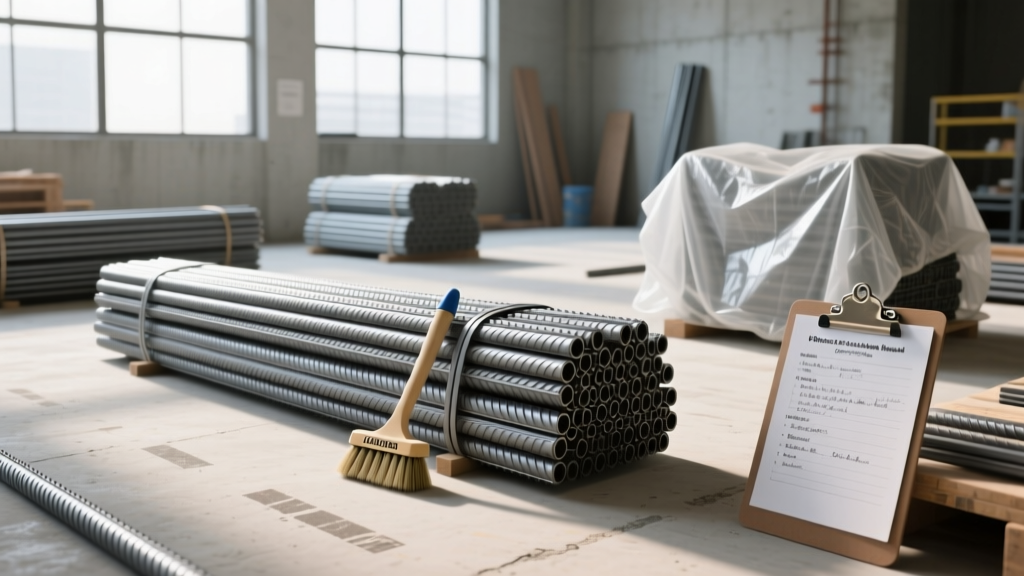
The Fiberglass Rebar Paradigm: Why Maintenance Differs from Steel
Fiberglass rebar, technically known as Glass Fiber Reinforced Polymer (GFRP), has fundamentally shifted reinforcement strategies in marine, bridge, and MRI facility construction. Unlike traditional epoxy-coated or black steel rebar, GFRP is entirely immune to electrochemical corrosion. However, this material swap introduces an entirely different set of maintenance and cleaning protocols. While steel maintenance focuses on rust prevention and cathodic protection, GFRP maintenance revolves around protecting the polymer resin matrix from ultraviolet (UV) degradation, preventing mechanical surface damage, and ensuring the sand-coated exterior remains uncontaminated for optimal concrete bonding.
According to the ACI 440.1R-15 Guide for the design and construction of concrete structures reinforced with FRP bars, improper handling and site contamination can reduce the bond strength between the GFRP bar and the concrete matrix by up to 40%. This playbook provides exact, actionable protocols for receiving, storing, cleaning, and maintaining fiberglass rebar from the moment it arrives on the job site through the post-cure lifecycle of the structure.
Phase 1: Receiving and On-Site Storage Protocols
The most critical vulnerability of fiberglass rebar before it is encased in concrete is its susceptibility to UV radiation and resin softening from excessive heat. Prolonged sunlight exposure breaks down the outer resin layer, leading to 'fiber blooming'—a condition where the glass fibers become exposed, brittle, and structurally compromised.
Site Storage Decision Matrix
| Storage Parameter | GFRP Protocol | Standard Steel Protocol |
|---|---|---|
| Ground Clearance | Minimum 6 inches on timber dunnage | Can rest directly on grade if dry |
| Dunnage Spacing | Every 4 feet to prevent sagging/creep | Every 8 to 10 feet |
| Stacking Height | Maximum 4 bundles high | Can stack 6+ bundles |
| Covering | Opaque, UV-blocking, breathable tarp | Optional plastic sheeting for rust prevention |
| Temperature Limits | Keep away from heat sources (>150°F degrades resin) | No strict upper temperature limits |
Phase 2: Pre-Pour Cleaning and Surface Preparation
GFRP bars rely on a factory-applied sand coating to create a mechanical interlock with the concrete paste. If this sand coating becomes clogged with job-site mud, form release agents, or oils, the structural load transfer is severely compromised. Unlike steel, you cannot use aggressive mechanical cleaning on fiberglass.
Approved vs. Prohibited Cleaning Agents
- Approved: Isopropyl alcohol (IPA) for localized oil spots; mild alkaline detergents mixed with water for general dust and mud removal; stiff nylon-bristle brushes.
- Prohibited: Acetone or MEK (Methyl Ethyl Ketone), which can soften and dissolve polyester and vinyl-ester resins; wire brushes or steel wool, which will strip the vital sand coating; high-pressure water blasting (>3,000 PSI), which can erode the resin matrix.
Step-by-Step Pre-Pour Cleaning Playbook
- Dry Brush: Use a stiff nylon brush to remove loose dirt, dried mud, and debris from the sand-coated surface.
- Wash: Apply a mild detergent solution using a low-pressure pump sprayer. Agitate stubborn spots with the nylon brush.
- Rinse: Rinse with clean water using a standard garden hose (never a pressure washer).
- Inspect: Run a gloved hand over the bar. It should feel rough and gritty. If it feels smooth, the sand coating has been damaged or clogged, and the bar must be rejected or evaluated by the structural engineer.
Phase 3: Cutting Tool Maintenance and Dust Control
Cutting fiberglass rebar generates fine glass dust and resin particulates that are hazardous to inhale and highly abrasive to standard construction tools. Standard abrasive masonry blades will melt the resin and glaze over within seconds.
Blade Selection and Grinder Maintenance
Always use continuous-rim diamond blades specifically rated for cutting composite materials. For #5 (5/8-inch) GFRP bars and larger, a 10-inch diamond blade on a chop saw is recommended. If using an angle grinder for field cuts, restrict the tool to a maximum of 4,000 RPM. Higher RPMs generate excessive friction heat, melting the vinyl-ester resin and fusing the glass fibers together at the cut edge, which creates a weak point in the reinforcement grid.
'Tool maintenance is just as critical as the cut itself. Glass dust infiltrates grinder bearings and vents rapidly. Operators must blow out angle grinders with compressed air at the end of every shift to prevent motor burnout.' — Composites Manufacturing Association (ACMA) safety guidelines.
PPE Requirement: Standard N95 masks are insufficient for cutting GFRP. The fine glass fibers require a P100 respirator cartridge, coupled with safety goggles and heavy-duty canvas gloves to prevent micro-splinters from embedding in the skin.
Phase 4: Post-Cure Concrete Maintenance and Repair
Once encased in concrete, fiberglass rebar requires zero maintenance. However, the concrete structure itself requires a different maintenance approach than steel-reinforced concrete. Because GFRP has a lower modulus of elasticity (typically 6,000 to 8,000 ksi compared to steel's 29,000 ksi), GFRP-reinforced concrete will exhibit wider and more frequent flexural cracking under service loads.
Crack Repair Decision Framework
When maintaining a GFRP-reinforced structure, surface-level crack sealing is rarely sufficient. Water ingress through wide cracks can lead to freeze-thaw spalling, which exposes the GFRP. While the bar won't rust, exposed GFRP in marine environments can suffer from moisture-assisted stress corrosion if the concrete's alkaline environment is compromised.
| Crack Width | Location | Required Repair Protocol |
|---|---|---|
| < 0.012 inches | Non-structural facade | Silane/Siloxane penetrating sealer application |
| 0.012 - 0.040 inches | Structural beams/decks | Low-viscosity epoxy injection to restore load transfer |
| > 0.040 inches | Marine/Bridge decks | Routing, sealing, and structural epoxy overlay |
Troubleshooting Common Site Contaminations
Even with strict protocols, job-site accidents happen. Use this troubleshooting guide to address common GFRP contamination scenarios before the concrete pour.
Scenario 1: Rust Staining from Adjacent Steel
The Issue: GFRP is often used in hybrid grids (e.g., steel in the interior, GFRP in the exterior cover). Rust runoff from adjacent carbon steel can stain the GFRP.
The Fix: Rust stains are purely aesthetic and do not degrade the GFRP resin. However, if the rust is accompanied by heavy iron-oxide scaling that physically clogs the sand coating, use a plastic scraper to gently remove the scale, followed by a nylon brush. Do not use chemical rust removers (like phosphoric acid), as they can etch the resin.
Scenario 2: Concrete Slurry Hardened on Stored Bars
The Issue: Rebar stored near a concrete washout area gets splattered with wet concrete that cures on the sand coating.
The Fix: Cured concrete slurry must be removed mechanically. Use a wooden block or a hard plastic putty knife to scrape the slurry off. If the slurry has deeply penetrated the sand coating and cannot be removed without stripping the sand, that specific section of the bar must be cut out and spliced using GFRP-approved mechanical couplers or lap splices, as per the FHWA GFRP Bridge Manual specifications.
Scenario 3: Tire Marks from Heavy Equipment
The Issue: A skid-steer or forklift runs over the staged rebar grid, leaving black rubber marks and potentially embedding dirt into the resin.
The Fix: First, inspect the bar for structural damage. GFRP has high tensile strength but lower shear and crush resistance than steel. If the bar is visibly flattened, cracked, or the outer resin is peeling, replace it. If the bar is structurally sound, clean the rubber marks using a mild solvent like mineral spirits applied to a rag, followed immediately by an IPA wipe-down to remove any oily residue left by the mineral spirits.
Summary of Lifecycle Best Practices
Maintaining fiberglass rebar is less about fighting corrosion and more about preserving the integrity of the polymer matrix and the mechanical sand coating. By enforcing strict UV-storage limits, utilizing non-abrasive cleaning agents, maintaining diamond cutting tools, and adapting post-cure concrete repair strategies to accommodate wider flexural cracks, contractors can ensure the 100-year design life of GFRP-reinforced structures is fully realized. Always consult the manufacturer's specific technical data sheets, as resin formulations (vinyl-ester vs. epoxy) can dictate slight variations in chemical tolerance and UV exposure limits.