Mastering the AISC Design Guide 19 Fire Resistance Structural Steel Framing PDF
Explore corrosion protection strategies for structural steel fireproofing, aligned with the AISC Design Guide 19 fire resistance structural steel framing PDF.

The Thermal-Corrosion Paradox in Steel Framing
When consulting the AISC Design Guide 19 Fire Resistance Structural Steel Framing PDF, structural engineers and fire protection specialists primarily focus on thermal performance, section factors (W/D ratios), and achieving specific hourly fire ratings under ASTM E119 standards. However, a critical blind spot often emerges at the intersection of fireproofing and long-term corrosion protection. Fireproofing materials, by their very nature, are designed to insulate steel from extreme heat. Unfortunately, this same insulating capacity can trap ambient moisture against the steel substrate, creating a high-risk environment for Corrosion Under Fireproofing (CUF).
In 2026, with commercial construction increasingly favoring complex architectural geometries and mixed-use environments with fluctuating humidity levels, understanding how fire-resistive coatings interact with anti-corrosion primers is no longer optional. The guidance found in the AISC Design Guides library provides the structural framework, but executing a durable build requires integrating rigorous surface preparation and environmental controls.
Material Selection Matrix: Fire Rating vs. Corrosion Risk
Not all fireproofing systems carry the same moisture-retention profile. Selecting the right Spray-Applied Fire Resistive Material (SFRM), intumescent coating, or board system dictates the underlying corrosion protection strategy. Below is a comparative analysis of the three primary fireproofing methods and their inherent corrosion vulnerabilities.
| Fireproofing System | Typical Cost (per sq ft) | Moisture Permeability | Corrosion Risk Profile | Required Primer Type |
|---|---|---|---|---|
| Cementitious SFRM (Medium Density, 15-22 pcf) | $2.50 - $4.50 | High (Porous) | Severe if unprimed; traps condensation against steel. | Inorganic Zinc-Rich (IOZ) |
| Intumescent Coatings (Thin-film, 1-2 hour rating) | $8.00 - $15.00 | Low (Acts as a barrier) | Moderate; risk occurs if topcoat is breached or primer incompatibility causes delamination. | Epoxy or Zinc-Epoxy Hybrid |
| Calcium Silicate / Gypsum Board Systems | $5.00 - $9.00 | Variable (Depends on joint sealing) | Low to Moderate; moisture ingress primarily occurs at unsealed mechanical fastener joints. | Alkyd or Epoxy Barrier |
Surface Preparation: AMPP/SSPC Standards for Fireproofed Steel
A common and costly misconception in structural steel erection is that the fireproofing layer itself acts as a corrosion barrier, negating the need for rigorous blast cleaning. This is entirely false. Cementitious SFRMs are highly alkaline and porous. If applied over a poorly prepared surface, the alkalinity can accelerate galvanic corrosion, while the porosity wicks moisture directly to the mill scale or rust layer.
According to current AMPP (Association for Materials Protection and Performance) standards, which absorbed the legacy SSPC specifications, the minimum surface preparation for steel receiving porous fireproofing in unconditioned spaces must be AMPP/SSPC-SP 6 (Commercial Blast). However, for structures in coastal environments, high-humidity facilities (like indoor pools or food processing plants), or exterior framing, AMPP/SSPC-SP 10 (Near-White Metal Blast) is mandatory.
Blasting to SP 10 is insufficient if the anchor profile (surface roughness) is not matched to the primer. For inorganic zinc-rich primers, an angular anchor profile of 1.5 to 2.5 mils (38-63 microns) is required. If the profile is too shallow, the zinc dust cannot mechanically lock into the steel, leading to sub-surface delamination once the heavy SFRM is applied over it.
Primer Compatibility and Cathodic Protection
The choice of primer beneath fireproofing must be dictated by the fireproofing material's chemical composition and permeability.
- Inorganic Zinc-Rich (IOZ) Primers: Products like Carboline Carbozinc 11 or Sherwin-Williams Zinc Clad are the gold standard for cementitious SFRM. IOZ primers provide cathodic (sacrificial) protection. Even if the porous SFRM holds moisture against the steel, the zinc corrodes preferentially, protecting the structural steel substrate.
- Epoxy Primers: Epoxies (e.g., Macropoxy 646) provide excellent barrier protection and are often required for intumescent coatings due to strict adhesion requirements during the intumescent's expansion phase (charring). However, if an epoxy primer is scratched during steel erection before fireproofing, it offers no cathodic protection, and corrosion will creep laterally under the fireproofing layer.
- Alkyd Primers: Generally prohibited beneath cementitious SFRM in modern specifications due to saponification (the breakdown of the alkyd resin by the high alkalinity of the cementitious spray).
Environmental Controls and the 5°F Dew Point Rule
Applying fireproofing or its underlying primer outside of strict environmental tolerances guarantees premature failure. The most frequently violated rule on active commercial job sites is the dew point margin.
Both the AMPP and major fireproofing manufacturers (such as Isolatek and Nullifire) mandate that the steel surface temperature must be at least 5°F (3°C) above the dew point during primer application, curing, and SFRM application. When steel cools below the dew point, microscopic condensation forms on the surface. If an epoxy primer or intumescent coating is applied over this invisible moisture layer, osmotic blistering will occur within months, eventually compromising the fire rating by causing the fireproofing to delaminate during a fire event.
Furthermore, ambient relative humidity (RH) must be strictly monitored. While cementitious SFRMs can tolerate higher humidity during application (up to 85% RH), intumescent coatings typically require RH levels below 80%, with specific maximum overcoating windows. If the epoxy primer sits exposed to the elements for longer than the manufacturer's stated overcoating window (often 14 to 30 days) before the fireproofing is applied, the primer surface must be sweep-blasted to re-establish the chemical bond.
Inspecting for Corrosion Under Fireproofing (CUF)
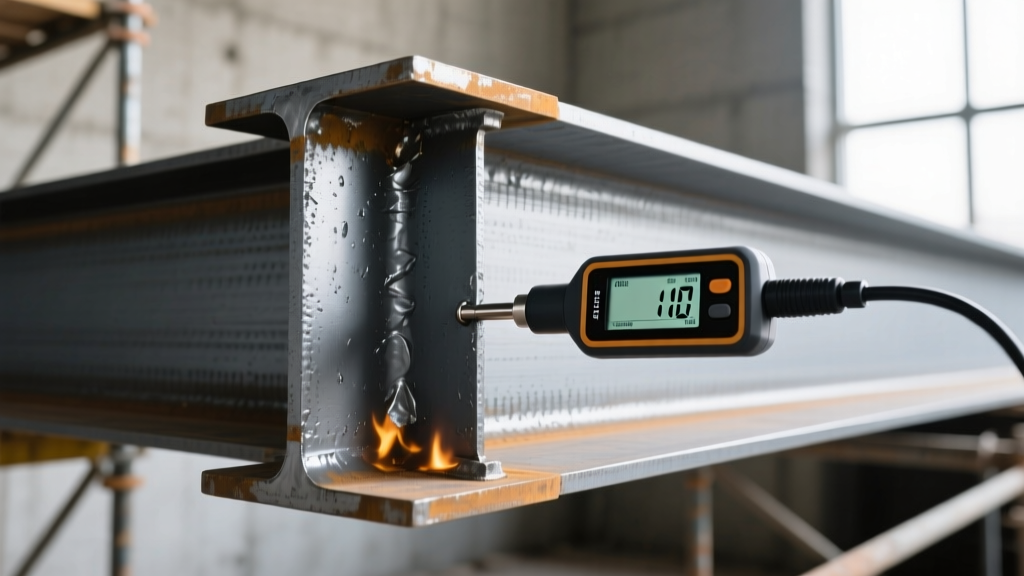
Once the steel is encased in SFRM or intumescent paint, visual inspection for corrosion becomes impossible without destructive testing. To mitigate this, modern structural maintenance frameworks utilize non-destructive evaluation (NDE) techniques.
- Pull-Off Adhesion Testing (ASTM D4541): Conducted on mock-up columns before full-scale application to ensure the primer-to-steel and fireproofing-to-primer tensile strength meets the minimum 150 psi threshold.
- Ultrasonic Thickness (UT) Gauging: Used on exposed base plates and connection gussets where fireproofing is often thin or prone to mechanical damage, establishing a baseline steel thickness for future CUF monitoring.
- Infrared Thermography: In conditioned buildings, thermal imaging can sometimes detect moisture trapped within porous SFRM, which acts as a thermal bridge and indicates a high probability of underlying CUF.
Frequently Asked Questions
Does the AISC Design Guide 19 mandate a specific primer for fireproofed steel?
The AISC Design Guide 19 Fire Resistance Structural Steel Framing PDF focuses primarily on the structural and thermal engineering requirements (like W/D ratios and hourly ratings). It defers to the fireproofing manufacturer's specific installation instructions and AMPP/SSPC standards for surface preparation and primer selection. Always consult the specific UL (Underwriters Laboratories) design directory for the exact primer approved for your chosen fireproofing assembly.
Can I apply cementitious fireproofing directly to bare, unprimed steel?
While some legacy specifications allowed SFRM application over tightly adhered mill scale, modern best practices and most commercial specifications strictly require a primer. Bare steel exposed to the alkaline, moisture-retaining environment of cementitious SFRM will experience accelerated corrosion, particularly in humid or coastal environments.
How does intumescent paint expansion affect corrosion protection during a fire?
Intumescent coatings expand up to 50 times their original thickness when exposed to temperatures exceeding 400°F, forming a carbonaceous char that insulates the steel. The underlying epoxy primer must remain intact during this expansion. If the primer has suffered from CUF and delaminated prior to the fire, the intumescent char will expand unevenly or flake off, exposing the structural steel to rapid thermal degradation and potential structural failure.
Written by
Sarah WhitfieldSarah Whitfield is a chartered quantity surveyor (MRICS) and construction cost analyst with 15 years of experience in material pricing, procurement strategy, and project budgeting. She earned her degree in Construction Management from the University of Reading (UK) and has worked on projects ranging from $2M custom homes to $180M mixed-use developments across North America and Europe. Sarah currently leads cost estimating for BuildMat Insight, maintaining a proprietary database of 4,000+ material price points updated quarterly. She is a frequent contributor to RSMeans cost data panels and has presented at the International Cost Engineering Council (ICEC) congress. Based in Denver, CO, Sarah is an avid trail runner and volunteer mentor for Women in Construction.
More from Sarah Whitfield
View all
Wood & Lumber
What Are the Different Types of Wood? A Builder's Guide
Compare structural softwoods, finish hardwoods, and engineered lumber. Analyze Janka ratings, MOE values, and 2026 pricing for construction.
Aug 4, 2026

Walls & Panels
Steel Framing vs Wood Framing: Corrosion and Moisture Defense
Compare steel framing vs wood framing for moisture resistance. Learn about galvanized coatings, condensation risks, and corrosion protection strategies.
Jul 21, 2026

Stone & Masonry
How to Cut Stone Veneer: Wet Saw vs Grinder Comparison
Compare the best tools for cutting stone veneer. We review wet saws, angle grinders, and chop saws to help you achieve clean, chip-free cuts.
Jul 21, 2026