Best Drill Bit Material for Steel to Prevent Corrosion Damage
Find the best drill bit material for steel to prevent corrosion. Learn how heat damages galvanized and stainless coatings, plus post-drilling protection steps.
The Hidden Link Between Drill Bit Metallurgy and Corrosion
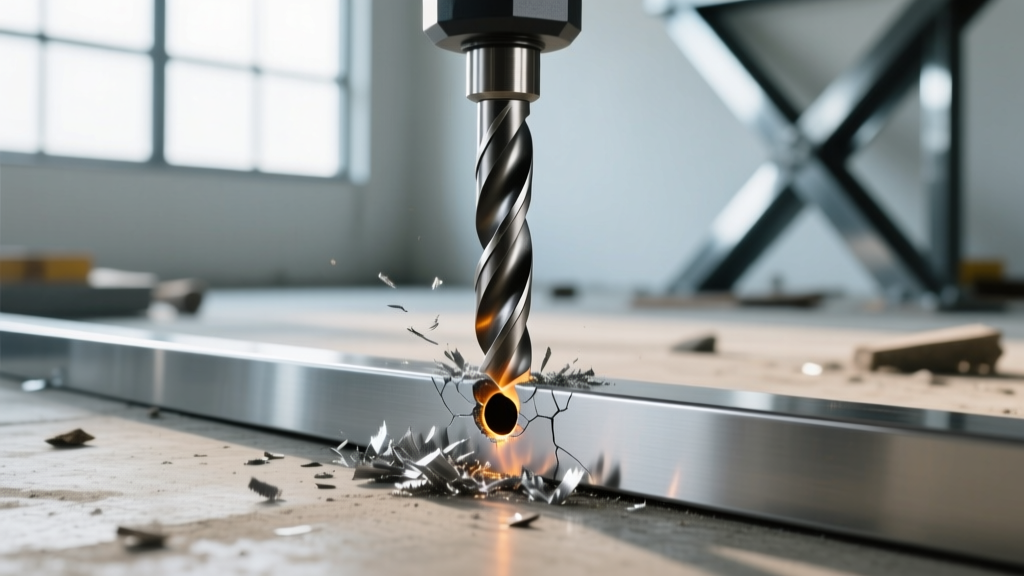
When fabricating structural or architectural steel, selecting the best drill bit material for steel is rarely just about cutting speed or tool life; it is fundamentally a corrosion prevention decision. Drilling generates intense localized friction. If the drill bit material lacks sufficient red-hardness or requires excessive axial pressure, the heat generated transfers directly into the workpiece. For corrosion-protected steels—specifically hot-dip galvanized (HDG) and austenitic stainless steel—this thermal spike destroys the protective metallurgical or passive oxide layers, creating immediate vulnerability to localized pitting and galvanic corrosion.
Standard High-Speed Steel (HSS) bits often push cutting zone temperatures past 1,000°F (537°C). At these temperatures, zinc coatings vaporize, and stainless steel suffers chromium depletion. Understanding the exact failure modes of different drill bit materials allows fabricators to preserve the integrity of the steel's protective envelope from the moment the hole is pierced.
Evaluating Drill Bit Materials for Corrosion-Sensitive Steel
The primary metric for evaluating a drill bit in the context of corrosion is its heat transfer coefficient and burr generation profile. Burrs trap moisture and debris, creating crevice corrosion cells, while heat destroys protective coatings. Below is a technical comparison of the primary bit materials used in steel fabrication.
| Bit Material / Grade | Composition & Hardness | Heat Generation | Corrosion Risk Profile | Best Application |
|---|---|---|---|---|
| Standard HSS (M2) | Tungsten/Molybdenum alloy, 62-64 HRC | High (Requires high axial pressure) | Severe: High heat destroys zinc/passive layers; creates heavy burrs. | Mild carbon steel (non-protected) |
| Cobalt M35 (5% Co) | HSS with 5% Cobalt, 64-66 HRC | Moderate (Retains hardness to 1,000°F) | Moderate: Acceptable for stainless if peck-drilled; risky for thin HDG. | Thick stainless steel, structural beams |
| Cobalt M42 (8% Co) | HSS with 8% Cobalt, 67-70 HRC | Low (Superior red-hardness to 1,150°F) | Low: Cuts cleanly with minimal heat transfer; preserves zinc boundaries. | Galvanized framing, hard stainless alloys |
| Solid Carbide | Tungsten Carbide, 72-76 HRC | Lowest (Extremely low friction, rigid cut) | Minimal: Cleanest hole geometry, virtually zero thermal damage. | CNC drilling, automated fabrication lines |
| TiAlN Coated HSS/Co | Titanium Aluminum Nitride surface layer | Low (Forms insulating Al2O3 layer at high heat) | Low: Excellent for dry drilling; prevents bit welding and workpiece scoring. | Field drilling, dry-cutting scenarios |
Drilling Galvanized Steel: Preserving the Zinc Envelope
Hot-dip galvanized steel relies on a metallurgical zinc-iron alloy layer for cathodic protection. The melting point of pure zinc is relatively low at 787°F (420°C). When a fabricator searches for the best drill bit material for steel that is galvanized, the goal is to keep the cutting edge temperature below this threshold, or at least prevent the heat from transferring into the surrounding zinc matrix.
The 'Burn-Off' Zone and HAZ Corrosion
Using a dull M2 HSS bit on 1/4-inch galvanized plate requires significant downward force. The friction rapidly exceeds 1,200°F at the shear zone. This causes the zinc coating within a 1/8-inch radius of the hole to melt, alloy unpredictably, or vaporize entirely. This Heat-Affected Zone (HAZ) is now bare carbon steel. Because the surrounding zinc is anodic to the steel, the bare hole will not immediately rust; instead, the surrounding zinc will sacrifice itself at an accelerated rate to protect the hole, leading to rapid white rust formation and eventual localized pitting.
Step Bits vs. Twist Bits for Thin-Gauge Galvanized
For light-gauge galvanized steel framing (e.g., 20-gauge to 14-gauge metal studs), twist drills often grab the material, tearing the zinc layer and creating jagged burrs that trap moisture. Carbide-tipped step drills or unibits are vastly superior here. They shear the metal progressively rather than plowing through it, leaving a clean, burr-free hole with minimal thermal distortion to the galvanized coating.
Drilling Stainless Steel: Preventing Free Iron Embedding
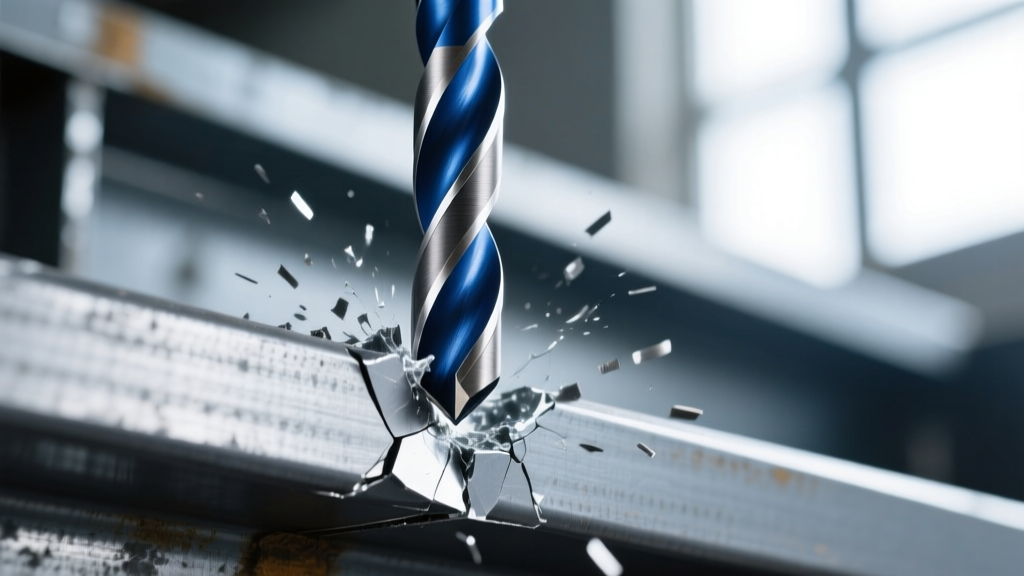
Stainless steel (such as Type 304 or 316) does not rely on a metallic coating; it relies on a microscopic, self-healing chromium oxide passive layer. Drilling stainless steel introduces two severe corrosion risks that dictate your choice of tooling.
- Free Iron Embedding: If you use a standard HSS drill bit that was previously used on carbon steel, microscopic particles of carbon steel (free iron) will embed into the softer austenitic matrix of the stainless steel. When exposed to atmospheric moisture, these iron particles rust, initiating deep pitting corrosion in the stainless workpiece.
- Heat Tint and Chromium Depletion: If the drill bit generates excessive heat (visible as blue, purple, or brown 'heat tint' around the hole), the carbon in the stainless steel migrates to the grain boundaries and binds with chromium, forming chromium carbides. This depletes the surrounding area of the chromium required to maintain the passive oxide layer, a phenomenon known as sensitization or weld decay.
The Solution: The best drill bit material for steel of the austenitic stainless variety is dedicated Solid Carbide (for drill presses) or M35/M42 Cobalt (for handheld operations). Crucially, fabricators must enforce strict tool segregation. Bits used on stainless must be color-coded and never used on mild steel. Furthermore, utilizing a TiAlN (Titanium Aluminum Nitride) coating on the cobalt bit provides a thermal barrier that reduces heat transfer into the stainless workpiece, preventing heat tint.
Post-Drilling Corrosion Protection Protocols
Even with the optimal M42 Cobalt or Carbide bit, drilling inherently breaches the protective layer of coated steels. Implementing immediate post-drilling protocols is mandatory for structural longevity.
Protocol 1: Repairing Galvanized Breaches (ASTM A780)
After drilling through HDG steel, the exposed bare steel at the hole wall must be re-galvanized. According to the American Galvanizers Association, the standard repair method involves applying a zinc-rich dust paint that meets ASTM A780 specifications.
- Preparation: Use a stainless steel wire brush (never carbon steel) to remove any heat-tinted or melted zinc slag from the hole perimeter.
- Application: Apply a cold galvanizing compound (e.g., ZRC Cold Galvanizing Compound or Thurmalox 245) that contains a minimum of 92% zinc dust in the dry film.
- Thickness: Build the coating to a minimum of 2.0 mils (50 µm) to match the surrounding hot-dip coating's cathodic protection capacity.
Protocol 2: Passivating Drilled Stainless Steel
For architectural stainless steel where heat tint or minor free-iron contamination is suspected around the drilled hole, chemical passivation is required.
- Citric Acid Formulations: Apply a citric acid-based passivation gel (e.g., CitriSurf 750) directly to the drilled hole and surrounding heat tint. Citric acid selectively chelates (dissolves) embedded free iron without attacking the base stainless alloy.
- Dwell Time: Allow the gel to dwell for 15 to 30 minutes at ambient temperature.
- Rinsing: Rinse thoroughly with deionized or clean potable water. The exposure to oxygen and water will immediately catalyze the reformation of the transparent chromium oxide layer.
Expert Decision Matrix: Matching Bit to Steel Type
Use this framework to select the correct tooling based on the specific corrosion-protected steel you are fabricating.
Decision Framework
IF Material = Hot-Dip Galvanized Structural Plate (1/4"+)
Selection: M42 Cobalt (8%), 135° split point. Technique: Peck drilling with cutting oil to suppress zinc burn-off. Post-treatment: ASTM A780 zinc-rich paint.
IF Material = Galvanized Light Gauge Framing (Under 3/16")
Selection: Carbide-tipped step drill bit. Technique: High RPM, low pressure, no cutting oil (prevents coating adhesion issues for subsequent repairs). Post-treatment: Zinc-rich aerosol spray.
IF Material = Austenitic Stainless Steel (Type 304/316)
Selection: Dedicated Solid Carbide (CNC) or TiAlN-coated M35 Cobalt (Handheld). Technique: Strict tool segregation, continuous feed to prevent work-hardening. Post-treatment: Citric acid passivation gel if heat tint is visible.
By aligning your drill bit metallurgy with the corrosion-protection mechanism of the base steel, you eliminate the root causes of fabrication-induced decay. Upgrading from standard HSS to M42 Cobalt or Solid Carbide represents a marginal increase in tooling costs but prevents catastrophic field failures, costly rework, and compromised structural integrity.
Written by
David NakamuraDavid Nakamura is a licensed architect (AIA) and construction technology writer focused on sustainable building methods, mass timber engineering, and high-performance building envelopes. He holds a Master of Architecture from the University of Washington and is a certified Passive House Consultant (CPHC). David spent eight years at the Seattle firm Mithun, where he led the design of three LEED Platinum projects, before founding his own practice specializing in net-zero residential design. He serves on the editorial advisory board of GreenBuilder Magazine and has authored peer-reviewed papers on cross-laminated timber (CLT) connections for the Journal of Structural Engineering. In his spare time, David teaches woodworking at Pratt Fine Arts Center and kayaks the Puget Sound.
More from David Nakamura
View all
Construction Cost
Labor Cost to Build a Deck Per Sq Ft: 2026 Installation Guide
Discover the exact labor cost to build a deck per sq ft in 2026. This installation guide breaks down contractor rates, complexity factors, and hidden fees.
Aug 4, 2026

Construction Cost
How Much Does It Cost to Build a 3 Bedroom House? Financing Guide
Learn exactly how much it costs to build a 3 bedroom house and explore 2026 financing options, construction loan types, and budget frameworks for your build.
Aug 4, 2026

Construction Cost
Cost to Build a Tennis Court: 2026 Guide
How much does it cost to build a tennis court in 2026? Breakdowns for asphalt, concrete, and synthetic surfaces plus fencing and lighting.
Jul 30, 2026