Secondary Steel Framing Cost Analysis & Pricing Guide 2026
Comprehensive 2026 cost analysis for secondary steel framing. Compare material, labor, and hidden costs of CFS studs vs wood for commercial builds.

The True Cost of Secondary Steel Framing in 2026
Secondary steel framing—primarily consisting of cold-formed steel (CFS) studs, tracks, purlins, and girts—serves as the backbone for non-structural interior partitions, exterior curtain wall back-ups, and secondary structural support in commercial and multi-family construction. While primary structural steel (hot-rolled I-beams and columns) handles the gravity and lateral loads, secondary framing dictates the speed, acoustics, and fire-resistance of the building envelope and interior layout.
For general contractors and estimators, budgeting secondary steel framing requires looking beyond the raw linear-foot cost of the studs. The 2026 construction market presents unique economic variables: fluctuating zinc coating prices (which dictate galvanization costs), evolving energy codes requiring continuous insulation to mitigate thermal bridging, and a shift toward off-site prefabricated CFS panels. This guide breaks down the exact material, labor, and hidden costs of secondary steel framing to provide a highly accurate project budget.
Material Cost Breakdown by Gauge and Profile
Cold-formed steel framing is categorized by gauge (thickness) and profile width. Non-structural interior partitions typically utilize 25-gauge or 20-gauge studs manufactured to ASTM C645 standards, while exterior load-bearing or tall curtain-wall back-up framing requires 16-gauge to 14-gauge structural studs engineered to AISI S240 specifications.
| Gauge | Profile / Width | Avg. Price per Linear Ft. (2026) | Primary Application |
|---|---|---|---|
| 25 ga (Non-Structural) | 3-5/8" Stud | $0.65 - $0.85 | Standard interior demising walls, furring |
| 20 ga (Standard Comm.) | 3-5/8" Stud | $1.15 - $1.45 | Commercial partitions, shaft walls |
| 16 ga (Structural) | 6" Stud | $2.20 - $2.85 | Exterior back-up, tall lobby walls |
| 14 ga (Heavy Structural) | 8" Stud | $3.50 - $4.20 | Load-bearing CFS, parapets, heavy shear |
| Deflection Track (Slip) | Variable | $1.80 - $2.50 | Top tracks allowing for slab deflection |
In multi-story commercial builds, concrete floor slabs deflect under live loads. Standard rigid tracks will buckle the partition walls. Specifying slotted deflection tracks (like ClarkDietrich's SL track or MarinoWARE's Viper) adds roughly $0.70 per linear foot compared to standard tracks, but prevents catastrophic drywall cracking and costly post-occupancy repairs.
Labor Economics: Productivity and Fastening Methods
Material costs represent only 35% to 45% of the total installed cost of secondary steel framing. Labor productivity is heavily influenced by the gauge of the steel and the fastening methodology required by the structural engineer.
Stick-Build vs. Prefabricated Panels
Traditional stick-building on-site remains common for complex, highly penetrated interior walls (e.g., hospital corridors with extensive MEP rough-ins). A skilled commercial metal stud framer can install 45 to 60 linear feet of 20-gauge framing per day. At an average 2026 burdened labor rate of $65/hour, labor costs range from $4.50 to $6.50 per linear foot for basic layouts.
However, for repetitive layouts (hotel corridors, apartment demising walls), the industry has aggressively pivoted to prefabricated CFS wall panels. Factory-built panels cost between $8.00 and $13.00 per square foot (material plus factory labor), but they install at a rate of 400+ square feet per day per crew. This reduces on-site labor costs by up to 40% and compresses the critical path schedule by weeks.
The Fastener Variable
- 25-Gauge Framing: Framers use manual crimping tools or standard drywall screws. Fastener cost is negligible ($0.02 per joint), and installation is rapid.
- 16-Gauge to 12-Gauge Framing: Requires self-drilling Tek screws (e.g., #10 or #12 hex-washer heads) or pneumatically driven hardened steel pins. Tek screws cost $0.08 to $0.15 each, and a single 8-foot stud-to-track connection requires multiple screws per flange. Fastener costs can add $0.40 to $0.80 per linear foot to the budget, and driving them requires heavier-duty pneumatic tools or high-torque screw guns.
Hidden Costs: Thermal Bridging and Acoustic Decoupling
When comparing secondary steel framing to traditional wood framing, estimators frequently miss the secondary systems required to make steel perform to modern building codes.
Thermal Bridging Mitigation
Steel is highly conductive—roughly 300 times more conductive than softwood lumber. In exterior curtain-wall back-up framing, steel studs act as thermal bridges, transferring heat and cold through the wall assembly. To meet ASHRAE 90.1-2022 energy codes, secondary steel framing requires continuous insulation (CI) outboard of the sheathing, or specialized thermal break strips installed between the stud flange and the drywall/sheathing. Budget an additional $1.20 to $2.50 per square foot of exterior wall area for thermal break materials and the associated labor to install them.
Acoustic Decoupling
In multi-family and hospitality projects, STC (Sound Transmission Class) ratings of 50+ are mandatory. Steel studs transmit impact and airborne noise efficiently. Achieving these ratings requires:
- Resilient channels or sound isolation clips ($0.60 - $1.10 per sq. ft.)
- Staggered-stud configurations (doubling the linear footage of framing required)
- Acoustic sealant at all perimeter tracks ($0.40 per linear foot)
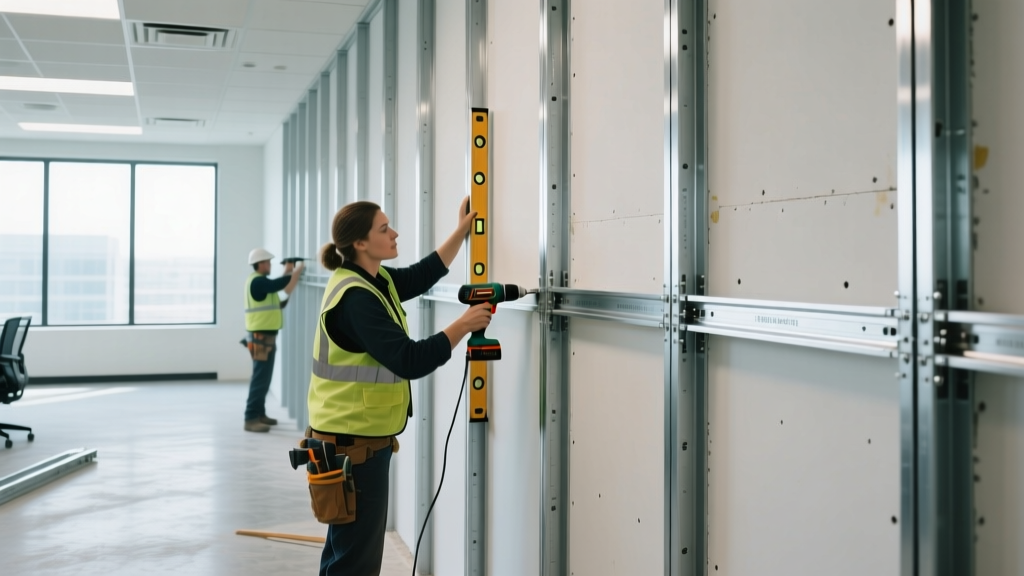
Secondary Steel vs. Wood Framing: 2026 Cost Matrix
While wood framing dominates single-family residential, secondary steel framing is the default for commercial and multi-family mid-rises. The following matrix compares the holistic costs of 20-gauge CFS versus SPF (Spruce-Pine-Fir) wood studs for a standard 10,000 sq. ft. commercial interior build-out.
| Cost Factor | 20-Gauge CFS Framing | SPF Wood Framing | Advantage |
|---|---|---|---|
| Raw Material Cost | $1.30 / LF | $0.95 / LF | Wood |
| Material Waste Factor | 2% - 5% (Highly recyclable) | 10% - 15% (Lumber yard off-cuts) | Steel |
| On-Site Labor Rate | $5.50 / LF | $4.80 / LF | Wood |
| Fire Insurance Premiums | Lower (Non-combustible framing) | Higher (Combustible during construction) | Steel |
| Moisture / Mold Risk | Zero (Galvanized coating) | High (Requires climate control) | Steel |
| Long-Term Call-backs | Low (No warping/shrinking) | High (Nail pops, drywall cracks from wood shrinkage) | Steel |
According to technical data published by the Steel Framing Industry Association (SFIA), the initial material premium for steel is typically offset by reduced waste disposal fees, lower builder's risk insurance premiums, and the elimination of moisture-related delays that frequently plague wood-framed commercial projects.
Value Engineering Strategies for CFS Projects
To optimize the budget for secondary steel framing without compromising structural integrity or code compliance, implement the following value engineering (VE) strategies during the pre-construction phase:
- Optimize Stud Spacing: While 16 inches on-center (o.c.) is standard, many 5/8-inch Type X gypsum board manufacturers allow 24-inch o.c. spacing for specific wall assemblies. Shifting to 24-inch spacing reduces stud material and labor by 30%.
- Consolidate Gauges: Avoid specifying five different stud gauges across a single floor plan. Standardizing on 20-gauge for all non-structural partitions and 16-gauge for all structural back-ups reduces bulk-ordering friction and minimizes on-site sorting errors.
- Utilize Skip-Sheathing: For exterior walls where the structural engineer allows, applying sheathing only at specific bracing intervals (skip-sheathing) rather than continuous sheathing can reduce material costs, provided the lateral load requirements are met.
- Pre-Punched Studs: Always order studs with factory-punched utility knockouts. Field-punching 16-gauge steel with hole-saws burns out drill bits, slows down the MEP trades, and creates sharp burrs that can damage wire insulation.
When specifying secondary steel for exterior applications or high-moisture interiors (e.g., commercial kitchens, natatoriums), standard G60 galvanized coating is insufficient. Upgrade to G90 or consider specialized epoxy-coated CFS members. The Steel Construction Institute (SCI) notes that premature corrosion in unconditioned spaces frequently stems from under-specifying the zinc coating thickness during the initial estimate.
Final Estimating Considerations
Accurately forecasting secondary steel framing costs in 2026 requires a holistic view of the wall assembly. Estimators must account for the premium of deflection tracks, the labor impact of heavy-gauge self-drilling fasteners, and the non-negotiable code requirements for thermal and acoustic mitigation. By leveraging prefabricated panels for repetitive layouts and optimizing stud spacing where fire-ratings permit, project teams can capitalize on the dimensional stability and fire-resistance of steel while keeping overall installed costs highly competitive.
Written by
Sarah WhitfieldSarah Whitfield is a chartered quantity surveyor (MRICS) and construction cost analyst with 15 years of experience in material pricing, procurement strategy, and project budgeting. She earned her degree in Construction Management from the University of Reading (UK) and has worked on projects ranging from $2M custom homes to $180M mixed-use developments across North America and Europe. Sarah currently leads cost estimating for BuildMat Insight, maintaining a proprietary database of 4,000+ material price points updated quarterly. She is a frequent contributor to RSMeans cost data panels and has presented at the International Cost Engineering Council (ICEC) congress. Based in Denver, CO, Sarah is an avid trail runner and volunteer mentor for Women in Construction.
More from Sarah Whitfield
View all
Wood & Lumber
What Are the Different Types of Wood? A Builder's Guide
Compare structural softwoods, finish hardwoods, and engineered lumber. Analyze Janka ratings, MOE values, and 2026 pricing for construction.
Aug 4, 2026

Walls & Panels
Steel Framing vs Wood Framing: Corrosion and Moisture Defense
Compare steel framing vs wood framing for moisture resistance. Learn about galvanized coatings, condensation risks, and corrosion protection strategies.
Jul 21, 2026

Stone & Masonry
How to Cut Stone Veneer: Wet Saw vs Grinder Comparison
Compare the best tools for cutting stone veneer. We review wet saws, angle grinders, and chop saws to help you achieve clean, chip-free cuts.
Jul 21, 2026