Stainless Steel Sheet Metal: Performance Specs & Grade Ratings
Compare stainless steel sheet metal grades, performance ratings, and ASTM specifications for architectural and structural building applications.
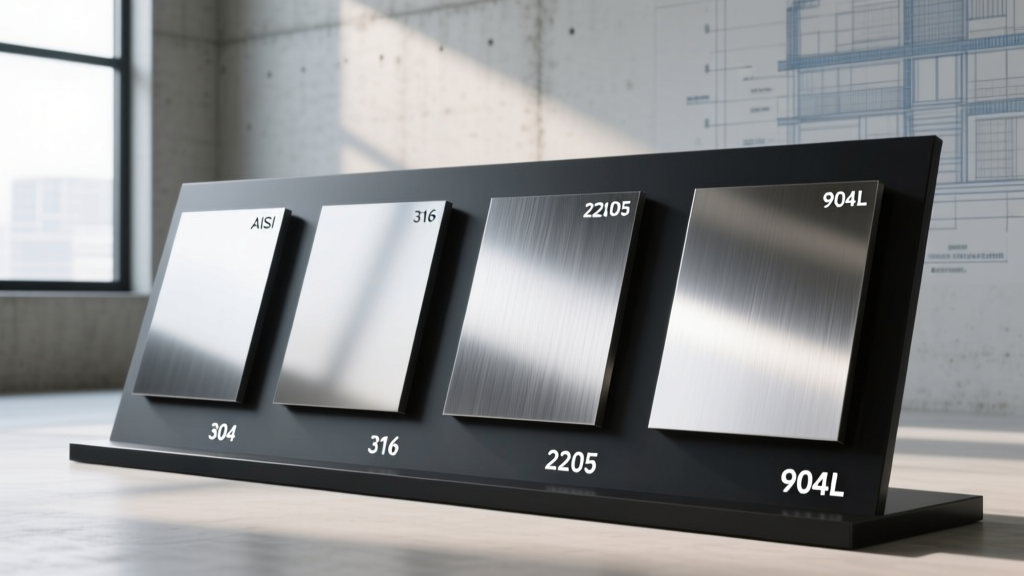
Core Alloy Grades and Mechanical Specifications
Specifying stainless steel sheet metal for building envelopes, interior cladding, and structural components requires strict adherence to ASTM A240 (Standard Specification for Chromium and Chromium-Nickel Stainless Steel Plate, Sheet, and Strip). The mechanical performance of the sheet varies significantly based on the metallurgical classification of the alloy. Austenitic grades (300-series) dominate architectural applications due to their formability and weldability, while ferritic (400-series) and duplex grades serve specialized structural or cost-sensitive roles.
| Grade | Metallurgy | Min. Tensile (ksi) | Min. Yield (ksi) | PREN Rating | Primary Architectural Use |
|---|---|---|---|---|---|
| 304 / 304L | Austenitic | 75 | 30 | 18.0 - 20.0 | Interior cladding, standard exterior facades, roofing |
| 316 / 316L | Austenitic | 75 | 30 | 24.0 - 28.0 | Coastal exteriors, high-chloride environments, pool enclosures |
| 430 | Ferritic | 65 | 40 | 16.0 - 18.0 | Interior decorative trim, elevator cabs, cost-sensitive panels |
| 2205 | Duplex | 90 | 65 | 34.0 - 38.0 | Heavy structural sheet, blast-resistant facades, harsh industrial |
The Pitting Resistance Equivalent Number (PREN) is the critical metric for predicting localized corrosion resistance in sheet metal. Calculated as %Cr + 3.3(%Mo) + 16(%N), a PREN above 24 (achieved by the molybdenum addition in 316) is the industry threshold for resisting pitting in marine or de-icing salt environments. For welded architectural structures, always specify the "L" (low carbon) variants like 304L or 316L to prevent sensitization and intergranular corrosion in the heat-affected zones.
Surface Finish Ratings and Architectural Applications
Surface finish dictates both the aesthetic performance and the actual corrosion resistance of the sheet. Rougher finishes trap moisture and chlorides, accelerating localized corrosion. Finishes are standardized under ASTM A480.
- 2B Finish: A smooth, moderately reflective cold-rolled finish. It is the standard mill finish for industrial applications and hidden structural components. Not recommended for high-visibility architectural facades due to inconsistent reflectivity.
- No. 4 Finish (Brushed): The industry standard for architectural sheet metal. Produced by polishing with 120-150 grit abrasives, it creates a directional satin appearance. It hides minor scratching and fingerprinting, making it ideal for elevator interiors, column covers, and exterior wall panels.
- No. 8 Finish (Mirror): Highly reflective, achieved through progressive polishing. While visually striking for decorative features, it requires frequent maintenance and is highly susceptible to visible scratching. It also exhibits lower corrosion resistance than No. 4 because the polishing process can embed iron particles if not properly passivated.
- 2BA (Bright Annealed): A smooth, bright finish produced by annealing in a controlled atmosphere. It offers better corrosion resistance than mechanically polished No. 8 because it avoids surface contamination, making it excellent for sterile environments or high-end decorative trim.
Specifier Warning: When using No. 4 brushed finishes on exterior facades, always specify that the polishing lines run vertically. Horizontal lines trap rainwater, dust, and chlorides, leading to accelerated streaking and localized pitting along the grooves.
Gauge, Thickness, and Tolerance Standards
A frequent and costly error in construction procurement is assuming stainless steel gauge numbers align with carbon steel or aluminum. The Manufacturers' Standard Gauge for stainless steel differs from other metals. For example, a 16-gauge stainless steel sheet is 0.0625 inches thick, whereas 16-gauge carbon steel is 0.0598 inches. Relying on gauge numbers rather than decimal thickness can result in structural under-design or improper fitment in curtain wall mullions.
According to the International Stainless Steel Forum, architectural specifications should always mandate decimal thickness (e.g., 0.075" instead of 14 gauge) and reference ASTM A480 for permissible thickness tolerances. For flat-rolled sheet under 3/16" thick, the standard thickness tolerance is typically ±0.005" to ±0.010" depending on the width and exact thickness. For precision architectural panels requiring tight interlocking seams, specify "narrow tolerances" to prevent panel warping during installation.
Thermal Expansion and Structural Movement
Austenitic stainless steels (304 and 316) possess a relatively high Coefficient of Thermal Expansion (CTE). At approximately 9.4 x 10^-6 /°F, the CTE of 304/316 is roughly 50% higher than that of carbon steel (6.5 x 10^-6 /°F) and significantly higher than concrete or masonry.
When detailing stainless steel sheet metal for long exterior runs (such as continuous fascia or coping), this thermal movement must be engineered into the clips and fastening systems. A 10-foot long 316 stainless steel panel experiencing a 100°F temperature swing (from a cold winter night to direct summer sun) will expand by approximately 0.11 inches. Rigid fastening without slotted holes or expansion joints will cause the sheet to buckle, oil-can, or tear the fastener holes.
Specifier's Decision Matrix: Grade Selection
Use this framework to select the correct stainless steel sheet metal grade for your building envelope:
- IF the project is inland (>20 miles from coast) and not exposed to heavy de-icing salts THEN specify 304 (No. 4 finish).
- IF the project is coastal (<20 miles), exposed to splash-zone chlorides, or located in heavy industrial pollution zones THEN specify 316 (No. 4 or 2BA finish).
- IF the application is strictly interior, non-welded decorative trim with strict budget constraints THEN specify 430.
- IF the sheet metal serves a blast-mitigation or heavy load-bearing structural role in a highly corrosive environment THEN specify 2205 Duplex.
Fabrication and Post-Treatment Requirements
The performance ratings of stainless steel sheet metal are entirely dependent on the preservation of the passive chromium oxide layer. Fabrication processes like shearing, plasma cutting, and welding can embed free iron into the surface or deplete the local chromium content.
To ensure the specified corrosion performance is achieved in the field, architectural specifications must mandate post-fabrication passivation (using nitric or citric acid per ASTM A967) to remove free iron and accelerate the formation of the passive layer. For welded 316 joints in aggressive environments, specify electropolishing or mechanical polishing followed by passivation to restore the PREN rating at the weld seam, as the heat input can cause localized molybdenum segregation.