Metal Roof Installation Cost Guide & Calculator 2026
Calculate your 2026 metal roof installation costs. Breakdowns for standing seam, corrugated panels, labor, underlayment, and waste factors.
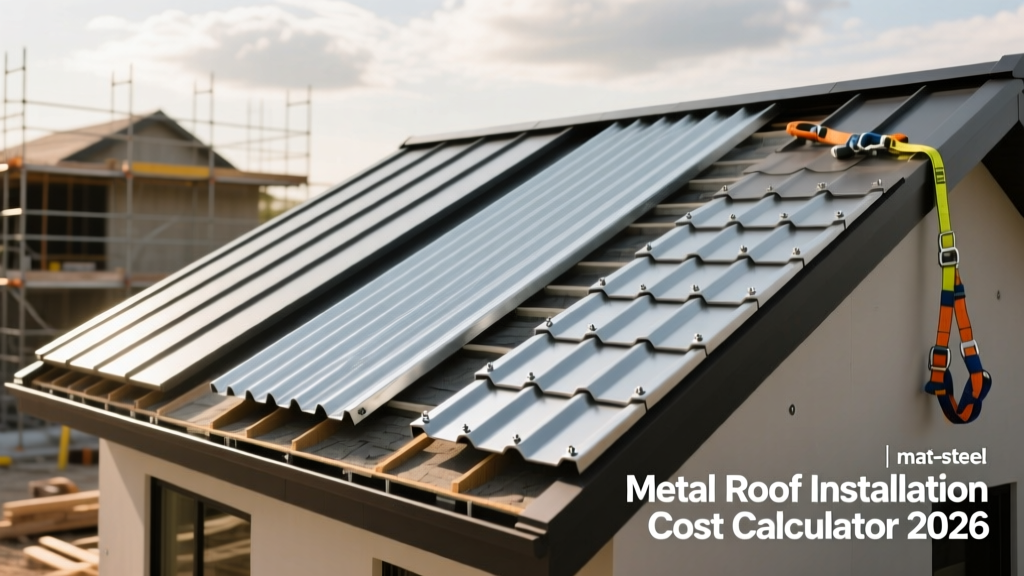
The True Cost of Metal Roof Installation in 2026
Estimating the cost of a metal roof requires moving beyond basic square-foot averages. In 2026, supply chain stabilization has normalized steel coil prices, but specialized labor and advanced coating systems continue to drive premium pricing. A complete metal roof installation encompasses panel profiles, gauge thickness, fastening systems, underlayment, and structural trim. For a standard 2,000-square-foot residential roof, total installed costs range from $18,500 for exposed-fastener corrugated systems to $42,000 for architectural standing seam with concealed clips.
Quick Cost Summary (Per Square Foot)
- 29-Gauge Corrugated (Exposed Fastener): $9.50 – $13.00 / sq. ft. installed
- 26-Gauge R-Panel (Exposed Fastener): $12.00 – $16.50 / sq. ft. installed
- 24-Gauge Standing Seam (Concealed Fastener): $17.00 – $24.00 / sq. ft. installed
- Old Roof Tear-Off & Disposal: $1.75 – $3.50 / sq. ft.
Material Cost Matrix: Profiles and Gauges
The two primary variables dictating material costs are the panel profile and the steel gauge. Lower gauge numbers indicate thicker steel. While 29-gauge is common in agricultural and budget residential applications, 24-gauge is the minimum recommended standard for architectural standing seam in regions with high wind or heavy snow loads.
| Panel Profile | Gauge / Thickness | Material Cost (Per Sq. Ft.) | Fastening System |
|---|---|---|---|
| Corrugated / 5V-Crimp | 29-Ga (0.0149") | $3.50 – $5.00 | Exposed Lap Screws |
| R-Panel / PBR | 26-Ga (0.0179") | $4.50 – $6.50 | Exposed Lap Screws |
| Snap-Lock Standing Seam | 24-Ga (0.0239") | $7.50 – $10.50 | Concealed Clips |
| Mechanical Lock Seam | 24-Ga (0.0239") | $9.00 – $13.00 | Concealed Clips + Seaming |
Coating Systems: PVDF vs. SMP
The paint finish applied to the galvanized or Galvalume steel substrate drastically impacts both upfront cost and long-term fade resistance. Silicone Modified Polyester (SMP) coatings are standard for exposed fastener panels, offering good durability at a lower price point. However, for architectural standing seam, specify a Kynar 500 or Hylar 5000 based PVDF (Polyvinylidene Fluoride) resin system. PVDF coatings cost approximately 15% to 20% more than SMP but resist UV chalk and fade significantly better, maintaining color integrity for 30 to 40 years.
Hidden Costs: Underlayment, Trim, and Fasteners
Novice estimators often calculate panel coverage and stop there. A weather-tight metal roof requires a complex ecosystem of secondary components. Budget an additional 25% to 35% on top of your raw panel costs for these critical accessories.
- Synthetic Underlayment: Never use traditional asphalt felt beneath metal panels; the high temperatures can cause the felt to bond to the steel, and it lacks the tensile strength required during installation. Use a high-temp synthetic underlayment (e.g., RoofTopGuard II or Titanium UDL30), costing $0.55 to $0.85 per square foot.
- Ice and Water Shield: Self-adhering modified bitumen membrane is mandatory in eaves, valleys, and around penetrations in cold climates. Budget $1.75 to $2.50 per square foot for these specific zones.
- Closure Strips: Foam closure strips are required at the ridge and eave of corrugated and R-panel roofs to block wind-driven rain and pests. Cost: $0.40 to $0.70 per linear foot.
- Fasteners: For exposed fastener roofs, use #10 x 1-inch hex washer head woodgrip screws with EPDM washers. Do not buy bulk bins from big-box stores; source manufacturer-approved fasteners with matched paint heads. A box of 1,000 premium coated screws costs roughly $65 to $85.
- Trim and Flashings: Z-flashings, drip edge, rake trim, and ridge caps are custom-bent from the same coil as the roof. Expect to pay $4.00 to $8.00 per linear foot for fabricated trim pieces.
Quantity Calculator: Estimating Panels and Waste
To accurately order materials, you must convert your home's flat footprint into actual roof surface area, then apply a waste factor. Metal panels cannot be cut and spliced like asphalt shingles; off-cuts from valleys and hips are largely unusable.
Step 1: Calculate Roof Area and Pitch Multiplier
Multiply your home's total square footage (including overhangs) by the pitch multiplier corresponding to your roof's slope.
| Roof Pitch | Multiplier | Angle |
|---|---|---|
| 3/12 | 1.031 | 14.0° |
| 4/12 | 1.054 | 18.4° |
| 6/12 | 1.118 | 26.6° |
| 8/12 | 1.202 | 33.7° |
| 10/12 | 1.302 | 39.8° |
| 12/12 | 1.414 | 45.0° |
Step 2: Apply the Waste Factor
Once you have the true surface area, add your waste percentage. Metal roofing waste is highly dependent on roof geometry.
Expert Estimation Rule: For a simple, unbroken gable roof, apply a 5% waste factor. For a complex hip roof with multiple valleys, dormers, and skylights, you must apply a 12% to 15% waste factor. Because standing seam panels are often custom-cut to the exact rafter length at the factory, ordering errors cannot be fixed on-site with scrap pieces.
Labor Rates and Installation Variables
Metal roofing installation demands specialized training, particularly for standing seam systems requiring mechanical field seaming or precise snap-lock engagement. In 2026, experienced metal roof crews charge between $7.00 and $14.00 per square foot for labor, heavily dependent on regional prevailing wages and roof complexity.
Tear-Off and Decking Prep: If removing an existing layer of asphalt shingles, budget $1.75 to $2.50 per square foot for tear-off and dumpster fees. If the existing roof has multiple layers or heavy tile, costs can exceed $4.00 per square foot. Furthermore, metal roofs require a perfectly flat deck. Budget $85 to $110 per sheet (4x8 OSB or plywood) for replacing rotted or warped decking. It is highly recommended to install 1x4 purlins or battens over the existing deck for standing seam roofs to create an air gap that mitigates condensation and improves thermal performance.
ROI, Energy Efficiency, and Long-Term Value
While the initial metal roof installation cost is 2 to 3 times higher than architectural asphalt shingles, the lifecycle economics heavily favor steel. According to the Metal Roofing Alliance, a properly installed metal roof will last 40 to 70 years, effectively outlasting the building's primary structural components. Furthermore, metal roofs are 100% recyclable at the end of their life, unlike asphalt shingles which contribute 20 billion pounds of waste to landfills annually.
From an energy perspective, specifying a "cool roof" PVDF coating with high solar reflectance (SR) and thermal emittance (TE) can reduce peak cooling demand by 10% to 15%. The U.S. Department of Energy notes that highly reflective metal roofs significantly reduce the urban heat island effect and lower interior attic temperatures, reducing HVAC strain. Additionally, many insurance providers offer premium discounts of 10% to 25% for homes with Class A fire-rated and impact-resistant metal roofing systems, accelerating the return on investment.