Stainless Steel Framing Nails: The Structural Selection Framework
Master the selection of stainless steel framing nails. Compare 304 vs 316 grades, shank types, and collation for pressure-treated and coastal builds.

The Galvanic Corrosion Problem in Modern Framing
The transition toward highly alkaline wood preservatives over the last two decades has fundamentally altered fastener requirements in structural framing. Modern pressure-treated lumber—specifically those utilizing Alkaline Copper Quaternary (ACQ) and Micronized Copper Quaternary (MCQ) treatments—contains high levels of dissolved copper. When standard hot-dipped galvanized (HDG) nails are driven into ACQ-treated wood, the copper acts as a cathode and the zinc coating on the nail acts as an anode. This creates a galvanic cell that rapidly consumes the zinc coating, leading to catastrophic fastener failure and structural compromise.
While G185 hot-dipped galvanized coatings offer a baseline of protection, building codes in coastal and high-moisture environments increasingly mandate stainless steel fasteners. According to the Simpson Strong-Tie Corrosion Information Guide, stainless steel provides the highest level of corrosion resistance for structural connectors and driven fasteners in severe environments. However, specifying 'stainless steel' is not a monolithic solution. Contractors and structural engineers must navigate alloy grades, shank geometries, head profiles, and pneumatic collation formats to ensure code compliance and structural integrity.
Never use stainless steel framing nails to fasten standard galvanized steel joist hangers, hurricane ties, or structural connectors. The stainless steel fastener will act as a cathode, aggressively accelerating the galvanic corrosion of the zinc-coated hanger. If your fasteners are stainless, your structural connectors must also be stainless steel (Type 304 or 316) or hot-dipped galvanized to a minimum G185 coating class, as outlined in FEMA P-55 Chapter 11 (Coastal Construction Materials).
Stainless Steel Framing Nails Selection Matrix
The following matrix provides a high-level decision framework for selecting the correct fastener specification based on environmental exposure and structural demands. This matrix assumes standard 3-1/4" x 0.131" framing nail dimensions.
| Attribute | 304 Stainless (Type 18-8) | 316 Stainless (Marine Grade) | G185 Hot-Dipped Galvanized (Baseline) |
|---|---|---|---|
| Alloy Composition | 18% Chromium, 8% Nickel | 16-18% Chromium, 10-14% Nickel, 2-3% Molybdenum | Low-carbon steel with 1.85 oz/sq ft zinc coating |
| Best Environment | Inland pressure-treated lumber, standard exterior decks, agricultural buildings | Coastal zones (within 1 mile of surf), saltwater exposure, high-humidity enclosures | Interior framing, standard exterior framing (away from coast) |
| ACQ/MCQ Compatibility | Excellent | Excellent | Good (Minimum required by code for treated wood) |
| Chloride Resistance | Moderate (Prone to pitting in salt spray) | Superior (Molybdenum prevents pitting) | |
| Avg. Cost (per 2,000 box) | $95 - $115 | $145 - $175 | $45 - $55 |
Metallurgical Breakdown: 304 vs. 316 Grades
Specifying the correct alloy is the most common point of failure in coastal construction. Both 304 and 316 stainless steels belong to the austenitic family, but their performance diverges sharply in the presence of chlorides (salt).
Type 304 (18-8 Stainless Steel)
Type 304 is the workhorse of the stainless fastener world. It contains 18% chromium and 8% nickel, which forms a passive chromium oxide layer on the surface that prevents rust. For framing applications involving ACQ or MCQ treated lumber in inland environments, 304 stainless steel framing nails provide more than adequate protection against the alkaline copper compounds. However, 304 is highly susceptible to crevice corrosion and pitting when exposed to airborne salt or direct saltwater splash.
Type 316 (Marine-Grade Stainless Steel)
The critical differentiator in 316 stainless steel is the addition of 2% to 3% molybdenum. This element specifically neutralizes the corrosive effects of chlorides, preventing the localized pitting that destroys 304 fasteners in marine environments. If your project is located within 3,000 feet of a saltwater coastline, or in a High-Velocity Hurricane Zone (HVHZ) where wind-driven salt spray is a factor, building inspectors will typically mandate 316 stainless steel framing nails for all structural shear walls and roof-to-wall connections.
Shank Geometry and Head Profiles
Beyond the alloy, the physical geometry of the nail dictates its structural performance under shear and withdrawal loads. All driven fasteners must comply with ASTM F1667 (Standard Specification for Driven Fasteners).
- Ring Shank vs. Smooth Shank: Ring shank nails feature concentric ridges along the shank that act like barbs, locking into the wood fibers. They provide up to 40% greater withdrawal resistance compared to smooth shank nails. For structural shear walls, roof trusses, and hurricane tie-downs, ring shank stainless steel framing nails are mandatory. Smooth shanks should be reserved for temporary bracing or non-structural blocking where future disassembly might be required.
- Full Round Head vs. Clipped Head: Clipped head nails (where the top of the nail head is cut off to allow tighter collation) have historically been used to increase magazine capacity. However, the International Building Code (IBC) and many coastal jurisdictions strictly prohibit clipped head nails in structural framing due to their reduced pull-through resistance under high wind uplift loads. Always default to full round head stainless steel framing nails for structural connections to ensure universal code compliance.
Pneumatic Collation and Tool Compatibility
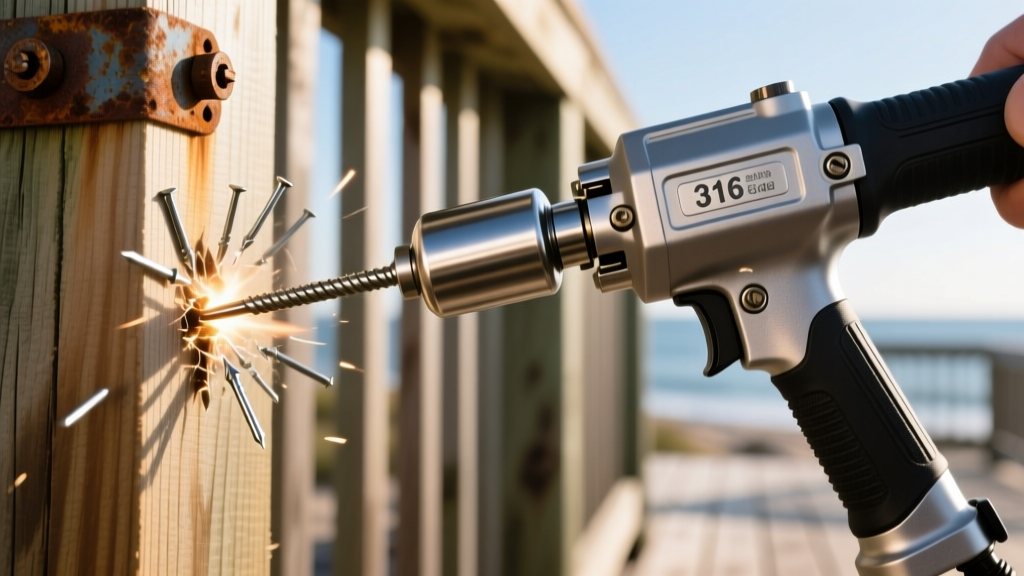
Stainless steel framing nails are manufactured in specific collation angles to match pneumatic nail guns. Selecting the wrong collation will result in tool jams and misfires.
- 21-Degree Plastic Collated: These are the industry standard for full round head framing nails. The nails are held together by a plastic strip. When fired, the plastic shatters. In high-end structural builds, some superintendents dislike 21-degree nails because the plastic debris falls into the framing cavities, though this rarely affects structural integrity.
- 30-Degree Paper Tape Collated: These typically feature clipped or offset full round heads. The paper tape is cleaner than plastic, leaving less debris on the job site. However, paper collation is highly susceptible to moisture absorption. If you are framing in high humidity or rain, 30-degree paper-taped stainless steel nails can swell and jam the tool magazine.
- 15-Degree Wire Coil: Used exclusively in coil nailers, these are common for high-volume production framing and sheathing. They offer the highest magazine capacity (up to 300 nails) but the wire welds can introduce minor surface rust points on the nail shank before driving, though the stainless core remains unaffected.
Cost Analysis and Lifecycle ROI
The upfront premium for stainless steel framing nails is significant, often causing friction during project estimation. A standard box of 2,000 G185 hot-dipped galvanized 3-1/4" x 0.131" framing nails costs approximately $45 to $55. The equivalent 304 stainless steel box runs $95 to $115, while 316 marine-grade commands $145 to $175.
The ROI Perspective: When evaluating fastener costs, frame the expense against the total structural assembly cost. Fasteners typically account for less than 1.5% of the total framing material budget. Upgrading from HDG to 316 stainless steel in a coastal custom home might add $800 to $1,200 to the total fastener budget, but it prevents a $40,000+ structural remediation liability if galvanic corrosion compromises the shear walls within a decade.
Field Decision Flowchart
Use this rapid decision tree on the job site or during the procurement phase to specify the correct stainless steel framing nail:
-> NO: Standard HDG or bright nails are sufficient.
-> YES: Proceed to Step 2.
Step 2: Is the project located within 1 mile of a saltwater coastline?
-> NO: Specify 304 Stainless Steel, Ring Shank, Full Round Head.
-> YES: Proceed to Step 3.
Step 3: Are the nails fastening structural steel connectors (joist hangers, ties)?
-> NO (Wood-to-Wood only): Specify 316 Stainless Steel, Ring Shank.
-> YES: Specify 316 Stainless Steel nails AND ensure the steel connectors are also 316 SS or ZMAX/G185 rated to prevent mixed-metal galvanic corrosion.
By treating fastener selection as a critical structural engineering decision rather than a consumable afterthought, builders ensure that modern pressure-treated lumber assemblies achieve their full design lifespan without hidden degradation at the connection points.
Written by
Priya KapoorPriya Kapoor is a real estate market analyst and construction economics researcher with expertise in housing affordability, development feasibility, and infrastructure investment. She holds a Master of Regional Planning from Cornell University and previously worked as a senior analyst at CBRE's Investment Properties group, where she modeled returns for $4B in mixed-use development pipelines. Priya now runs an independent research practice advising developers, municipalities, and REITs on construction cost forecasting and market timing. She publishes the quarterly "BuildMat Market Pulse" report tracking material price indices across 12 commodity categories. Based in Austin, TX, Priya serves on the board of Habitat for Humanity Austin and is a marathon runner.
More from Priya Kapoor
View all
Construction Cost
Cost to Build a 1600 Sq Ft Home in 2026: Full Breakdown
Accurate 2026 cost to build a 1600 sq ft home—material, labor, and regional pricing breakdowns included. Plan your budget with real-time estimates.
Aug 11, 2026

Wood & Lumber
Name the Types of Wood for Pressure Treatment and Preservation
Learn how to name the types of wood best suited for pressure treatment. Compare species treatability, chemical retention levels, and 2026 preservation costs.
Aug 4, 2026

Stone & Masonry
Stone Veneer Suppliers Lindenhurst: 2026 Cost Analysis
Analyze 2026 stone veneer costs in Lindenhurst, NY. Compare local supplier pricing, delivery fees, and Suffolk County installation labor rates.
Aug 4, 2026