Stainless Steel Framing Guide: 304 vs 316 Grades, Costs, and Structural Uses
Compare 304 vs 316 stainless steel framing grades, structural applications, corrosion metrics, and 2026 cost data in this complete specifier's guide.

Stainless steel framing is frequently misunderstood as merely a premium substitute for standard galvanized light-gauge steel. In reality, specifying stainless steel wall studs, tracks, and structural members is a calculated metallurgical decision driven by aggressive environmental exposures, stringent hygiene requirements, and lifecycle cost mitigation. While standard G60 or G90 galvanized framing relies on a sacrificial zinc coating that eventually depletes, stainless steel derives its corrosion resistance from a self-healing chromium-oxide passive layer integrated into the base metal.
This guide deconstructs the technical specifications, grade selection frameworks, fabrication constraints, and current market pricing for stainless steel framing systems, providing structural engineers and architects with the data required to specify these materials accurately.
Metallurgical Breakdown: Selecting the Correct Alloy Grade
The term 'stainless steel' encompasses a family of over 150 distinct alloys, but only a few are economically and structurally viable for roll-formed framing and structural studs. The selection hinges on the Pitting Resistance Equivalent Number (PREN), a predictive metric calculated as %Cr + 3.3(%Mo) + 16(%N). A higher PREN indicates superior resistance to localized pitting and crevice corrosion.
| Alloy Grade | Classification | PREN Score | Yield Strength (ksi) | Primary Framing Application |
|---|---|---|---|---|
| Type 430 | Ferritic | ~17 | 45 - 65 | Interior non-load-bearing partitions in mild environments; magnetic for specialized wall-mounting. |
| Type 304 / 304L | Austenitic | ~19 | 30 - 45 | Standard interior wet areas, food processing facilities, and exterior soffits in non-coastal zones. |
| Type 316 / 316L | Austenitic (Mo) | ~26 | 30 - 45 | Coastal/marine structures, indoor natatoriums (chloramines), and chemical processing plants. |
| Duplex 2205 | Duplex (Aust-Ferr) | ~35 | 65 - 80 | Heavy-duty structural load-bearing columns and trusses in extreme offshore or high-chloride environments. |
For general construction framing, Type 304 and Type 316 dominate the market. The 'L' variants (304L, 316L) denote low carbon content, which is critical if the framing members require field welding. Low carbon prevents carbide precipitation (sensitization) in the heat-affected zone, ensuring the weld joints retain their corrosion resistance.
High-Stakes Structural Applications
Stainless steel framing is rarely specified for standard residential or commercial drywall partitions due to its initial capital expenditure. It is reserved for environments where galvanized steel experiences premature failure modes.
1. Indoor Natatoriums and Aquatic Centers
Indoor pools generate airborne chloramines, which condense on structural members and cause rapid stress corrosion cracking (SCC) in standard carbon steel and even some lower-grade stainless alloys. According to structural safety guidelines, austenitic stainless steels (specifically 316) or specialized duplex grades are mandated for ceiling suspension systems and wall framing in these facilities to prevent catastrophic structural failures caused by hidden corrosion.
2. Coastal and Marine Facades
Within 1,000 meters of a saltwater coastline, wind-driven aerosolized chlorides bypass standard exterior cladding and attack the underlying stud framework. Type 316 framing, with its 2-3% molybdenum content, resists chloride-induced pitting. The International Stainless Steel Forum notes that 316 is the baseline requirement for architectural and structural elements in marine environments to ensure a 50+ year design life without maintenance.
3. Cleanrooms and Pharmaceutical Facilities
FDA-regulated environments require framing that can withstand aggressive, high-pressure chemical washdowns (including peracetic acid and chlorine dioxide). Stainless steel studs do not shed particulates, harbor biological growth in microscopic pits, or degrade under UV sterilization protocols, making them mandatory for ISO-classified cleanroom partitions.
Fabrication Constraints and Fastener Compatibility
Installing stainless steel framing requires strict job-site protocols to prevent contamination that compromises the passive oxide layer.
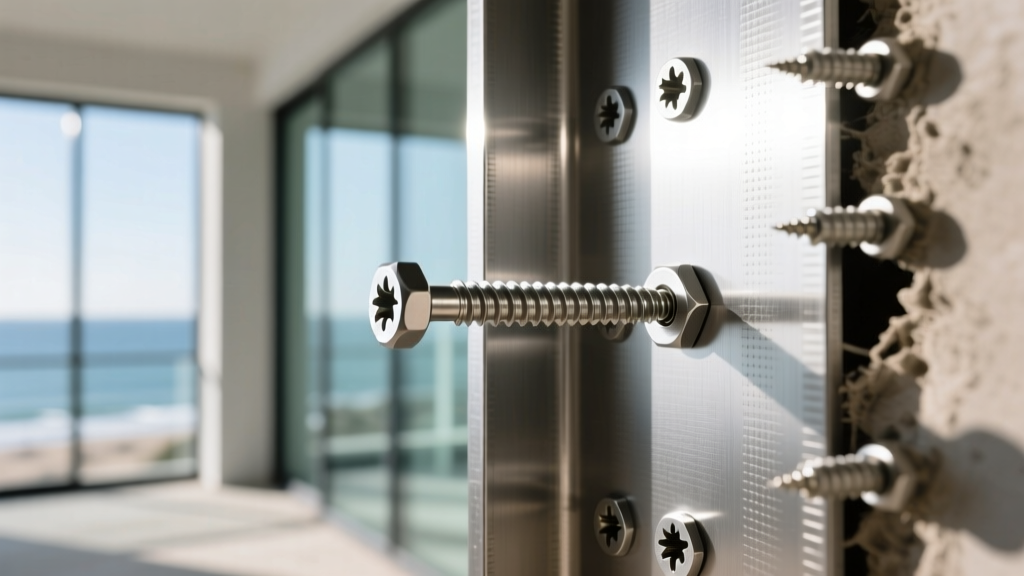
Never use carbon steel saw blades, grinding discs, or wire brushes on stainless steel studs. Embedded iron particles from carbon steel tools will oxidize rapidly, creating 'tea-staining' and localized pitting that mimics base-metal failure. Furthermore, joining stainless steel studs with standard zinc-plated drywall screws creates a galvanic cell where the zinc acts as a sacrificial anode, corroding completely within months and leaving the joint mechanically unfastened.
Fastener Selection Matrix
The fundamental rule of stainless fastening is to use a fastener of the same or higher metallurgical grade as the base material.
- For 304 Framing: Use 305 or 316 stainless steel self-drilling screws. (Using 316 on 304 is acceptable and prevents galvanic decay).
- For 316 Framing: Use exclusively 316 stainless steel fasteners.
- Isolation Washers: When bolting stainless structural members to carbon steel beams, use non-conductive neoprene or EPDM isolation washers and sleeves to break the electrical path and prevent bimetallic corrosion.
2026 Pricing Metrics and Lifecycle ROI
The upfront material cost of stainless steel framing is substantially higher than galvanized alternatives, but the Total Cost of Ownership (TCO) shifts in aggressive environments. As of early 2026, nickel surcharges and molybdenum market volatility continue to influence pricing, making accurate budgeting critical for specifiers.
| Framing Material | Avg. Cost per Linear Foot (3-5/8' 20ga Stud) | Expected Lifespan in Marine Environment | Maintenance Requirement |
|---|---|---|---|
| Galvanized G90 Carbon Steel | $1.85 - $2.40 | 5 - 12 Years | High (inspections, rust mitigation, replacement) |
| Type 304 Stainless Steel | $5.50 - $7.25 | 20 - 30 Years | Moderate (surface cleaning, crevice monitoring) |
| Type 316 Stainless Steel | $8.90 - $12.50 | 50 - 100+ Years | Minimal (routine visual inspection) |
While the initial material multiplier for 316 stainless steel is roughly 4.5x to 5x that of standard galvanized studs, the elimination of secondary encapsulation systems (such as heavy-duty vapor barriers, epoxy coatings, or cathodic protection) often narrows the installed cost gap. For projects requiring a 75-year structural design life, the AISC Design Guide 27 for Structural Stainless Steel demonstrates that the lifecycle ROI of stainless steel framing surpasses coated carbon steel by year 25, as it eliminates the need for invasive remediation.
Common Failure Modes and Edge Cases
Even highly alloyed stainless steel can fail if detailed incorrectly. Specifiers must design around these specific metallurgical vulnerabilities:
- Crevice Corrosion: The passive oxide layer requires oxygen to regenerate. In tight, unventilated lap joints or under overlapping track flanges where moisture is trapped and oxygen is depleted, localized acidic environments form, leading to rapid pitting. Solution: Specify continuous welds over stitch welds, or use non-absorbent sealants to completely fill crevices and block moisture ingress.
- Stress Corrosion Cracking (SCC): Austenitic grades (304/316) are susceptible to SCC when subjected to high tensile stress in the presence of chlorides at elevated temperatures (above 140°F / 60°C). Solution: In high-heat, high-chloride zones (e.g., framing around industrial boilers or geothermal vents), specify Duplex 2205 or ferritic grades, which are highly resistant to SCC.
- Thermal Bridging: Stainless steel has a lower thermal conductivity than carbon steel, but it is still a significant thermal bridge compared to wood or composite framing. Solution: Incorporate thermal break pads (such as structural polyurethane or aerogel strips) between the stainless track and the exterior concrete or steel substrate to maintain building envelope energy codes.
Specifier's Decision Framework
Use the following logic tree to determine if stainless steel framing is required for your project scope:
- Is the environment within 1km of a saltwater body? Yes → Specify Type 316.
- Will the framing be exposed to airborne chloramines (pools) or industrial halogens? Yes → Specify Type 316 or Duplex 2205.
- Is the space subject to daily caustic chemical washdowns (Food/Pharma)? Yes → Specify Type 304 (mild chemicals) or 316 (harsh oxidizers).
- Is the application a standard interior commercial partition in a climate-controlled zone? Yes → Reject stainless; specify standard Galvanized G60/G90 to optimize budget.
By aligning the specific alloy grade with the exact environmental stressors, structural engineers can leverage the immense longevity of stainless steel framing without over-specifying and inflating project budgets. Proper detailing, fastener isolation, and adherence to Nickel Institute fabrication guidelines ensure the structural integrity of the framework outlasts the building envelope itself.
Written by
James ThorntonJames Thornton is a construction industry veteran with 25 years of hands-on experience in wood framing, lumber grading, and residential building codes. He started as a framing carpenter in rural Oregon, earned his ICC Residential Building Inspector certification, and eventually became a senior plan reviewer for the City of Portland Bureau of Development Services. James holds a B.S. in Wood Science & Technology from Oregon State University and is a certified lumber grader through the West Coast Lumber Inspection Bureau (WCLIB). He has inspected over 3,000 residential construction sites and authored the city's internal guide on advanced framing techniques (2x6 at 24" O.C.). James lives in Bend, OR, where he builds custom timber-frame cabins and competes in lumberjack sports.
More from James Thornton
View all
Insulation
Best Home Insulation Materials: Complete 2026 Guide
Compare top home insulation materials for 2026. Find R-values, installed costs per square foot, and best uses for fiberglass, spray foam, and mineral wool.
Aug 4, 2026

Sustainable Building
Certify Your Green Building Material for LEED and WELL
Step-by-step guide to certifying a green building material for LEED v5 and WELL v2. Master EPDs, HPDs, and VOC limits for 2026 project specifications.
Aug 4, 2026

Stone & Masonry
Veneer Stacked Stone Panels: Interior Design & Style Showcase
Discover how veneer stacked stone panels transform interiors. Explore modern design profiles, material pairings, and technical installation specs.
Aug 4, 2026