Steel Material Taxonomy and Selection When Putting on a Metal Roof
Master the steel material taxonomy before putting on a metal roof. Compare Galvalume gauges, PVDF coatings, and standing seam profiles for modern builds.
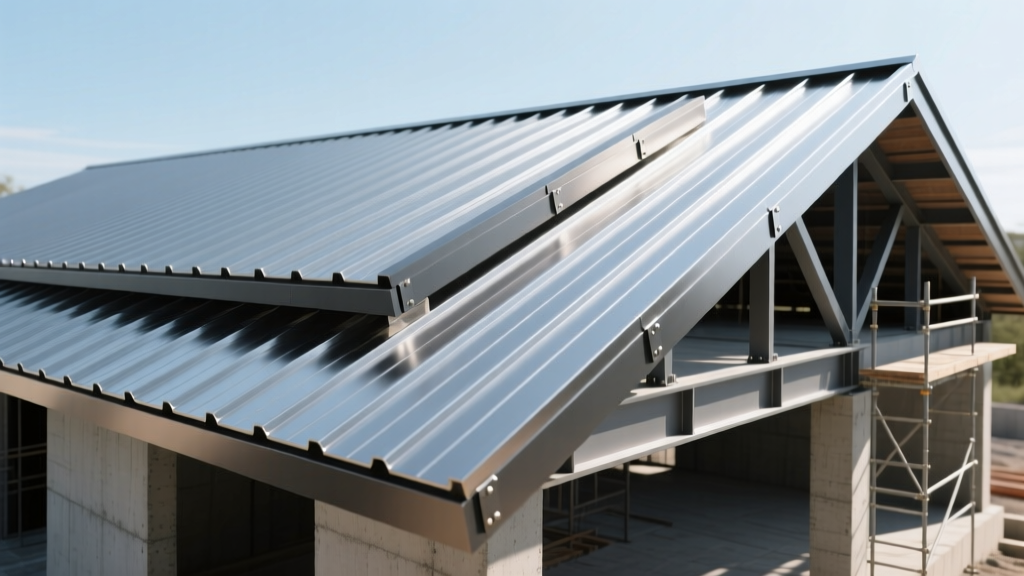
The Base Substrate Taxonomy: Galvalume vs. Galvanized Steel
When putting on a metal roof, the foundational decision begins at the substrate level. Architectural steel roofing relies on cold-rolled steel coils that are subsequently coated to prevent oxidation. The industry standard bifurcates into two primary metallic coating classifications:
Galvalume (Aluminum-Zinc Alloy)
Defined under ASTM A792, Galvalume consists of a steel substrate coated with an alloy of approximately 55% aluminum, 43.4% zinc, and 1.6% silicon. In roofing specifications, you will typically see this designated as AZ50 or AZ55 (indicating 0.50 or 0.55 ounces of alloy per square foot of surface area). The aluminum provides long-term barrier protection and heat reflectivity, while the zinc offers galvanic (sacrificial) protection at cut edges and scratches. According to the Metal Construction Association, Galvalume-coated panels routinely achieve a functional lifespan of 40 to 60 years in non-coastal environments, making it the undisputed baseline for modern architectural roofing.
Galvanized Steel (Zinc Coating)
Defined under ASTM A653, galvanized steel is coated with pure zinc, typically designated as G90 (0.90 ounces per square foot). While the thicker zinc layer provides excellent initial sacrificial protection at cut edges, it lacks the aluminum barrier that prevents the underlying steel from eventually rusting once the zinc is depleted. Galvanized steel is generally reserved for agricultural buildings, temporary structures, or fully painted concealed systems where cut-edge exposure is minimized.
Decoding Thickness: Gauge, Mils, and Yield Strength
The steel roofing industry utilizes the Manufacturers' Standard Gauge (MSG) for sheet steel, an inverse scale where a lower number indicates a thicker panel. However, relying solely on gauge numbers is a critical error; you must verify the decimal thickness and the steel's yield strength (measured in ksi - kilopounds per square inch).
| Gauge | Decimal Thickness (Inches) | Weight (lbs/sq ft) | Typical Yield Strength | Application Profile |
|---|---|---|---|---|
| 29-Gauge | 0.0135" | 0.56 | 33 ksi - 50 ksi | Agricultural, interior liners, light residential exposed fastener |
| 26-Gauge | 0.0179" | 0.75 | 50 ksi - 80 ksi | Standard residential exposed fastener, light commercial standing seam |
| 24-Gauge | 0.0239" | 1.00 | 50 ksi - 80 ksi | Premium residential, commercial architectural standing seam |
| 22-Gauge | 0.0299" | 1.25 | 50 ksi - 80 ksi | Heavy commercial, high-wind/hail zones, long-span structural panels |
For architectural standing seam systems, 24-gauge is the industry standard. It provides sufficient rigidity to resist "oil canning" (the visual rippling effect caused by thermal expansion and manufacturing stresses) while remaining malleable enough for on-site mechanical seaming. If you are installing over an open framing system (bypassing solid decking), 22-gauge is required to meet structural span requirements.
Paint and Coating Chemistry: PVDF vs. SMP
The metallic coating protects the steel from rusting, but the organic paint system protects the metallic coating from UV degradation and dictates the aesthetic longevity of the roof. The taxonomy of coil coatings is dominated by two resin chemistries:
70% PVDF (Polyvinylidene Fluoride)
Often referred to by the trade names Kynar 500® or Hylar 5000®, PVDF resins are the gold standard for architectural metal roofing. The molecular bond of the fluoropolymer is highly resistant to UV photon breakdown. A high-quality PVDF system (like Sherwin-Williams Fluropon or PPG Duranar) applied at a 1.0-mil thickness will retain 90% of its original color and resist chalking for 30 to 40 years. The Cool Roof Rating Council frequently tests PVDF-coated panels for high solar reflectance, as the resin matrix holds reflective ceramic pigments securely without degrading.
SMP (Silicone Modified Polyester)
SMP coatings offer excellent hardness and abrasion resistance, making them highly resistant to scratching during the roll-forming and installation processes. However, SMP resins are susceptible to UV-induced chalking and fading, particularly in darker colors (like charcoal, bronze, or matte black). SMP is typically warranted for 10 to 15 years for fade resistance and is best reserved for agricultural applications, trim, or light-colored exposed fastener panels where budget constraints outweigh long-term aesthetic retention.
Expert Specification Note: When ordering PVDF panels, ensure the specification explicitly requires a "70% PVDF resin" formulation. Some manufacturers use 50% PVDF blends to cut costs, which drastically reduces the coating's lifespan and voids standard 30-year fade warranties.
Profile Geometry: Matching Pitch to Panel Design
The physical geometry of the panel dictates water shedding capabilities and structural performance. The selection taxonomy divides into two main categories:
Exposed Fastener (Corrugated, R-Panel, 5V-Crimp)
These panels feature overlapping sidelaps secured by screws driven directly through the panel face into the substrate.
- Minimum Pitch: 3:12 (with sealed laps) or 4:12 (standard).
- Pros: Lower material cost ($1.50 - $2.50 per sq. ft.), faster installation, wider purlin spacing tolerance.
- Cons: Fastener gaskets degrade over 15-20 years requiring maintenance; thermal expansion/contraction causes back-out of screws; not recommended for low-slope applications.
Concealed Fastener (Standing Seam)
Standing seam panels utilize a cleat or clip system attached to the deck, allowing the panel to snap or mechanically lock over the clip without any fastener penetrating the weather-exposed surface.
- Snap-Lock: Panels snap together over a fixed clip. Minimum pitch 3:12. Ideal for residential and straightforward commercial roofs.
- Mechanical Lock: Panel seams are folded together using a robotic or hand seamer. Can be single-lock (90 degrees) or double-lock (180 degrees). Minimum pitch can drop to 1:4 or even 1:8 with specialized sealant tape in the seams. Mandatory for complex commercial geometries, valleys, and low slopes.
The Fastener Matrix and Galvanic Compatibility
A catastrophic failure point when putting on a metal roof is the misapplication of fasteners, leading to galvanic corrosion. When two dissimilar metals are in contact in the presence of an electrolyte (rain, condensation), the less noble metal corrodes rapidly.
Furthermore, avoid direct contact between the steel roofing panels and copper flashings, untreated cedar wood (which contains acidic tannins), or alkaline masonry. Use butyl tape or high-temperature peel-and-stick membranes as separation barriers where these materials must interface.
2026 Material Cost and ROI Framework
Understanding the material taxonomy allows for accurate budget forecasting. The pricing matrix below reflects stabilized 2026 mill-direct and distributor pricing for raw materials (excluding labor, underlayment, and structural framing).
| Panel Profile | Material Spec (Substrate/Gauge/Coating) | Est. Material Cost (per sq. ft.) | Expected Lifespan |
|---|---|---|---|
| Exposed Fastener (R-Panel) | Galvalume / 26-Gauge / SMP Paint | $1.65 - $2.20 | 25 - 35 Years |
| Exposed Fastener (Corrugated) | Galvalume / 26-Gauge / PVDF Paint | $2.40 - $3.10 | 40 - 50 Years |
| Snap-Lock Standing Seam | Galvalume / 24-Gauge / PVDF Paint | $3.80 - $4.90 | 50+ Years |
| Mechanical Lock Standing Seam | Galvalume / 22-Gauge / PVDF Paint | $5.20 - $6.80 | 60+ Years |
While the initial capital expenditure for a 24-gauge mechanical lock standing seam roof is substantially higher than an exposed fastener system, the life-cycle cost analysis heavily favors the standing seam. Eliminating exposed fasteners removes the primary maintenance vector (screw replacement and washer degradation), and the structural integrity of the thicker gauge withstands severe weather events, often resulting in significant premiums discounts from property insurers.
Final Specification Checklist
Before finalizing your material order, ensure your bill of materials explicitly states:
- The base substrate (e.g., ASTM A792 Galvalume AZ55).
- The exact decimal thickness or gauge (e.g., 24-gauge, 0.0239" min).
- The paint resin chemistry and mil thickness (e.g., 70% PVDF, 1.0 mil topcoat, 0.2 mil primer).
- The profile geometry and seam type (e.g., 1.75" snap-lock, trapezoidal rib).
- Fastener composition and washer type for all trim and accessory attachments.