Steel Framing Channel Grades: ASTM Specs & Selection Guide
Master steel framing channel grades, ASTM specs, and gauge matrices. Learn to specify 33, 50, and 97 ksi CFS for load-bearing and curtain walls.

Decoding Cold-Formed Steel Framing Channel Nomenclature
Specifying the correct steel framing channel requires navigating a precise matrix of yield strengths, thicknesses, and coating weights. Unlike structural hot-rolled steel (W-shapes and I-beams), cold-formed steel (CFS) framing channels—commonly referred to as C-sections or studs—are manufactured by brake-pressing or roll-forming galvanized sheet steel. The Steel Framing Industry Association (SFIA) mandates a strict alphanumeric nomenclature to identify these members. Understanding this code is the first step in matching the channel grade to the structural demand.
Consider the standard designation: 362S162-50 (43).
362: Web depth in hundredths of an inch (3.625 inches).
S: Member type (S = Stud, T = Track, U = Channel, F = Furring).
162: Flange width in hundredths of an inch (1.625 inches).
50: Minimum yield strength in ksi (Grade 50).
(43): Design thickness in mils (43 mils, traditionally known as 18 gauge).
The number immediately following the dash represents the steel grade, which dictates the yield strength of the framing channel. Selecting between Grade 33, Grade 50, and high-strength Grade 97 alters not only the load-bearing capacity of the wall assembly but also the fastener requirements, cutting methods, and overall project economics.
The Yield Strength Matrix: Grade 33 vs. Grade 50 vs. Grade 97
Under ASTM A1003, the standard specification for structural sheet steel for CFS framing, manufacturers produce coils in distinct strength grades. The Cold-Formed Steel Engineers Institute (CFSEI) provides the design methodologies (AISI S100) that translate these raw material properties into allowable wall heights and axial loads.
Material Property Quick Reference
- Grade 33: 33 ksi Yield Strength | 45 ksi Ultimate Tensile Strength. (Ductile, easy to cut, standard for non-load-bearing curtain walls and soffits).
- Grade 50: 50 ksi Yield Strength | 65 ksi Ultimate Tensile Strength. (The industry baseline for load-bearing studs, truss chords, and shear wall boundary elements).
- Grade 97: 97 ksi Yield Strength | 110+ ksi Ultimate Tensile Strength. (Ultra-high-strength, used in specialized engineered applications to reduce member thickness while maintaining axial capacity).
Historically, Grade 33 was the default for all interior partitions. However, as 2026 building codes demand higher acoustic performance and deeper utility cavities, engineers frequently specify wider webs (e.g., 600S or 800S). To prevent flange local buckling in these deeper, slender sections, Grade 50 has effectively become the baseline for almost all commercial steel framing channels, even in non-load-bearing applications where stiffness is required to support heavy gypsum board finishes.
Thickness (Mils) vs. Grade: The Engineering Trade-Off
A common misconception in procurement is that 'gauge' dictates strength. In reality, thickness (measured in mils) and grade (yield strength) work in tandem. A thinner Grade 50 channel can outperform a thicker Grade 33 channel in axial compression, but it may fail prematurely under concentrated transverse loads due to web crippling.
| Designation (Mils) | Traditional Gauge | Min. Thickness (in) | Optimal Grade Pairing | Primary Application |
|---|---|---|---|---|
| 33 mils | 20 ga | 0.0329 | Grade 50 | Interior non-load partitions, ceiling furring |
| 43 mils | 18 ga | 0.0428 | Grade 33 or 50 | Standard load-bearing walls, exterior sheathing |
| 54 mils | 16 ga | 0.0538 | Grade 50 | Multi-story load-bearing, heavy shaft walls |
| 68 mils | 14 ga | 0.0677 | Grade 50 | Foundation sill tracks, high-load headers |
| 97 mils | 12 ga | 0.0966 | Grade 50 | Heavy structural trusses, moment frames |
Galvanization Standards: G60 vs. G90 Coatings
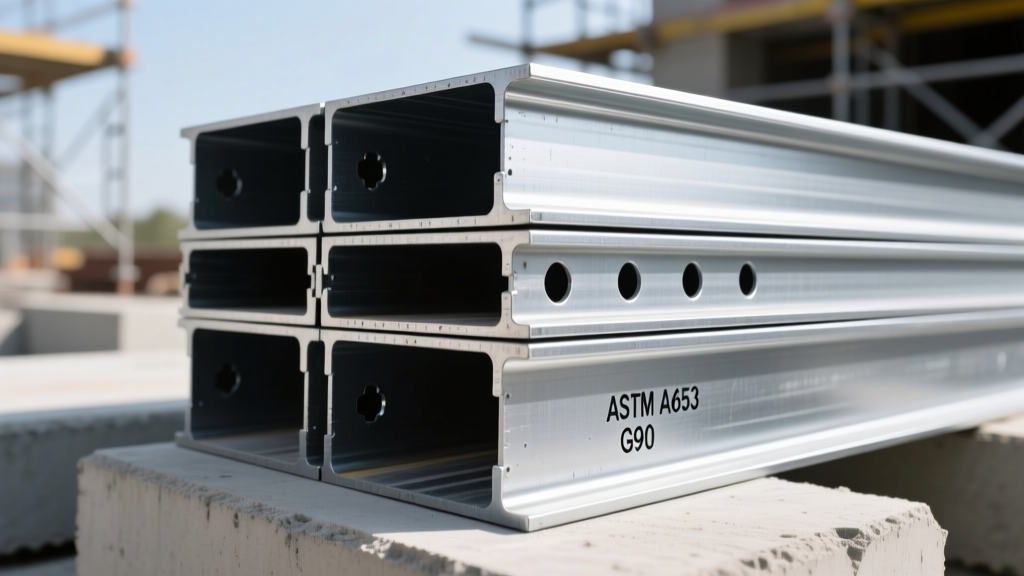
The structural grade of the steel framing channel is irrelevant if the member corrodes before the building envelope is sealed. Galvanization is governed by ASTM A653. The coating is designated by the weight of zinc applied to both sides of the sheet steel per square foot.
- G60 (0.60 oz/sq ft): The standard for interior, climate-controlled environments. It provides adequate protection against ambient humidity during the construction phase and interior service life.
- G90 (0.90 oz/sq ft): Mandatory for exterior load-bearing walls, parapets, and any channel embedded in or touching concrete foundations. The thicker zinc layer sacrifices itself (galvanic protection) to prevent red rust when exposed to moisture and alkaline concrete environments.
According to ClarkDietrich technical documentation, using G60 channels in exterior cavity walls can lead to premature section loss, particularly at the punch-outs where the raw, uncoated steel edge is exposed to condensation. Always specify G90 for any steel framing channel located outboard of the vapor barrier.
Fastener Compatibility and the 'Screw Spin' Phenomenon
Upgrading to higher-grade or thicker steel framing channels introduces significant field challenges regarding fasteners. When framing crews attempt to attach 54-mil (16 ga) or 68-mil (14 ga) Grade 50 channels using standard #8 or #10 self-piercing screws, they frequently encounter 'screw spin'—where the drill point burns out the hole before the threads can bite, stripping the connection.
Field Protocol for Thick/High-Grade Channels:
- Use Self-Drilling Tek Screws: For any channel 54 mils or thicker, abandon self-piercing screws. Use #12 or #14 self-drilling screws with a #3 or #4 drill point (e.g., a 12-24 x 1-1/4" HWH Unslotted Tek).
- Pre-Punching for Track Connections: When nesting 68-mil studs into 68-mil tracks, the combined thickness at the flange joint exceeds 130 mils. Pneumatic pin tools or pre-drilling with a 1/8" cobalt bit is required before driving fasteners.
- High-Strength (Grade 97) Caution: Grade 97 steel is exceptionally hard. Standard bi-metal drill bits will overheat and snap. Framers must use cobalt-tipped or specialized hardened-steel drill points, which increases labor time by approximately 15-20% per connection.
2026 Cost Analysis: Grade and Gauge Economics
Material optimization requires balancing the cost per linear foot against the installed labor cost. While Grade 97 steel allows engineers to specify thinner (and theoretically lighter/cheaper) sections, the field labor required to cut and fasten ultra-high-strength steel often negates the material savings.
"The most cost-effective steel framing channel for mid-rise load-bearing construction in 2026 remains the 43-mil and 54-mil Grade 50 C-section. It offers the optimal intersection of mill availability, roll-forming consistency, and field-driven fastener compatibility without requiring specialized cutting blades."
| Channel Profile (Web x Flange) | Grade 33 Cost / LF | Grade 50 Cost / LF | Delta & Justification |
|---|---|---|---|
| 362S162 (43 mils / 18ga) | $1.15 - $1.30 | $1.25 - $1.45 | ~9% premium for Grade 50; universally justified for structural integrity. |
| 600S162 (54 mils / 16ga) | N/A (Rarely milled) | $2.10 - $2.45 | Grade 50 is mandatory at this depth to prevent flange buckling. |
| 800S250 (68 mils / 14ga) | N/A | $3.80 - $4.50 | Heavy structural; requires G90 coating and specialized fasteners. |
Troubleshooting Common Grade-Related Failure Modes
When the specified steel framing channel grade or thickness does not match the field conditions, specific mechanical failures occur during or immediately after construction.
- Web Crippling at Sill Tracks: Occurs when point loads (like roof truss heels) bear directly on the unsupported web of a thin (33-mil) channel. Fix: Install web stiffeners (clip angles) or upgrade the localized channel to 68-mil Grade 50.
- Flange Local Buckling: Visible as a wavy deformation along the lip return of the stud. This happens when deep, thin-walled studs (e.g., 800S at 43 mils) are subjected to compression without adequate lateral bracing from gypsum sheathing or strap bracing. Fix: Ensure bridging or strap bracing is installed at intervals not exceeding 48 inches on center.
- Galvanic Corrosion at Dissimilar Metals: If a G90 galvanized steel framing channel is bolted directly to unanodized aluminum or copper flashing without a dielectric separator, rapid pitting will occur. Fix: Apply heavy-duty peel-and-stick bituminous membranes between the CFS track and dissimilar substrates.
Procurement Checklist for Contractors
Before releasing a steel framing channel purchase order to the supplier, verify the following data points against the structural drawings:
- Confirm the exact ASTM A1003 grade (33, 50, or 97) for every wall type schedule.
- Verify the design thickness in mils, rejecting any supplier attempts to substitute 'commercial gauge' equivalents which may fall below the minimum structural thickness.
- Check the galvanization coating (G60 vs G90) based on the wall's exposure classification.
- Ensure the punch-out knockouts align with the plumbing and electrical rough-in requirements (standard 1.5" vs. oversized 3.0" utility punch-outs).
- Confirm the lip return depth (typically 0.5" for standard studs, but deeper for high-load track systems) matches the proprietary clip schedules.
Written by
Priya KapoorPriya Kapoor is a real estate market analyst and construction economics researcher with expertise in housing affordability, development feasibility, and infrastructure investment. She holds a Master of Regional Planning from Cornell University and previously worked as a senior analyst at CBRE's Investment Properties group, where she modeled returns for $4B in mixed-use development pipelines. Priya now runs an independent research practice advising developers, municipalities, and REITs on construction cost forecasting and market timing. She publishes the quarterly "BuildMat Market Pulse" report tracking material price indices across 12 commodity categories. Based in Austin, TX, Priya serves on the board of Habitat for Humanity Austin and is a marathon runner.
More from Priya Kapoor
View all
Construction Cost
Cost to Build a 1600 Sq Ft Home in 2026: Full Breakdown
Accurate 2026 cost to build a 1600 sq ft home—material, labor, and regional pricing breakdowns included. Plan your budget with real-time estimates.
Aug 11, 2026

Wood & Lumber
Name the Types of Wood for Pressure Treatment and Preservation
Learn how to name the types of wood best suited for pressure treatment. Compare species treatability, chemical retention levels, and 2026 preservation costs.
Aug 4, 2026

Stone & Masonry
Stone Veneer Suppliers Lindenhurst: 2026 Cost Analysis
Analyze 2026 stone veneer costs in Lindenhurst, NY. Compare local supplier pricing, delivery fees, and Suffolk County installation labor rates.
Aug 4, 2026