Steel Framing Suppliers: 2026 Cost Analysis & Pricing Breakdown
Compare top steel framing suppliers in 2026 with our detailed cost analysis. Discover pricing breakdowns, hidden fees, and procurement strategies.

The 2026 Steel Framing Market: Navigating Supplier Pricing
Procuring cold-formed steel (CFS) and structural steel framing requires more than comparing base material lists. In 2026, the pricing models utilized by steel framing suppliers have shifted from simple per-linear-foot metrics to complex, multi-tiered structures influenced by raw material indexes, regional freight corridors, and fabrication surcharges. For general contractors and estimators, understanding the granular cost drivers between national distributors and regional roll-formers is the difference between a profitable bid and a margin-eroding change order.
This cost analysis deconstructs the current pricing landscape for steel framing suppliers, providing exact baseline costs, hidden fee structures, and a strategic framework for procurement.
The 2026 Steel Framing Supplier Pricing Matrix
The baseline cost of steel studs and tracks fluctuates based on the supplier's scale, proximity to the mill, and inventory holding strategies. The table below outlines the average 2026 pricing for standard architectural and structural framing components across different supplier tiers.
| Supplier Tier | 20ga Non-Load (33ksi) Cost/LF | 16ga Load-Bearing (50ksi) Cost/LF | Avg. Lead Time | Minimum Order Quantity (MOQ) |
|---|---|---|---|---|
| National Distributors (e.g., ClarkDietrich, MarinoWARE) | $1.15 - $1.35 | $2.90 - $3.40 | 3 - 5 Weeks | $15,000 - $25,000 |
| Regional Roll-Formers | $1.05 - $1.25 | $2.75 - $3.15 | 1 - 2 Weeks | $3,000 - $5,000 |
| Direct Mill / Master Coil Buyers | $0.85 - $1.00 | $2.30 - $2.70 | 6 - 8 Weeks | $75,000+ |
Many regional suppliers quote 'bare stud' pricing that excludes standard factory end-dimpling (for track nesting) and web punch-outs for MEP routing. Always verify if the quoted price per linear foot includes standard 1.5-inch knockouts spaced 24 inches on center. Adding post-fabrication punch-outs on-site costs approximately $0.35 to $0.50 per hole in labor, instantly erasing any initial material savings.
Deconstructing the Quote: Hidden Costs in Steel Procurement
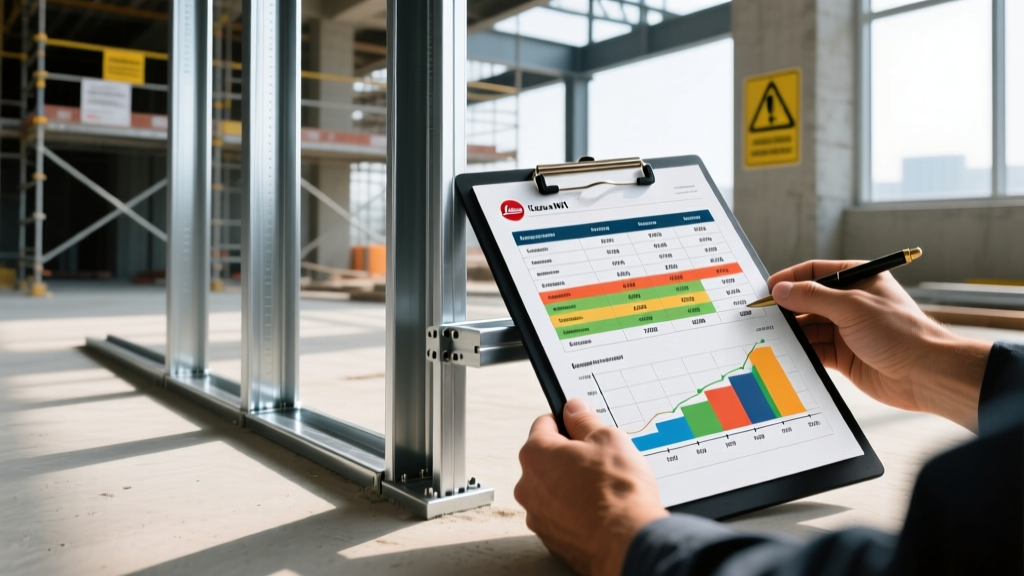
When evaluating bids from steel framing suppliers, the base material cost typically represents only 70% to 80% of the final delivered price. The remaining percentage is composed of ancillary fees that vary wildly between vendors.
Freight and Fuel Surcharges (FSC)
Steel framing is highly voluminous but relatively lightweight, meaning trucks 'cube out' (reach maximum volume) before they 'weigh out' (reach maximum weight limits). Consequently, freight is calculated by cubic volume rather than tonnage. In 2026, expect freight costs to range from $0.12 to $0.28 per linear foot, heavily dependent on the supplier's proximity to the job site. National suppliers often bake a standardized FSC into their base pricing, while regional suppliers itemize it based on current spot diesel prices.
Galvanization Coating Upcharges
Per AISI S200 standards, interior non-load bearing partitions typically require a minimum G40 galvanization coating. However, exterior sheathing backers, shaft walls, and high-moisture areas mandate G60 or G90 coatings. Upgrading from G40 to G60 adds roughly 4% to 6% to the material cost, while G90 (required for direct concrete contact or severe corrosive environments) adds 9% to 14%. Suppliers with in-house galvanizing lines offer these upgrades at a lower premium than those outsourcing the coating process.
Custom Fabrication and Short-Length Fees
Standard stud lengths are 8', 9', 10', and 12'. If your project requires specific lengths (e.g., 9' 4" to accommodate specific floor-to-floor heights without cutting), suppliers will charge a custom cut-to-length fee. This usually manifests as a 10% to 15% upcharge on the base linear foot price, plus a scrap factor for the unusable offcuts. Ordering standard lengths and cutting on-site remains more cost-effective unless the volume exceeds 10,000 linear feet of a single custom dimension.
National vs. Regional Suppliers: A Cost-Benefit Framework
Choosing between a national powerhouse and a local steel framing supplier requires a strategic assessment of your project's timeline, cash flow, and complexity.
When to Choose National Steel Framing Suppliers
- Complex Assemblies: National suppliers stock specialized components like deflection tracks, bypass clips, and acoustic isolation clips that regional roll-formers do not keep in standard inventory.
- Multi-State Rollouts: For retail or hospitality chains building across multiple states, national suppliers provide centralized billing and standardized pricing, eliminating regional bidding discrepancies.
- Technical Support: Firms like ClarkDietrich or Steeler provide in-house engineering support for load-bearing CFS design, which can offset the higher material cost by reducing third-party structural engineering fees.
When to Choose Regional Roll-Formers
- Agile Timelines: Regional suppliers operate with lower overhead and smaller batch runs, allowing them to turn around standard stud and track orders in 3 to 7 days, compared to the 3-5 week lead times of national distributors.
- Just-In-Time Delivery: Urban infill projects with zero laydown space benefit from regional suppliers who can deliver daily 'milk runs' of material directly to the hoist or loading dock, eliminating the need for on-site storage and the associated risk of material damage or theft.
- High-Volume Standard Partitions: For projects consisting primarily of standard 20-gauge, 25-gauge non-load bearing demising walls, regional suppliers offer the lowest absolute cost per linear foot.
Material Grade and Gauge Impact on Bottom-Line Costs
A common error in cost analysis is treating all '16-gauge' steel as financially equal. The yield strength of the steel drastically alters both the material cost and the structural efficiency of the framing.
According to the Steel Framing Industry Association (SFIA), cold-formed steel is categorized by minimum yield strength. Grade 33 (33 ksi) is standard for non-structural applications, while Grade 50 (50 ksi) and Grade 80 (80 ksi) are used for load-bearing walls and trusses.
Opting for 50ksi high-strength steel allows engineers to specify thinner gauges (e.g., using 18-gauge instead of 16-gauge) while maintaining the same axial load capacity. While the 50ksi steel costs approximately 8% more per pound than 33ksi, the reduction in overall material weight often results in a net project savings of 3% to 5% on the total framing package, alongside reduced shipping costs.
Furthermore, verify that the supplier's material complies with ASTM A1003, the standard specification for steel sheet used in cold-formed framing. Substituting non-certified commercial-grade steel might save 5% upfront but will result in failed municipal inspections and rejected submittals.
Strategic Procurement: Locking in Rates in a Volatile Market
Steel prices are tethered to global scrap indexes and iron ore futures. To protect your project margins from mid-build price escalations, implement the following procurement strategies when negotiating with steel framing suppliers:
- Mill-Direct Hedging: For projects exceeding $100,000 in framing materials, bypass distributors and negotiate directly with master coil buyers. You can lock in a coil price based on the current CRU (Commodity Research Unit) index, paying only a fixed roll-forming fee per ton. This isolates your material cost from distributor markup inflation.
- Consignment Stocking: Negotiate a consignment agreement with a regional supplier where they hold your material in their warehouse for up to 60 days post-fabrication without charging storage fees. This protects you from lead-time delays while keeping the material off your balance sheet until it is delivered to the site.
- Scrap Buy-Back Clauses: Include a clause in your supplier contract that mandates the supplier to buy back clean, unpunched CFS offcuts at 40% to 50% of the current scrap index. This recoups a portion of the inevitable waste generated during framing installation.
Frequently Asked Questions
How do I verify the actual thickness of the steel framing delivered?
Suppliers often use 'design thickness' rather than physical measurements. A 16-gauge stud has a minimum design thickness of 0.0547 inches. Always require the supplier to provide mill test reports (MTRs) with your delivery, and use a digital micrometer on-site to verify the bare metal thickness, excluding the galvanized coating, which can add up to 0.002 inches to the measurement.
Are there cost differences between punched and solid web studs?
Yes. Solid web studs (without factory MEP punch-outs) are generally 3% to 5% cheaper per linear foot because they require less roll-forming die maintenance and run faster through the mill. However, the labor cost to drill holes on-site for electrical wiring and plumbing vastly outweighs the material savings. Always order pre-punched studs unless the wall is designated as a sheer wall or fire-rated assembly that specifically prohibits web penetrations.
Written by
Priya KapoorPriya Kapoor is a real estate market analyst and construction economics researcher with expertise in housing affordability, development feasibility, and infrastructure investment. She holds a Master of Regional Planning from Cornell University and previously worked as a senior analyst at CBRE's Investment Properties group, where she modeled returns for $4B in mixed-use development pipelines. Priya now runs an independent research practice advising developers, municipalities, and REITs on construction cost forecasting and market timing. She publishes the quarterly "BuildMat Market Pulse" report tracking material price indices across 12 commodity categories. Based in Austin, TX, Priya serves on the board of Habitat for Humanity Austin and is a marathon runner.
More from Priya Kapoor
View all
Construction Cost
Cost to Build a 1600 Sq Ft Home in 2026: Full Breakdown
Accurate 2026 cost to build a 1600 sq ft home—material, labor, and regional pricing breakdowns included. Plan your budget with real-time estimates.
Aug 11, 2026

Wood & Lumber
Name the Types of Wood for Pressure Treatment and Preservation
Learn how to name the types of wood best suited for pressure treatment. Compare species treatability, chemical retention levels, and 2026 preservation costs.
Aug 4, 2026

Stone & Masonry
Stone Veneer Suppliers Lindenhurst: 2026 Cost Analysis
Analyze 2026 stone veneer costs in Lindenhurst, NY. Compare local supplier pricing, delivery fees, and Suffolk County installation labor rates.
Aug 4, 2026