Steel Framing Tools: Protecting Galvanized Coats From Rust
Discover how your choice of steel framing tools impacts galvanized coating integrity and learn exact post-cut corrosion protection protocols.

The Hidden Corrosion Risk in Light Gauge Steel Framing
Light gauge steel framing (LGSF) is inherently immune to rot, termites, and warping, but it possesses one critical vulnerability: corrosion. The structural longevity of a steel stud relies entirely on its continuous hot-dip galvanized zinc coating—typically graded as G60 (0.60 ounces per square foot) for interior walls or G90 (0.90 ounces per square foot) for exterior and high-moisture applications. This zinc layer acts as a sacrificial anode, corroding preferentially to protect the underlying carbon steel.
However, the moment a contractor makes a single cut or drills a hole, that continuous barrier is breached. The specific steel framing tools used to modify these members dictate the severity of the coating damage and the subsequent rust risk. Understanding the metallurgical impact of your cutting and fastening tools is not just a matter of efficiency; it is a fundamental requirement for structural durability and code compliance in modern construction.
The Metallurgy of the Cut: Thermal vs. Mechanical Destruction
Zinc melts at a relatively low 787°F (419°C) and vaporizes at 1,665°F (907°C). When you use high-speed friction tools to cut steel studs, the localized heat easily exceeds these thresholds, creating a Heat-Affected Zone (HAZ) where the zinc is entirely burned away or alloyed into brittle iron-zinc intermetallic compounds that offer zero cathodic protection.
Using standard abrasive chop saws (equipped with aluminum oxide or silicon carbide cutoff wheels) is the leading cause of premature field corrosion in steel framing. The friction generates extreme heat, leaving a 1/4-inch to 1/2-inch bare steel HAZ on both sides of the cut. If left untreated in an exterior wall cavity, red rust will penetrate the 16-gauge stud thickness within 3 to 5 years.
To preserve the galvanized barrier, modern framing crews must transition from thermal cutting to mechanical cutting. Mechanical shearing or cold-cutting removes material without raising the ambient temperature of the steel above the zinc melting point, preserving the coating right up to the microscopic edge of the cut.
Steel Framing Tools Comparison: Corrosion Impact Matrix
| Tool Category | Specific Model Example | Heat Generation | Zinc Coating Damage | Post-Cut Protection Required |
|---|---|---|---|---|
| Abrasive Chop Saw | DeWalt D28730 | Extreme (>1000°F) | Severe (HAZ burns off zinc) | Heavy grinding & cold galvanizing |
| Cold-Cutting Miter Saw | Evolution S380CPS | Low (<300°F) | Minimal (Edge only) | Light zinc-rich spray touch-up |
| Electric Nibbler/Shear | Bosch GSC 18V-16 | None | None (Coating wraps edge) | None required |
| Aviation Snips (Manual) | Malco M2006 Max2000 | None | None (Mechanical shear) | None required |
| Reciprocating Saw | Milwaukee M18 FUEL (Bi-Metal) | Moderate | Moderate (Friction heat) | Zinc-rich spray touch-up |
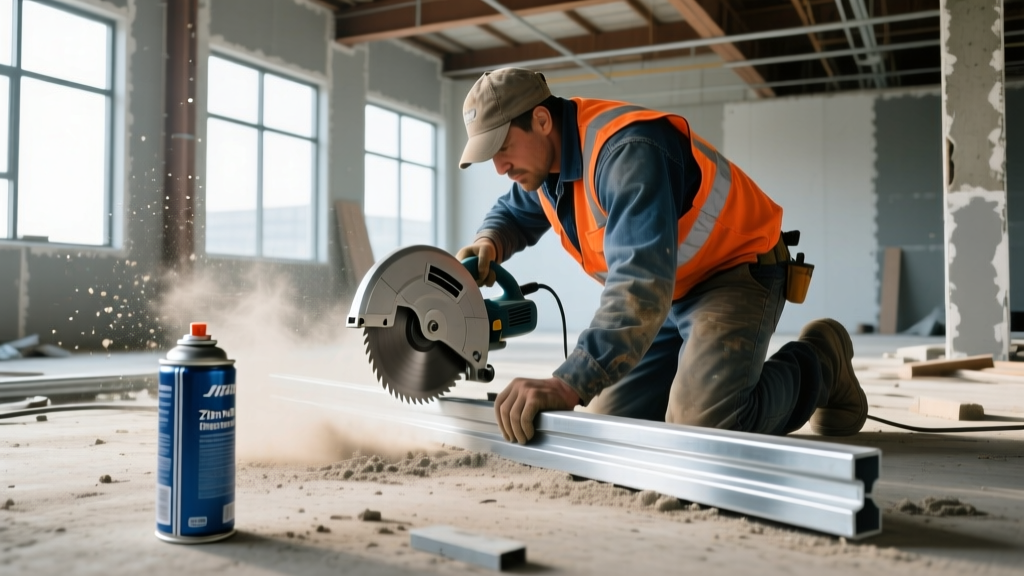
Fastening Tools and the Micro-Corrosion Threat
Cutting is an obvious breach, but fastening introduces micro-corrosion risks that are frequently overlooked. The drill point of a self-drilling screw must penetrate the zinc coating and the steel substrate. If the drill point generates excessive friction heat, it can micro-burn the zinc layer immediately surrounding the screw head, creating a capillary channel for moisture.
Choosing the Right Fasteners and Screw Guns
To mitigate fastener-induced corrosion, the tool's RPM must be matched to the fastener's geometry. Using a high-torque, variable-speed screw gun (like the Simpson Strong-Tie Quik Drive system) set between 1,800 and 2,500 RPM ensures the self-drilling point clears the steel before the threads engage, minimizing dwell time and friction heat.
Furthermore, specify fasteners with advanced corrosion-resistant coatings rather than standard zinc plating. For exterior or high-humidity assemblies, utilize screws featuring a zinc-aluminum flange coating (such as Buildex Stalgard or TekS lines) which provide up to 1,000 hours of salt-spray resistance compared to the 50-hour resistance of standard electroplated screws. The mating surface of the screw head must also feature a neoprene or EPDM washer to mechanically seal the micro-breach in the stud's galvanized layer.
Post-Cut Protection Protocols: The Cold Galvanizing Process
Even with the best cold-cutting steel framing tools, the raw edge of the steel is exposed. According to guidelines from the Steel Framing Industry Association (SFIA), all exposed cuts, welds, and drilled holes in load-bearing galvanized steel must be repaired in the field to restore the sacrificial anode protection.
Do not use standard rust-inhibitive primers (like red oxide) or generic spray paints. These act only as barrier coats and will fail if scratched. You must use a true zinc-rich compound containing a minimum of 90% zinc dust in the dry film, which provides active galvanic protection identical to the original hot-dip coating.
- ZRC Cold Galvanizing Compound: 95% zinc dust in dry film. Industry standard for structural repairs.
- Rust-Oleum Professional 10607: 93% pure zinc in dry film. Excellent for aerosol application in tight stud cavities.
- Thurmalox 245: High-performance zinc silicate for high-heat or extreme moisture environments.
Step-by-Step Field Repair Protocol
Follow the surface preparation standards outlined by the Society for Protective Coatings (SSPC), specifically SSPC-SP2 (Hand Tool Cleaning), to ensure the cold galvanizing compound bonds correctly to the steel substrate.
- Deburr and Clean: Use a wire brush or abrasive pad to remove any slag, burrs, or white rust (zinc oxide) from the cut edge. The edge must be bare, bright metal.
- Solvent Wipe: Wipe the exposed edge and 1/2-inch of the surrounding galvanized coating with a clean rag dampened with xylene or acetone to remove cutting oils and finger oils. Allow to flash off completely.
- Agitate the Compound: Zinc dust is extremely heavy and settles at the bottom of the can. Shake aerosol cans for a full two minutes after the mixing ball rattles. If using a brushable liquid, use a mechanical stirrer until no heavy sludge remains at the bottom.
- Apply to Target Mil Thickness: Apply the zinc-rich paint to the cut edge and overlap onto the existing galvanized coating by at least 1/2 inch. The target dry film thickness (DFT) is 2.5 to 3.0 mils. This usually requires two medium coats rather than one heavy coat, which can run and leave the top edge thin.
Job Site Storage and Cross-Contamination Risks
Corrosion protection extends beyond the tools used to cut the steel; it encompasses how the steel is stored and handled around those tools. A common failure mode in 2026 construction sites is "contact corrosion" or bimetallic cross-contamination.
If a contractor uses an abrasive saw to cut mild steel lintels, uncoated steel brackets, or threaded rod in the same immediate area where galvanized steel studs are staged, the airborne iron dust will settle on the galvanized framing. When moisture is introduced (from humidity, rain, or drywall mud), this iron dust acts as a cathode, accelerating the localized corrosion of the zinc coating beneath it.
Best Practices for Material Preservation
- Segregate Cutting Stations: Establish a dedicated "black steel" cutting zone at least 30 feet away from the galvanized framing staging area, preferably downwind.
- Prevent Wet Storage Stain: Galvanized steel requires atmospheric oxygen to form the stable zinc carbonate patina. If studs are stacked tightly in bundles and exposed to rain or condensation, the trapped moisture cannot evaporate, leading to "white rust" (zinc hydroxide). While white rust is mostly cosmetic, severe cases can deplete the zinc layer. Always store bundles elevated on dunnage and covered with breathable tarps, never sealed in non-breathable polyethylene.
- Tool Maintenance: Regularly clean the guards and tables of your cold-cutting miter saws. Accumulated metal shavings from previous cuts can become embedded in the zinc coating of subsequent studs when pressure is applied during the clamping process, creating microscopic rust initiation sites.
Summary: The Tool-Durability Connection
The durability of a light gauge steel structure is only as strong as its most compromised galvanized edge. By retiring abrasive thermal saws in favor of cold-cutting carbide blades and electric shears, contractors drastically reduce the size of the Heat-Affected Zone. When paired with rigorous SSPC-compliant field repairs using 90%+ zinc-rich compounds and proper fastener selection, the structural steel remains entirely encapsulated in its sacrificial armor. Investing in the correct steel framing tools is not merely an equipment expense; it is a direct investment in the multi-decade corrosion resistance of the building envelope.
For further technical specifications on cold-formed steel design and coating requirements, refer to the American Iron and Steel Institute (AISI) Cold-Formed Steel Design Manual, which provides the foundational engineering standards for coating thickness and structural degradation allowances in modern framing.
Written by
David NakamuraDavid Nakamura is a licensed architect (AIA) and construction technology writer focused on sustainable building methods, mass timber engineering, and high-performance building envelopes. He holds a Master of Architecture from the University of Washington and is a certified Passive House Consultant (CPHC). David spent eight years at the Seattle firm Mithun, where he led the design of three LEED Platinum projects, before founding his own practice specializing in net-zero residential design. He serves on the editorial advisory board of GreenBuilder Magazine and has authored peer-reviewed papers on cross-laminated timber (CLT) connections for the Journal of Structural Engineering. In his spare time, David teaches woodworking at Pratt Fine Arts Center and kayaks the Puget Sound.
More from David Nakamura
View all
Construction Cost
Labor Cost to Build a Deck Per Sq Ft: 2026 Installation Guide
Discover the exact labor cost to build a deck per sq ft in 2026. This installation guide breaks down contractor rates, complexity factors, and hidden fees.
Aug 4, 2026

Construction Cost
How Much Does It Cost to Build a 3 Bedroom House? Financing Guide
Learn exactly how much it costs to build a 3 bedroom house and explore 2026 financing options, construction loan types, and budget frameworks for your build.
Aug 4, 2026

Construction Cost
Cost to Build a Tennis Court: 2026 Guide
How much does it cost to build a tennis court in 2026? Breakdowns for asphalt, concrete, and synthetic surfaces plus fencing and lighting.
Jul 30, 2026