Best Type of Wood for Framing: Lumber Grades Explained
Discover the best type of wood for structural framing. Compare DF-L, SYP, and SPF lumber grades, moisture content, and structural design values.

The Myth of a Single "Best" Wood in Construction
When builders and architects ask for the best type of wood for structural framing, the question fundamentally misunderstands how modern timber engineering works. In light-frame and heavy-timber construction, the biological species of the tree is secondary to its lumber grade and design values. A No. 1 graded Spruce-Pine-Fir (SPF) stud will routinely outperform a No. 3 graded Douglas Fir-Larch (DF-L) in load-bearing capacity.
To select the optimal framing lumber, you must shift your focus from generic species names to the standardized grading rules established by agencies like the Western Wood Products Association (WWPA) and the Southern Pine Inspection Bureau (SPIB). These grades dictate the allowable fiber stress in bending (Fb) and modulus of elasticity (E), which directly govern your span limits and structural safety margins.
Decoding the Lumber Grade Stamp: Your Quality Blueprint
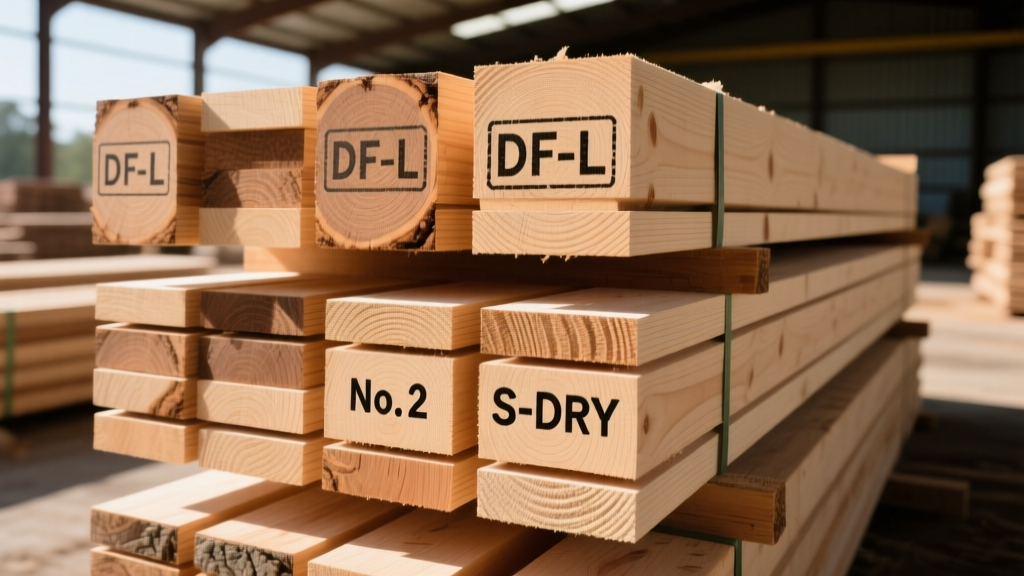
Every piece of dimensional lumber stamped for structural use carries a localized ink brand that serves as its engineering passport. Misreading this stamp is one of the most common causes of framing failures and inspection rejections. Here is the exact anatomy of a structural grade stamp:
- Species Group: Identifies the wood. Common stamps include DF-L (Douglas Fir-Larch), SYP (Southern Yellow Pine), SPF (Spruce-Pine-Fir), and Hem-Fir (Hemlock-Fir).
- Grade Designation: Ranges from Select Structural (highest strength, minimal defects) down to No. 1, No. 2 (the industry standard for framing), No. 3, and Stud (specifically graded for vertical load-bearing walls, not horizontal spans).
- Moisture Condition: Stamped as S-GRN (Green, >19% moisture content), S-DRY (Dry, ≤19% MC), or KD / KD-HT (Kiln-Dried, ≤15% MC).
- Grading Agency & Mill ID: The logo of the supervising agency (e.g., WWPA, SPIB, NLGA) and a numeric mill identifier for traceability.
Species Showdown: Structural Design Values Matrix
According to the American Wood Council's design value tables, the "best" wood depends entirely on the structural demand of your specific framing member. Below is a comparison of the baseline allowable design properties for the three most common framing species groups at the No. 2 grade level (values represent baseline repetitive member design values for 2x4 through 2x6 dimensions).
| Species Group | Grade | Fb (Bending psi) | E (Stiffness psi) | Ideal Application |
|---|---|---|---|---|
| Southern Yellow Pine (SYP) | No. 2 | 1,750 | 1,800,000 | High-shear floor joists, heavily loaded headers |
| Douglas Fir-Larch (DF-L) | No. 2 | 1,500 | 1,900,000 | Long-span roof rafters, beams requiring high stiffness |
| Spruce-Pine-Fir (SPF) | No. 2 | 1,300 | 1,600,000 | Standard vertical wall studs, non-critical interior partitions |
Information Gain: Notice that DF-L has a lower Fb (bending strength) than SYP, but a higher E (stiffness). If you are framing a floor system where preventing "bounce" (deflection) is the primary concern, DF-L is the superior choice. If you are framing a heavily loaded transfer beam or a short-span floor joist where sheer snapping force is the risk, SYP is the best type of wood for the job.
Moisture Content: The Hidden Driver of Framing Failures
The physical dimensions of lumber change as it equilibrates with the ambient relative humidity. Selecting the wrong moisture grade leads to catastrophic finishing defects, drywall cracking, and structural fastener withdrawal.
S-GRN (Green) vs. S-DRY (Dry)
Lumber stamped S-GRN was surfaced at a moisture content above 19%. This wood is cheaper and commonly used in exterior framing or concrete formwork. However, as S-GRN lumber dries in a heated interior environment, it shrinks. Southern Yellow Pine shrinks approximately 1/4 inch per 10 inches of depth when drying from 30% to 15% moisture content. If you use S-GRN 2x10 floor joists, expect the floor system to drop by nearly 1/4 inch as it dries, which will tear drywall seams and misalign door jambs.
Visual Defect Tolerances: Where Quality Degrades
The USDA Forest Products Laboratory Wood Handbook outlines exactly how visual defects impact structural grading. A piece of wood is downgraded based on the size, location, and frequency of these natural flaws:
- Slope of Grain: The angle of the wood fibers relative to the longitudinal axis of the board. A slope of 1-in-10 is generally the maximum allowed for No. 2 grade. Steeper slopes drastically reduce the Fb value, making the board prone to snapping under bending loads.
- Edge Knots vs. Center Knots: Knots located on the narrow edge of a 2x4 are far more detrimental to bending strength than knots located in the center of the wide face. Select Structural grades severely restrict edge knots, whereas No. 2 permits them within specific diameter limits.
- Wane: The presence of bark or missing wood on the corners of the board. While wane does not significantly impact the structural strength of the wood fiber, excessive wane reduces the nailing surface area, compromising the shear capacity of plywood or OSB sheathing attached to the framing.
Practical Decision Framework: Matching Grade to Application
Stop guessing and use this framework to specify the correct lumber for your next project phase:
- Exterior Wall Studs (Single-Story): SPF Stud Grade, S-DRY. Cost-effective, perfectly adequate for vertical axial loads, and minimizes thermal bridging due to lower wood density.
- Interior Load-Bearing Walls (Multi-Story): DF-L or SYP No. 2, S-DRY. Requires higher compressive strength perpendicular and parallel to the grain to support stacked floor loads.
- Long-Span Floor Joists (14'+ spans): DF-L No. 1 or Select Structural, S-DRY. The high Modulus of Elasticity (E) prevents floor vibration and limits long-term creep deflection.
- Concrete Formwork & Scaffolding: SYP No. 3 or S-GRN. High impact resistance, moisture tolerance, and lower cost make it ideal for temporary, reusable structural applications.
Frequently Asked Questions
What does the "KD-HT" stamp mean on my lumber?
KD-HT stands for Kiln-Dried and Heat-Treated. The heat treatment (HT) indicates the wood was heated to a core temperature of 56°C for at least 30 minutes to kill wood-boring pests, complying with ISPM 15 international shipping regulations. It does not inherently change the structural grade, but it guarantees a low moisture content (usually under 15%), making it excellent for precision interior framing.
Can I mix SPF and DF-L in the same structural floor system?
No. Mixing species groups in a continuous structural diaphragm or floor system creates differential stiffness. Because DF-L has a higher E value than SPF, the DF-L joists will carry a disproportionate amount of the load, leading to localized overstressing and potential sequential failure across the floor deck. Always maintain species and grade uniformity within a single structural plane.
Is engineered lumber (LVL/I-Joists) better than solid sawn lumber?
For long spans (over 18 feet) and heavy point loads, engineered wood products like Laminated Veneer Lumber (LVL) and I-joists vastly outperform solid sawn lumber. They are manufactured to eliminate natural defects like knots and slope of grain, offering predictable, uniform design values that solid wood cannot match at those dimensions.
Written by
Priya KapoorPriya Kapoor is a real estate market analyst and construction economics researcher with expertise in housing affordability, development feasibility, and infrastructure investment. She holds a Master of Regional Planning from Cornell University and previously worked as a senior analyst at CBRE's Investment Properties group, where she modeled returns for $4B in mixed-use development pipelines. Priya now runs an independent research practice advising developers, municipalities, and REITs on construction cost forecasting and market timing. She publishes the quarterly "BuildMat Market Pulse" report tracking material price indices across 12 commodity categories. Based in Austin, TX, Priya serves on the board of Habitat for Humanity Austin and is a marathon runner.
More from Priya Kapoor
View all
Construction Cost
Cost to Build a 1600 Sq Ft Home in 2026: Full Breakdown
Accurate 2026 cost to build a 1600 sq ft home—material, labor, and regional pricing breakdowns included. Plan your budget with real-time estimates.
Aug 11, 2026

Wood & Lumber
Name the Types of Wood for Pressure Treatment and Preservation
Learn how to name the types of wood best suited for pressure treatment. Compare species treatability, chemical retention levels, and 2026 preservation costs.
Aug 4, 2026

Stone & Masonry
Stone Veneer Suppliers Lindenhurst: 2026 Cost Analysis
Analyze 2026 stone veneer costs in Lindenhurst, NY. Compare local supplier pricing, delivery fees, and Suffolk County installation labor rates.
Aug 4, 2026