The Best Type of Wood for Baseball Bats: Treatment & Preservation
Discover the best type of wood for baseball bats and learn expert treatment and preservation techniques to maximize durability and moisture control.

The Intersection of Wood Anatomy and Bat Preservation
When evaluating the best type of wood for baseball bats, most discussions center on barrel hardness, trampoline effect, and swing weight. However, from a materials science perspective, the true differentiator between a bat that lasts a season and one that shatters on first contact lies in treatment, preservation, and moisture management. Wood is a hygroscopic material; it continuously exchanges moisture with its environment. A baseball bat is essentially a highly engineered wooden lever subjected to extreme kinetic impacts (up to 8,000 pounds of force on the barrel). If the cellular structure of the wood is not properly treated and preserved, catastrophic shear failure is inevitable.
Preserving a wooden baseball bat requires a deep understanding of its anatomical classification—specifically whether it is ring-porous or diffuse-porous—and applying targeted kiln-drying, surface compression, and sealing protocols to lock in the optimal moisture content (MC).
Evaluating the Best Type of Wood for Baseball Bats
The professional and high-level amateur baseball landscape is dominated by three primary species. Each requires a distinctly different preservation approach due to its unique cellular structure.
Sugar Maple (Acer saccharum): The Diffuse-Porous Standard
Sugar maple is currently the most popular wood in the major leagues. As a diffuse-porous wood, its vascular cells (pores) are uniform in size and distributed evenly throughout the growth ring. This gives maple exceptional surface hardness (Janka rating of ~1,450 lbf) and prevents the flaking associated with ash. However, maple is highly unforgiving. According to the USDA Forest Products Laboratory Wood Handbook, diffuse-porous woods lose their impact resistance rapidly if their moisture content drops too low. If maple dries below 8% MC, the hemicellulose becomes brittle, leading to the dangerous, multi-piece shattering that forced Major League Baseball to intervene in 2008.
Northern White Ash (Fraxinus americana): The Ring-Porous Traditionalist
Ash is a ring-porous wood, characterized by large earlywood vessels and dense latewood bands. This anatomical difference gives ash its legendary flexibility and "whip" through the strike zone (Janka ~1,320 lbf). The preservation challenge with ash is flaking. When the lignin binding the earlywood and latewood dries out, the growth rings begin to delaminate upon impact. Ash requires a slightly higher target MC (10-12%) and must never be over-dried in the kiln.
Yellow Birch (Betula alleghaniensis): The Hybrid Alternative
Yellow Birch (Janka ~1,260 lbf) offers the hardness of maple with a flex profile closer to ash. Birch is highly susceptible to surface denting early in its lifespan. Its preservation protocol relies heavily on mechanical surface compression (bone rubbing) to artificially harden the outer cell layers before the bat sees live pitching.
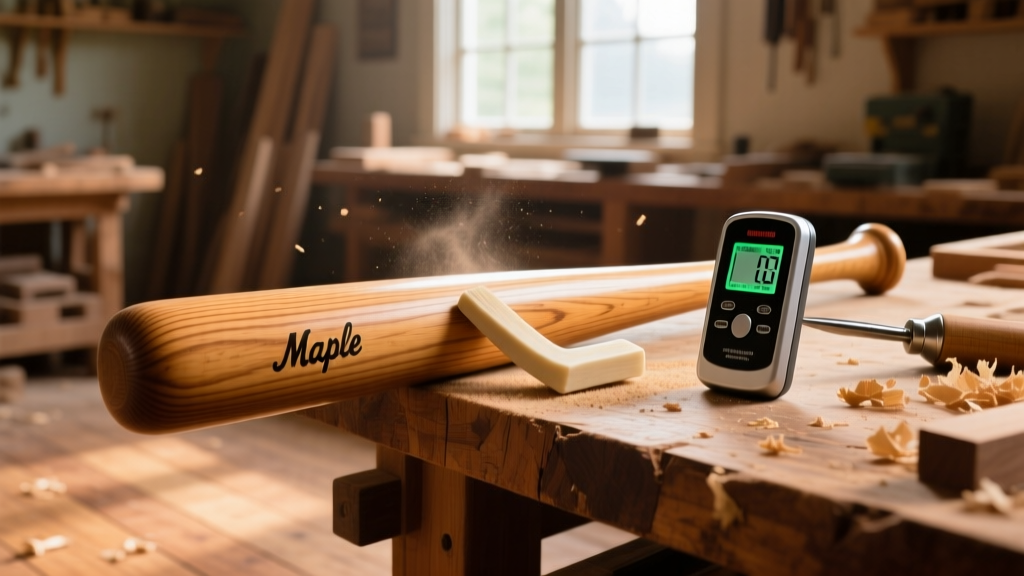
For professional-grade maple and birch bats, the target Moisture Content (MC) is strictly 8.0% to 10.0%. For ash, the target is 10.0% to 12.0%. Bats measuring above 12% MC will feel "dead" and lose exit velocity, while bats below 8% MC become brittle projectiles. Always verify MC with a pinless dielectric moisture meter calibrated for the specific wood density.
Treatment and Preservation Protocols by Species
Manufacturing a bat on a CNC lathe is only half the process. The treatment phase dictates the structural integrity of the final product.
1. Kiln Drying and Acclimatization
Billets (the raw wooden blanks) must be kiln-dried using a carefully controlled schedule. Rapid drying causes honeycomb checking (internal splitting). For maple, a dehumidification kiln set to 110°F with a slow humidity drawdown over 30 to 45 days is standard. Once milled into the final bat shape, the raw wood must acclimatize in a climate-controlled room (45% Relative Humidity, 70°F) for 7 to 14 days to relieve internal turning stresses before any finish is applied.
2. Bone Rubbing and Surface Compression
Bone rubbing is a historical treatment that remains vital for preserving ash and birch bats. By vigorously rubbing the barrel with a hardened animal bone or polished steel rod, the wood's lumen (cell cavities) are physically compressed without adding foreign chemicals. This mechanical treatment closes the surface pores, increasing the localized Janka hardness of the barrel by up to 15% and creating a natural barrier against ambient moisture absorption. According to research on wood modification from Penn State Extension, mechanical compression of wood fibers significantly reduces the rate of hygroscopic moisture exchange.
3. Cupping and End-Grain Sealing
Cupping removes 0.5 to 1.5 ounces of weight from the barrel end to optimize the swing weight distribution. However, cupping exposes the end-grain. Wood absorbs and releases moisture through the end-grain 50 times faster than through the radial or tangential faces. If left untreated, a cupped bat will rapidly absorb field humidity, altering its weight and balance. Preservation requires sealing the cupped end with a specialized wax emulsion (like Anchorseal) or a cyanoacrylate wood hardener before the final topcoat is applied.
Preservation Needs: Species Comparison Matrix
| Wood Species | Target MC (%) | Primary Failure Mode | Optimal Finish Treatment |
|---|---|---|---|
| Sugar Maple | 8.0% - 10.0% | Catastrophic shattering (brittle shear) | High-gloss Polyurethane (moisture lock) |
| Northern White Ash | 10.0% - 12.0% | Ring delamination (flaking) | Raw or Light Linseed Oil (maintains flex) |
| Yellow Birch | 9.0% - 11.0% | Surface denting and early compression | Bone-rubbed + Satin Polyurethane |
Advanced Preservation: The MLB Ink Dot and Humidor Storage
For maple and birch, preservation begins before the lathe even spins. Major League Baseball mandates the "Ink Dot Test" for all diffuse-porous bats. A drop of ink is placed on the face-grain of the handle; it bleeds along the medullary rays, revealing the exact slope of the grain. MLB rules dictate a maximum grain slope of 1:20 (a 3-degree deviation). Bats with steeper grain slopes possess continuous longitudinal weak points that no amount of surface sealing can fix. The ink dot ensures that only structurally sound, straight-grained billets enter the treatment pipeline.
"Wood is an orthotropic material, meaning its mechanical properties differ in the longitudinal, radial, and tangential directions. Impact resistance is highest along the longitudinal grain. When a bat strikes a ball on the edge-grain (quarter-sawn) rather than the face-grain (flat-sawn), the radial shear strength is maximized, significantly reducing the risk of breakage in preserved maple bats."
Humidor Storage for Active Players
Once a bat is treated and finished, environmental preservation is the responsibility of the player. Leaving a polyurethane-sealed maple bat in the trunk of a car in 95°F heat, or in a damp dugout, will cause the wood inside the finish to expand and contract, eventually causing the finish to micro-crack. Once micro-cracks form, moisture infiltrates the end-grain and handle. Serious players store their game-day bats in a dedicated wooden humidor or a climate-controlled lockbox maintained at 50% Relative Humidity (RH). This stabilizes the equilibrium moisture content (EMC) and preserves the factory-calibrated swing weight.
Troubleshooting Common Wood Bat Failures
Even with the best type of wood for baseball bats and meticulous treatment, failures occur. Understanding the failure mode tells you which preservation step was compromised:
- Handle Snap (Clean Break): Usually caused by an improper grain slope (failed ink dot test) or the player consistently hitting off the wrong face of the bat (edge-grain vs. face-grain). Not a preservation failure, but a structural/user error.
- Barrel Shattering (Multi-piece): Indicates the maple or birch was over-dried in the kiln (MC below 8%) or stored in an excessively dry, heated indoor environment during the winter, destroying the hemicellulose elasticity.
- Surface Flaking/Peeling: Common in ash bats that were finished with a hard polyurethane instead of an oil-based penetrant. The rigid finish restricts the natural flex of the ring-porous ash, causing the finish and the top layer of earlywood to peel off upon impact.
- End-Grain Checking (Splitting at the knob or cup): The cupped end or knob was not properly sealed with an end-grain sealer before the topcoat, allowing rapid moisture cycling that splits the wood longitudinally.
Expert Sourcing and Final Recommendations
Selecting the best type of wood for baseball bats ultimately depends on the player's swing mechanics and the manufacturer's treatment capabilities. If you prioritize maximum exit velocity and a stiff feel, choose a Sugar Maple bat, but ensure it features a high-gloss polyurethane finish and is stored in a climate-controlled environment to prevent brittle shattering. If you rely on bat speed, whip, and a larger sweet spot, opt for Northern White Ash, ensuring it is treated with a flexible oil finish to prevent ring delamination. Regardless of the species, always verify the manufacturer's kiln-drying protocols and insist on bats that have passed the strict 1:20 slope-of-grain ink dot verification. Proper preservation is not just about extending the life of the bat; it is a critical safety measure that ensures the wood fails predictably rather than explosively.
Written by
Elena RodriguezElena Rodriguez is a civil engineer and technical writer specializing in concrete technology, masonry systems, and ASTM/ACI compliance. She earned her B.S. in Civil Engineering from Texas A&M University and spent a decade at a materials testing laboratory, performing over 2,000 concrete compressive strength tests and masonry prism evaluations. Elena is an ACI-certified Field Testing Technician (Grade I) and a member of ASTM Committee C12 on Natural Building Stone. She currently consults on forensic engineering cases involving concrete failures and moisture intrusion. Based in San Antonio, TX, Elena is a proud member of the Society of Women Engineers (SWE) and coaches her daughter's FIRST Robotics team.
More from Elena Rodriguez
View all
Walls & Panels
Cost Analysis: Light Gauge Steel Framing Advantages and Disadvantages
Evaluate light gauge steel framing advantages and disadvantages through a strict cost analysis lens, comparing material, labor, and lifecycle expenses.
Aug 4, 2026

Walls & Panels
Gypsum Board Types: Exact Specifications, Thickness & Dimensions
Compare standard, Type X, and moisture-resistant gypsum board types. Get exact specifications, thicknesses, dimensions, and ASTM standards for your project.
Aug 4, 2026

Fire Resistance
Best Fire-Resistant Outdoor Decking Materials: 2026 Buyer Guide
Discover the best fire-resistant outdoor decking materials for 2026. Compare Class A PVC, aluminum, and hardwood options for WUI compliance and safety.
Aug 4, 2026