What Type of Wood Is Best for Cooking Utensils? A Structural Guide
Discover what type of wood is best for cooking utensils by analyzing micro-structural integrity, mechanical load limits, and thermal stability.

The Micro-Structural Anatomy of Food-Safe Timber
When evaluating what type of wood is best for cooking utensils, most consumer guides focus solely on aesthetics or basic toxicity. However, from a structural engineering and materials science perspective, a wooden spoon or spatula is a micro-structural tool subjected to intense cantilever bending, thermal shock, and chemical exposure. The primary structural determinant for culinary wood is its porosity and capillary anatomy.
Woods are broadly categorized into diffuse-porous (closed-grain) and ring-porous (open-grain) structures. According to anatomical data compiled by The Wood Database, diffuse-porous species like Hard Maple and Cherry feature tightly packed, microscopic xylem vessels. This closed-grain structure prevents moisture, food particles, and bacteria from penetrating the wood's subsurface layers via capillary action. Conversely, ring-porous woods like Red Oak possess large, open earlywood vessels that act as microscopic straws, trapping organic matter and creating a structural liability in wet, food-prep environments.
Mechanical Load Limits: Cantilever Bending and Shear Strength
A cooking utensil functions as a cantilever beam. When stirring a dense, high-viscosity mixture—such as sourdough starter, bagel dough, or thick polenta—the handle and neck of the spoon experience significant shear stress and bending moments. If the wood's Modulus of Rupture (MOR) or Janka hardness is insufficient, the utensil will suffer catastrophic structural failure (snapping at the neck) or micro-splintering along the grain.
The USDA Forest Products Laboratory provides benchmark mechanical data for timber species. For culinary applications, a minimum Janka hardness of 900 lbf (pounds-force) is required to resist denting and edge degradation, while an MOR above 10,000 psi ensures the handle can withstand lateral torque without fracturing.
Structural Performance Matrix: Top Culinary Species
| Wood Species | Janka Hardness (lbf) | Modulus of Rupture (psi) | T/R Shrinkage Ratio | Structural Verdict |
|---|---|---|---|---|
| Hard Maple (Sugar) | 1,450 | 15,800 | 1.5 | Optimal bending strength; industry standard. |
| Olive Wood | 2,710 | 14,200 | 1.8 | Extreme surface hardness; brittle under high torque. |
| Teak | 1,155 | 14,600 | 1.5 | High silica content dulls carving tools; excellent moisture resistance. |
| Cherry (American) | 995 | 12,300 | 1.4 | Superior dimensional stability; moderate load capacity. |
| Bamboo (Grass) | 1,380 | 14,500 | N/A (Laminated) | High tensile strength; prone to delamination if adhesives fail. |
Thermal Shock and Dimensional Stability
Wood is hygroscopic, meaning it absorbs and releases moisture from its environment. When a wooden spoon is plunged into boiling water and then left to air dry, it undergoes rapid thermal and moisture cycling. This induces differential shrinkage. Wood shrinks at different rates along three axes: longitudinal (negligible), radial, and tangential.
The Tangential-to-Radial (T/R) shrinkage ratio is a critical metric for utensil longevity. A T/R ratio close to 1.0 indicates uniform shrinkage, minimizing internal tension. Woods with high T/R ratios (above 2.0) are prone to checking (splitting) and warping because the outer growth rings shrink much faster than the inner rings. Cherry and Hard Maple boast exceptionally low T/R ratios, making them highly resistant to the micro-fractures that eventually cause a spoon to split down the bowl.
Top Structural Performers for Culinary Tools
1. Hard Maple (Acer saccharum)
Hard Maple is the undisputed structural champion for commercial and domestic utensils. Its diffuse-porous anatomy is so tight that it resists bacterial ingress without the need for synthetic sealants. With an MOR of 15,800 psi, maple spatulas can scrape the bottom of a cast-iron Dutch oven without flexing or snapping. It is also virtually flavorless and lacks the toxic oils found in exotic species.
2. Olive Wood (Olea europaea)
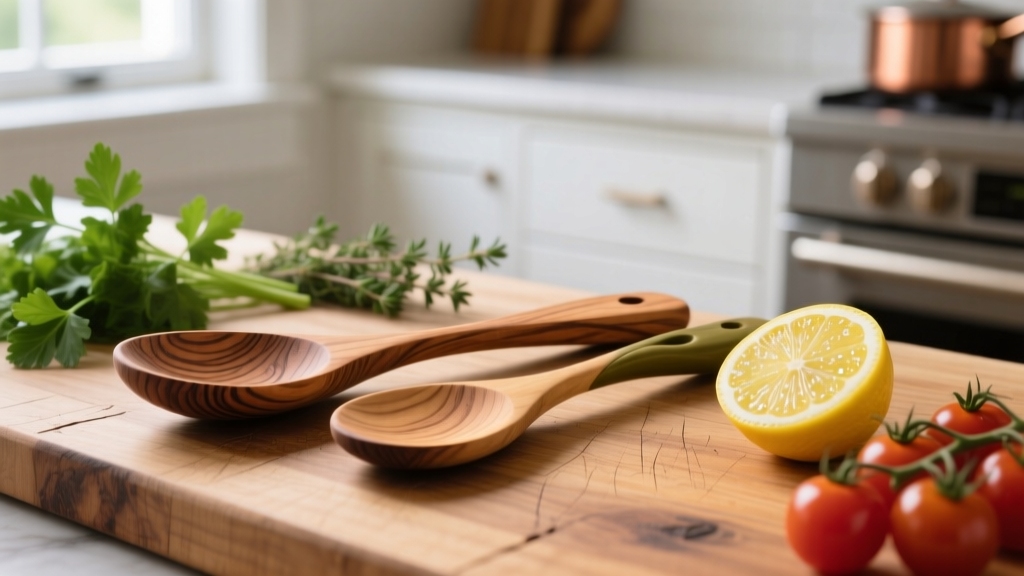
Olive wood offers unparalleled surface density (2,710 lbf Janka), making it highly resistant to knife scarring and staining from acidic foods like tomato sauce. However, its structural limitation lies in its interlocked, irregular grain pattern. While incredibly hard, olive wood can be brittle under extreme lateral torque. It is best utilized for short-handled spoons, tasting spoons, and serving forks rather than long mixing levers.
3. Black Cherry (Prunus serotina)
Cherry is prized by woodcarvers for its predictable grain and low T/R shrinkage ratio. Structurally, it is slightly softer than maple, which makes it an excellent candidate for thin, flexible spatulas designed for delicate tasks like folding egg whites or flipping fragile fish fillets. Over time, cherry oxidizes and darkens, developing a rich patina that also serves as a visual indicator of the wood's polymerized oil finish.
Structural and Toxicological Failures: Woods to Avoid
Selecting the wrong timber introduces both mechanical failure points and biological hazards. The FDA Code of Federal Regulations (Title 21, Part 175) outlines strict parameters for indirect food additives, which extends to the natural resins and finishes used on culinary wood. Avoid the following species entirely:
- Red Oak: Unlike White Oak (which has closed tyloses), Red Oak has open pores that will wick up meat juices and harbor pathogens.
- Pine / Fir (Softwoods): Structurally too soft (Janka ~400 lbf). They dent easily, trap food in the divots, and exude bitter, food-unsafe terpenes and resins when heated.
- Rosewood & Cocobolo: Exotic Dalbergia species contain potent sensitizing oils and quinones that can cause severe allergic reactions and leach into hot, acidic foods.
- Yew & Oleander: Highly toxic. Never use wood from ornamental or poisonous landscaping trees, even if sealed.
Milling and Grain Orientation in Utensil Fabrication
The structural integrity of a wooden spoon is not solely dependent on the species; it is heavily dictated by how the timber is milled. A spoon carved from flat-sawn (face grain) lumber will have growth rings running parallel to the bowl's surface. When exposed to moisture, these rings will cup and warp, eventually causing the bowl of the spoon to split.
For maximum structural longevity, utensils must be carved from edge-grain (quarter-sawn) blanks, where the growth rings run perpendicular to the bowl's surface (end-grain facing up). This orientation ensures that the wood expands and contracts uniformly across the thickness of the spoon, virtually eliminating the risk of the bowl splitting during thermal cycling. When purchasing hand-carved utensils, inspect the grain lines on the bowl: if they form tight, concentric ovals, the spoon was carved from edge-grain stock and will last decades. If the grain lines run straight off the edges, it is face-grain and prone to warping.
Maintenance for Structural Preservation
To maintain the cellular structure of the wood, utensils require periodic hydration with food-safe, polymerizing oils. Mineral oil is commonly recommended, but it is a non-drying oil that simply coats the surface. For superior structural reinforcement, use a blend of fractionated coconut oil and beeswax, or pure tung oil (ensure it is 100% pure, not the hardware store varnish blend). These oils penetrate the xylem vessels and cross-link, creating an internal, water-resistant polymer matrix that stabilizes the wood against humidity fluctuations.
Written by
James ThorntonJames Thornton is a construction industry veteran with 25 years of hands-on experience in wood framing, lumber grading, and residential building codes. He started as a framing carpenter in rural Oregon, earned his ICC Residential Building Inspector certification, and eventually became a senior plan reviewer for the City of Portland Bureau of Development Services. James holds a B.S. in Wood Science & Technology from Oregon State University and is a certified lumber grader through the West Coast Lumber Inspection Bureau (WCLIB). He has inspected over 3,000 residential construction sites and authored the city's internal guide on advanced framing techniques (2x6 at 24" O.C.). James lives in Bend, OR, where he builds custom timber-frame cabins and competes in lumberjack sports.
More from James Thornton
View all
Insulation
Best Home Insulation Materials: Complete 2026 Guide
Compare top home insulation materials for 2026. Find R-values, installed costs per square foot, and best uses for fiberglass, spray foam, and mineral wool.
Aug 4, 2026

Sustainable Building
Certify Your Green Building Material for LEED and WELL
Step-by-step guide to certifying a green building material for LEED v5 and WELL v2. Master EPDs, HPDs, and VOC limits for 2026 project specifications.
Aug 4, 2026

Stone & Masonry
Veneer Stacked Stone Panels: Interior Design & Style Showcase
Discover how veneer stacked stone panels transform interiors. Explore modern design profiles, material pairings, and technical installation specs.
Aug 4, 2026