Beyond the Basic Plywood Definition: APA & Marine Product Lines
Move beyond the basic plywood definition. We decode APA sheathing, PureBond interior, and BS 1088 marine product lines for 2026 construction specs.
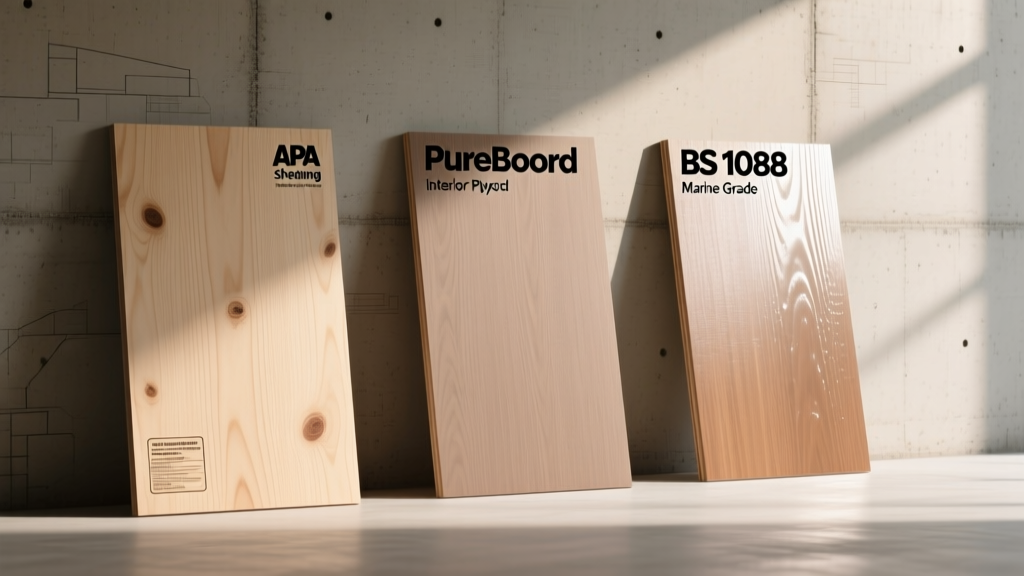
The Technical Plywood Definition vs. Industry Reality
The standard dictionary plywood definition—an engineered wood panel made of thin veneers glued together with adjacent layers rotated up to 90 degrees—fails to capture the structural, chemical, and performance complexities required for modern construction. While cross-graining fundamentally restricts panel expansion and shrinkage along the grain, the true performance of the material is dictated by the adhesive chemistry, veneer grading, and manufacturing tolerances governed by specific industry standards.
In professional procurement, relying on a superficial plywood definition leads to catastrophic specification errors. A panel stamped for interior use will delaminate when exposed to weather during a framing delay, and a standard exterior panel will fail under the continuous moisture load of a boat hull or exterior soffit. To specify correctly, builders and architects must look past the generic term and evaluate specific brand product lines and their underlying performance certifications.
Structural Product Line Deep-Dive: APA Rated Sheathing
When framing roofs, walls, and subfloors, generic 'CDX' is an outdated colloquialism. The modern specification requires APA Rated Sheathing. Major manufacturers like Weyerhaeuser and Roseburg produce these panels using phenol-formaldehyde (PF) resins, which cure into a rigid, waterproof thermoset plastic that will not degrade under prolonged moisture exposure.
Exposure 1 vs. Exterior Classifications
A critical distinction in the structural plywood definition is the bond classification. Exposure 1 panels (the vast majority of roof and wall sheathing) utilize the same waterproof PF glue as Exterior panels, but they are manufactured with lower-grade inner veneers (C or D grade) that may have larger knots and gaps. Exposure 1 is designed to withstand construction delays and weather exposure, but it is not intended for permanent outdoor exposure. Exterior panels use higher-grade inner plies and are rated for continuous outdoor weathering, such as in exterior soffits or permanent siding substrates.
| Span Rating | Nominal Thickness | Primary Application | Fastener Schedule (Edges) |
|---|---|---|---|
| 24/0 | 1/2" (11.1mm) | Roof Sheathing (24" o.c.) | 8d nails at 6" o.c. |
| 32/16 | 5/8" (15.9mm) | Roof / Subfloor Combo | 8d nails at 6" o.c. |
| 40/20 | 3/4" (18.3mm) | Heavy Duty Subfloor | 10d nails at 6" o.c. |
Interior & Hardwood Lines: The Formaldehyde Factor
For cabinetry, millwork, and interior built-ins, the structural definition of plywood shifts toward surface aesthetics and indoor air quality (IAQ). Traditional interior plywood relies on urea-formaldehyde (UF) resins. While UF provides a strong, rigid bond and a light-colored glue line ideal for hardwood veneers, it off-gasses volatile organic compounds (VOCs).
To comply with strict EPA Formaldehyde Emissions Standards and the CARB Airborne Toxic Control Measure, manufacturers have heavily innovated in adhesive chemistry. Columbia Forest Products pioneered the PureBond product line, replacing UF resins with a soy-based, formaldehyde-free adhesive technology. PureBond hardwood plywood (available in Maple, Oak, and Walnut veneers) meets LEED v4 Low-Emitting Materials credits and eliminates the need for costly post-manufacturing off-gassing periods in high-end residential and commercial fit-outs.
Marine Grade: Decoding the BS 1088 Standard
The most misunderstood segment of the market is marine plywood. A common error is assuming that any panel made with waterproof (Exterior) glue qualifies as 'marine.' This is false. True marine plywood must conform to stringent international standards, most notably British Standard BS 1088 or BS 6566.
What Makes a Product Line 'Marine'?
- Face and Back Veneers: Must be 'A' grade, completely free of knots, knotholes, or patches.
- Inner Veneers: Must be 'B' grade or higher. Unlike standard exterior plywood, marine panels do not allow core gaps. Core gaps trap water, leading to internal rot and delamination in marine environments.
- Species Density: Premium lines like Bruynzeel or Joubert utilize Okoume or Sapele mahogany. These tropical hardwoods possess natural rot resistance and uniform density, preventing the telegraphing of inner plies through the face veneer.
- Adhesive: Phenol-formaldehyde (PF) hot-pressed to withstand continuous boiling water immersion tests.
Using standard ACX exterior plywood for a boat transom or a high-moisture exterior door core will result in edge delamination within 24 to 36 months. The premium paid for BS 1088 certified Okoume marine plywood is an insurance policy against structural failure in continuous wet environments.
2026 Procurement & Cost Matrix
Pricing for engineered wood panels fluctuates based on timber harvest yields, resin petroleum costs, and freight. Below is a benchmark pricing matrix for standard 4' x 8' panels in the North American market for early 2026.
| Product Line / Type | Thickness | Est. Cost per Sheet | Best Use Case |
|---|---|---|---|
| APA Rated Sheathing (Exposure 1) | 1/2" | $48 - $58 | Roof/Wall framing, temporary hoarding |
| Sanded Pine (B-C or A-C) | 3/4" | $85 - $105 | Painted built-ins, shelving, utility cabinets |
| PureBond Hardwood (Maple Veneer Core) | 3/4" | $135 - $165 | High-end cabinetry, LEED-certified millwork |
| BS 1088 Okoume Marine | 3/4" | $195 - $260 | Boat building, exterior doors, continuous moisture |
Expert Selection Framework for Builders
Use this decision matrix on the job site or in the estimating office to ensure the specified plywood definition matches the environmental and structural demands of the project.
- Is the panel part of the structural envelope (roof, wall, floor)?
Action: Specify APA Rated Sheathing with the correct Span Rating. Ensure the stamp reads 'Exposure 1' minimum. Do not substitute OSB in high-moisture zones (like bathroom subfloors) without specific edge-sealing protocols. - Will the panel be exposed to continuous liquid water or high humidity (boat hulls, exterior doors, saunas)?
Action: Specify BS 1088 Marine Plywood. Verify the absence of core gaps by inspecting the panel edges before acceptance. Seal all edges with penetrating epoxy before installation. - Is the panel for interior millwork in a school, hospital, or LEED-targeted residence?
Action: Specify NAF (No Added Formaldehyde) or ULEF (Ultra-Low Emitting Formaldehyde) cores. Columbia PureBond or equivalent soy-resin hardwood lines are mandatory to pass indoor air quality testing. - Is the panel for painted, utilitarian interior shelving or garage storage?
Action: Standard sanded AC or BC pine plywood is sufficient. Avoid MDF cores if the shelving span exceeds 24 inches to prevent sagging under load.
Understanding the nuanced differences between structural sheathing, IAQ-compliant hardwood cores, and gap-free marine panels transforms the basic plywood definition from a dictionary entry into a precise tool for building durability and code compliance.