What Type of Wood Is Butcher Block? A Species Comparison
Discover what type of wood is butcher block. Compare hard maple, walnut, cherry, and teak for countertops with Janka ratings and pricing.
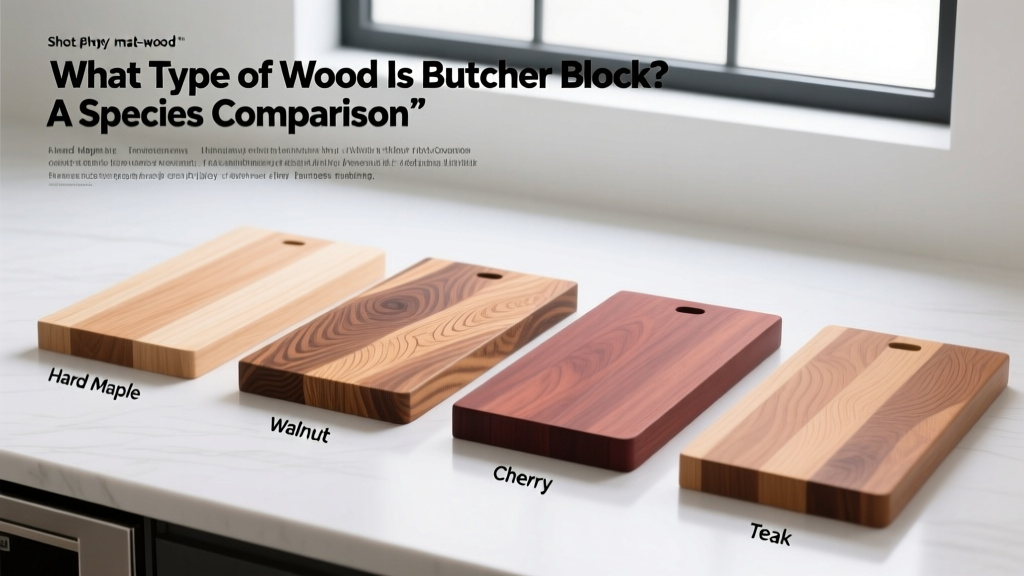
The Misconception: Butcher Block is a Technique, Not a Tree
When homeowners and contractors ask, 'what type of wood is butcher block,' they are operating under a common semantic misconception. Butcher block is not a specific species of timber; it is a structural lamination technique. It involves gluing together strips, blocks, or planks of wood to create a thick, stable, and durable surface capable of withstanding heavy mechanical impact and moisture exposure.
However, the performance, longevity, and aesthetic of a butcher block countertop or island are entirely dictated by the specific hardwood species chosen for the lamination. Selecting the wrong species for a high-moisture kitchen environment or heavy chopping zone will result in premature warping, deep bacterial harboring, or finish failure. Below is a comprehensive comparison of the top hardwood species used in butcher block fabrication, analyzed by structural integrity, Janka hardness, and dimensional stability.
The Foundation: Grain Orientation Matters
Before evaluating species, you must understand how the wood is oriented. The grain direction fundamentally changes how the wood interacts with knives, moisture, and structural loads.
- Edge Grain: Strips are laid on their sides. This is the most common and cost-effective orientation for kitchen countertops. It offers excellent dimensional stability and a uniform linear aesthetic.
- Face Grain: Boards are laid flat, showing the wide face of the timber. While visually striking and cathedral-patterned, face grain is the softest orientation and will scar easily under knife pressure. It is best reserved for dining tables or baking stations, not heavy prep zones.
- End Grain: Blocks are stood vertically so the growth rings face up. This is the traditional 'butcher' orientation. Knife blades slip between the vertical wood fibers rather than cutting across them, making it self-healing and highly resistant to scarring. It is the most expensive and heaviest option.
Top Hardwood Species Compared
1. Hard Maple (Acer saccharum) - The Industry Baseline
Hard Maple is the undisputed gold standard for commercial and residential butcher block. It features a tight, closed-grain structure that prevents moisture and food particles from penetrating the surface, making it inherently hygienic. With a Janka hardness rating of 1,450 lbf, it resists denting from dropped pots while remaining soft enough not to instantly dull high-carbon steel chef knives. According to the USDA Forest Products Laboratory Wood Handbook, Hard Maple exhibits a tangential shrinkage rate of 9.9% and radial shrinkage of 4.8%, meaning fabricators must account for moderate seasonal movement in wide installations.
2. Black Walnut (Juglans nigra) - The Premium Aesthetic
Walnut provides a rich, dark chocolate hue that creates striking contrast in modern kitchens. It is slightly more porous than maple and softer, with a Janka rating of 1,010 lbf. Because it is an open-grain wood, it requires a more rigorous finishing schedule to ensure food safety. Walnut is also highly photosensitive; exposure to direct UV light will cause the dark heartwood to lighten and shift toward a golden-brown tone over the first year of installation.
3. Cherry (Prunus serotina) - The Aging Beauty
Cherry is prized for its warm undertones and smooth texture. At 950 lbf on the Janka Hardness Scale, it is the softest of the traditional butcher block woods. It will readily accept knife marks and dents, which many owners embrace as a rustic patina. Like walnut, cherry oxidizes rapidly, darkening from a pale pinkish-brown to a deep, rich reddish-brown within six months of UV exposure.
4. Teak (Tectona grandis) - The Moisture Master
If the butcher block will be installed near a sink or in an outdoor kitchen, Teak is the superior choice. Teak heartwood is saturated with natural silica and tectoquinones (oils), giving it unparalleled resistance to water ingress, rot, and fungal decay. The trade-off is that the high silica content (up to 1.4% by weight) is highly abrasive and will dull knives faster than maple or cherry. Teak also features a prominent, coarse grain that requires filling if used for direct meat preparation.
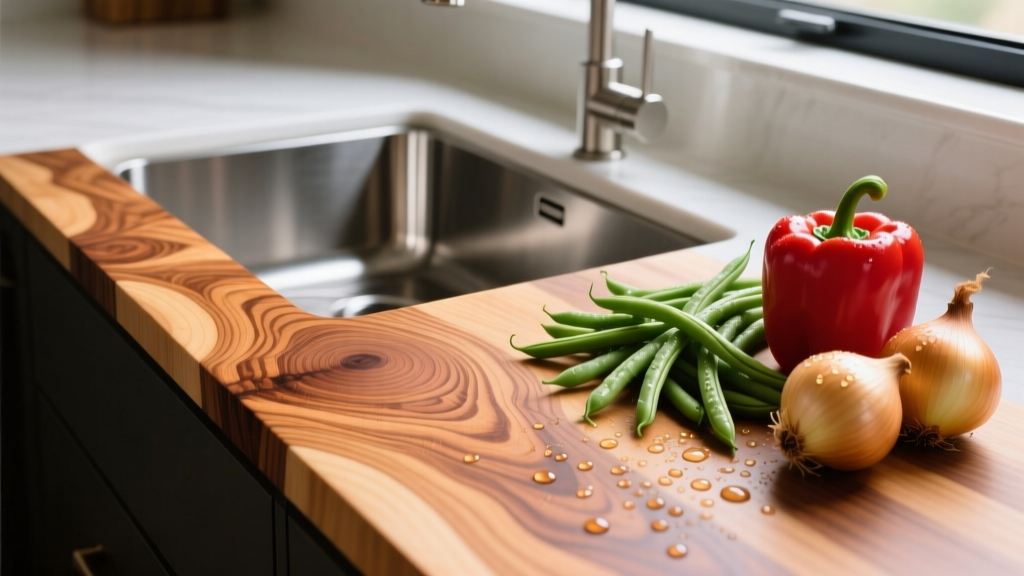
Species Performance & Pricing Matrix
| Wood Species | Janka Hardness (lbf) | Grain Porosity | Avg. Cost per Sq. Ft. (Edge Grain) | Best Application |
|---|---|---|---|---|
| Hard Maple | 1,450 | Closed / Tight | $45 - $65 | Heavy daily prep, commercial kitchens |
| Black Walnut | 1,010 | Semi-Porous | $95 - $135 | Island seating, light prep, aesthetics |
| Cherry | 950 | Semi-Porous | $75 - $105 | Baking stations, dining tables |
| Teak | 1,000 - 1,155 | Open / Oily | $130 - $170 | Sink surrounds, outdoor kitchens |
| Strand Bamboo | 1,380 - 1,450 | N/A (Grass) | $35 - $55 | Eco-conscious builds, budget prep |
Decision Framework: Match the Species to the Task
- If you need a heavy meat prep station: Choose End-Grain Hard Maple. The vertical fibers part for knife blades and close back up, preventing deep scarring and bacterial ingress.
- If you want a dark, luxurious island with seating: Choose Edge-Grain Black Walnut. Apply a hardwax oil to protect against water rings from glasses while maintaining a matte, natural feel.
- If the block borders an undermount sink: Choose Teak or seal a Maple block with a marine-grade, food-safe epoxy on the bottom and end-grain edges to prevent capillary water wicking.
Critical Considerations: Finishing and Food Safety
The wood species is only half the equation; the finish determines the countertop's survival. Any finish used on direct food-prep surfaces must comply with FDA food-contact substance regulations once fully cured.
Non-Polymerizing Oils (Mineral Oil)
Food-grade mineral oil is the traditional choice. It does not cure or harden; it simply occupies the wood's cellular cavities to block water. The drawback: It evaporates and washes away, requiring reapplication every 3 to 4 weeks in high-use zones. If neglected, the wood will dry out and crack.
Polymerizing Oils (Pure Tung Oil, Raw Linseed Oil)
These oils undergo a chemical reaction with oxygen to harden into a solid resin within the wood fibers. They offer vastly superior water resistance and require maintenance only once or twice a year. Warning: You must use 100% pure tung oil. Commercial 'tung oil finishes' often contain metallic driers and toxic solvents that are not food-safe.
Hardwax Oils (Rubio Monocoat, Osmo TopOil)
The modern fabricator standard. Hardwax oils bond molecularly with the top microns of the wood, providing exceptional stain and water resistance without building a plastic-like surface film. While expensive (often adding $15-$20 per square foot to fabrication costs), they allow for spot-repairs if the surface is scorched or deeply scratched, eliminating the need to sand the entire countertop.
Installation Clearances and Wood Movement
Wood is hygroscopic; it absorbs and releases ambient moisture. A 30-inch deep Hard Maple countertop can expand or contract up to 1/8 of an inch across its width between summer (high humidity) and winter (dry, heated air).
When installing butcher block, never glue it directly to the cabinet boxes. Use slotted mounting holes in the cabinet corner braces and secure the wood with pan-head screws and fender washers. This allows the timber to slide laterally as it expands and contracts. Furthermore, always leave a 1/8-inch expansion gap where the butcher block meets a rigid surface like a stone backsplash or a stainless steel appliance garage, concealing the gap with a flexible, color-matched silicone caulk rather than rigid grout or wood trim.
Written by
Marcus ChenMarcus Chen is a licensed structural engineer (PE) and building materials analyst with over 12 years of experience across residential, commercial, and industrial construction. He holds a Master of Science in Civil Engineering from UC Berkeley and spent six years at Thornton Tomasetti before transitioning to independent consulting and technical writing. Marcus specializes in material selection for seismic-prone regions, concrete reinforcement strategies, and lifecycle cost analysis. His work has been cited by the American Concrete Institute (ACI) and the Structural Engineers Association of California (SEAOC). When he is not on a job site or at his desk, you will find him hiking the Sierra Nevada or restoring a 1920s craftsman bungalow in Oakland, CA.
More from Marcus Chen
View all
Construction Cost
How Much Did the Eiffel Tower Cost to Build?
How much did the Eiffel Tower cost to build in 1889? We adjust for inflation and compare its budget to modern skyscraper construction.
Aug 4, 2026

Fire Resistance
What Is a Fire Resistant Material? Testing & Certification Guide
Discover what is a fire resistant material through ASTM and UL testing. Learn how fire ratings, certifications, and assemblies work in construction.
Aug 4, 2026

Construction Cost
How Much Did the Burj Khalifa Cost to Build?
How much did the Burj Khalifa cost to build? We break down the $1.5B project and extract 5 money-saving strategies for your next build.
Jul 30, 2026