Types of Wood Deck Materials Compared: Cost, Decay & Lifespan
Compare top types of wood deck materials: pressure-treated pine, cedar, redwood, and tropical hardwoods. Get exact costs, lifespans, and maintenance data.
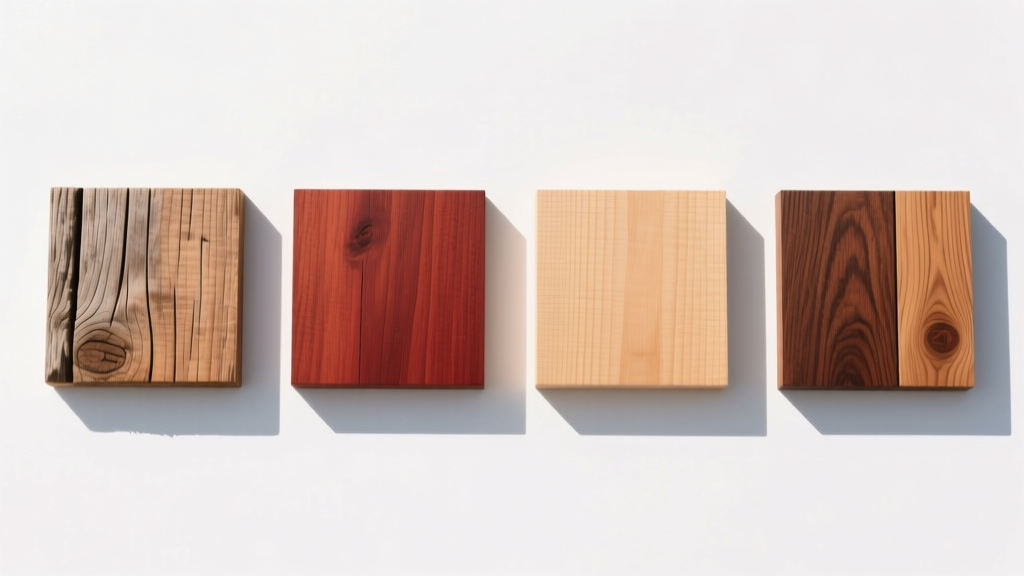
The Decking Material Matrix: Core Specifications at a Glance
Selecting the right decking material requires balancing initial capital expenditure against long-term maintenance, structural decay resistance, and aesthetic longevity. The following matrix benchmarks the five dominant wood decking categories available in 2026, evaluating them across critical performance metrics.
| Material Category | Avg. Cost (per lin. ft.) | Expected Lifespan | Janka Hardness (lbf) | Maintenance Frequency |
|---|---|---|---|---|
| Pressure-Treated (PT) Southern Yellow Pine | $2.50 - $4.50 | 15 - 20 years | 690 | Annual sealing required |
| Western Red Cedar | $5.50 - $8.50 | 20 - 25 years | 350 | Biennial UV/oil coating |
| California Redwood | $9.00 - $14.00 | 25 - 30 years | 420 | Biennial UV/oil coating |
| Tropical Hardwoods (Ipe, Cumaru) | $14.00 - $22.00 | 40 - 75+ years | 2,430 - 3,680 | Optional (grays naturally) |
| Modified Woods (Accoya, Thermory) | $10.00 - $16.00 | 30 - 50 years | 900 - 1,200 | Biennial pigmented oil |
Pressure-Treated Southern Yellow Pine: The Budget Standard
Pressure-treated (PT) Southern Yellow Pine captures over 70% of the residential decking market due to its low entry cost and high structural load capacity. Modern PT lumber no longer relies on chromated copper arsenate (CCA); instead, it utilizes micronized copper quaternary (MCQ) or copper azole (CA-C) preservatives.
Understanding AWPA Use Categories
Not all pressure-treated wood is identical. The American Wood Protection Association (AWPA) classifies treated lumber by its intended exposure level. For deck construction, you must verify the end-tags for the correct Use Category:
- UC4A (Ground Contact / General Use): Minimum retention of 0.15 pcf (pounds per cubic foot) for MCQ. Use this for decking, joists, and beams that are elevated and have good airflow.
- UC4B (Heavy-Duty Ground Contact): Minimum retention of 0.28 pcf. Mandatory for structural support posts embedded in concrete or direct soil contact, and for joists that trap moisture (e.g., low-clearance decks under 18 inches from grade).
Western Red Cedar & Redwood: The Softwood Upgrades
For builders seeking natural decay resistance without the extreme density of tropical hardwoods, Western Red Cedar and California Redwood remain premier choices. Both species contain high levels of natural extractives (tannins and oils) that deter fungal decay and insect infestation. However, this resistance is strictly limited to the heartwood.
Grade Stamps and Heartwood Content
The most common mistake in purchasing softwood decking is buying lower grades that contain excessive sapwood. Sapwood lacks the natural preservatives found in heartwood and will rot within 3 to 5 years in wet climates. When ordering, specify grades verified by the Western Red Cedar Lumber Association (WRCLA) or the California Redwood Association (CRA):
- Clear Heart (Grade A/B): 100% heartwood, vertical grain, knot-free. The most stable and expensive option, ideal for high-visibility surfaces.
- Construction Heart (Grade C): 100% heartwood but allows tight knots (up to 1.5 inches). This is the optimal price-to-performance tier for most residential decks.
- Construction Common: Contains both heartwood and sapwood. Avoid this grade for decking surfaces; reserve it only for painted structural framing if local codes permit.
Tannin Bleeding Mitigation: Both cedar and redwood will leach dark red/brown tannins when exposed to rain, staining adjacent masonry or light-colored siding. Pre-wash the boards with a commercial tannin remover (oxalic acid-based) before applying any penetrating oil finish.
Tropical Hardwoods: Ipe, Cumaru, and Tigerwood
Tropical hardwoods represent the pinnacle of natural wood decking. Ipe (Handroanthus spp.) is the industry benchmark, boasting a Janka hardness rating of 3,680 lbf—over five times harder than PT pine. According to data compiled by The Wood Database, Ipe's density makes it virtually impervious to wood-boring insects and highly resistant to surface scratching from pet claws or heavy patio furniture.
Installation Realities and Hidden Fasteners
The extreme density that makes tropical hardwoods durable also makes them notoriously difficult to machine. Standard carpentry practices fail here:
- Pre-drilling is mandatory: You cannot face-screw Ipe without pre-drilling and counter-sinking every single hole using carbide-tipped drill bits. Failure to do so will snap screws and burn the wood.
- Hidden Fastening Systems: Most professional installers bypass face-screwing entirely, opting for hidden biscuit or clip systems (e.g., Tiger Claw TC-G or Eb-Ty). These require routing a precise groove into the edge of each board using a slot-cutting router bit.
- End-Grain Sealing: Tropical hardwoods check (split at the ends) rapidly when exposed to sun. Every cut end must be immediately coated with an end-grain sealer like Anchorseal to prevent moisture loss and splitting.
Modified Woods: The Engineered Alternatives
For those who want the performance of tropical hardwoods but prefer the environmental profile of fast-growing plantation timber, modified woods have emerged as a dominant category. These are real woods altered at the cellular level to resist moisture and decay.
Acetylated vs. Thermally Modified
Accoya (Acetylated Radiata Pine): The wood is submerged in acetic anhydride, which replaces the wood's free hydroxyl groups with acetyl groups. This process reduces the wood's ability to absorb water by up to 80%, yielding dimensional stability that rivals aluminum. Accoya carries a 50-year above-ground warranty and machines as easily as standard pine.
Thermory (Thermally Modified Ash/Pine): The wood is baked in a low-oxygen kiln at temperatures exceeding 400°F (215°C). This caramelizes the sugars (removing the food source for fungi) and permanently alters the cellular structure. Thermally modified ash achieves a rich, dark brown hue without chemical stains, though it becomes more brittle and requires careful handling during installation.
25-Year Lifecycle Cost Analysis
Initial material costs rarely tell the full financial story. Wood decks require ongoing maintenance to prevent UV degradation, moisture intrusion, and biological growth. The following projection models the total cost of ownership for a standard 400 sq. ft. deck (assuming 1,600 linear feet of 5.5" wide decking) over 25 years.
| Material | Initial Decking Cost | 25-Yr Maintenance Cost (Sealers/Oils) | Estimated Board Replacements | Total 25-Year Cost |
|---|---|---|---|---|
| PT Southern Yellow Pine | $5,600 | $3,200 (Annual sealing) | $800 | $9,600 |
| Western Red Cedar (Const. Heart) | $11,200 | $2,400 (Biennial oiling) | $400 | $14,000 |
| Ipe (Tropical Hardwood) | $28,800 | $0 (Allowed to gray naturally) | $0 | $28,800 |
| Accoya (Acetylated Pine) | $20,800 | $2,000 (Biennial UV coating) | $0 | $22,800 |
Note: Labor costs for installation, framing, and structural footings are excluded from this matrix, as they remain relatively constant across material types, though tropical hardwoods incur a 20-30% labor premium due to machining difficulty.
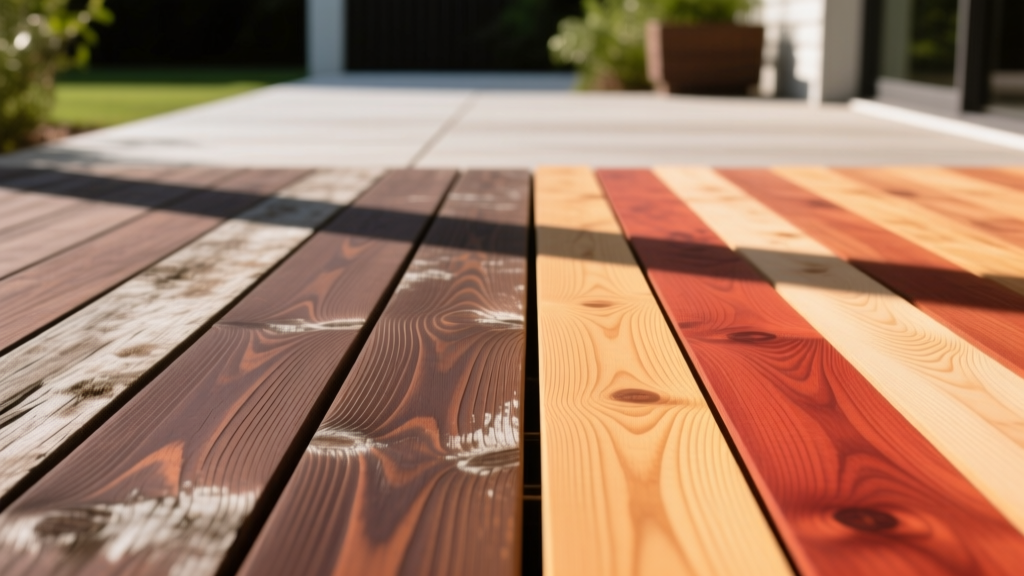
Decision Framework: Which Wood Should You Specify?
Use this conditional logic to finalize your material selection based on your specific project constraints:
- Choose Pressure-Treated Pine IF: Your budget is strictly capped under $7/lin. ft., you are building a multi-level structural frame where high load-bearing capacity is required, and you do not mind dedicating a weekend every spring to power-washing and sealing.
- Choose Cedar or Redwood IF: You want a premium, aromatic softwood aesthetic, you are building in a dry climate (like the Pacific Northwest or Mountain West) where natural decay resistance is sufficient, and you are willing to pay a 100% premium over PT pine for better dimensional stability.
- Choose Tropical Hardwoods (Ipe/Cumaru) IF: You are building a luxury property, a commercial boardwalk, or a ground-level deck near saltwater where maximum abrasion and rot resistance are non-negotiable, and you have the budget for specialized hidden fastener hardware.
- Choose Modified Woods (Accoya/Thermory) IF: You demand the 50-year lifespan of Ipe but require a material that is lightweight, easy to cut with standard tools, and sourced from rapidly renewable, FSC-certified plantation forests.
Written by
Elena RodriguezElena Rodriguez is a civil engineer and technical writer specializing in concrete technology, masonry systems, and ASTM/ACI compliance. She earned her B.S. in Civil Engineering from Texas A&M University and spent a decade at a materials testing laboratory, performing over 2,000 concrete compressive strength tests and masonry prism evaluations. Elena is an ACI-certified Field Testing Technician (Grade I) and a member of ASTM Committee C12 on Natural Building Stone. She currently consults on forensic engineering cases involving concrete failures and moisture intrusion. Based in San Antonio, TX, Elena is a proud member of the Society of Women Engineers (SWE) and coaches her daughter's FIRST Robotics team.
More from Elena Rodriguez
View all
Walls & Panels
Cost Analysis: Light Gauge Steel Framing Advantages and Disadvantages
Evaluate light gauge steel framing advantages and disadvantages through a strict cost analysis lens, comparing material, labor, and lifecycle expenses.
Aug 4, 2026

Walls & Panels
Gypsum Board Types: Exact Specifications, Thickness & Dimensions
Compare standard, Type X, and moisture-resistant gypsum board types. Get exact specifications, thicknesses, dimensions, and ASTM standards for your project.
Aug 4, 2026

Fire Resistance
Best Fire-Resistant Outdoor Decking Materials: 2026 Buyer Guide
Discover the best fire-resistant outdoor decking materials for 2026. Compare Class A PVC, aluminum, and hardwood options for WUI compliance and safety.
Aug 4, 2026